-
Films With Friends Collection 6: Citizens on Patrol
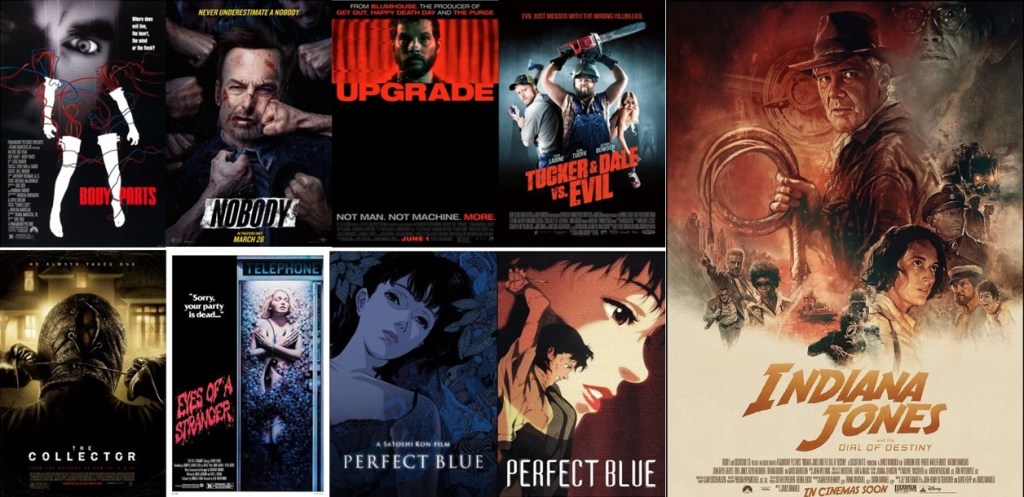
Body Parts (1991)
This horror sci-fi film was co-written and directed by Eric Red, the man who wrote the now cult classic Near Dark, The Hitcher and Blue Steel. And if you have ever seen any of those flicks, you would be impressed. Trust me.
Jeffy Fahey is Bill Chrushank, a psychologist working with convicted killers and a university lecturer, who is worrying that his work isn’t making a difference. One morning, heading into work, Bill gets into a car accident and loses his right arm. His wife Karen (Kim Delany) is approached by Dr. Agatha Webb (Lindsay Duncan) who gives her the news, but says they can transplant a new arm on him immediately. But the decision has to be made now. Karen signs the paperwork, and Bill gets a new arm.
After a recovery montage, Bill tip-top and feeling pretty good about his luck and life. Until one of his death row patients Ray (Paul Ben-Victor) notices a death row tattoo on Bill’s wrist and freaks out. Bill wanting an answer, asks a Police forensics friend of his to take his finger prints. Turns out his new right arm belonged to a convicted serial killer Charley Fletcher (John Walsh). Que the nightmares and mood swings.
After striking his son and almost strangling his wife while he slept, Bill leaves and confronts Dr. Webb. And isn’t she an ego driven mad scientist. He contacts the two other transplant recipients of Charley’s limbs, Mark (Peter Murnik) who got the legs, and Remo (the great Brad Dourif) an artist who got the left arm. And they have all had odd side effects. But when both men are killed and the transplanted limbs are violently removed, Bill and Detective Sawchuck (Zakes Mokae) discover that Charley, whose head has been transplanted onto a new body, is coming for his arm.
Red skilfully delivers a tense horror film about a man losing his mind after a traumatic event, and finding out he is the side effect of a Frankenstein style experiment. A great cast, cinematography and musical score elevate this flick to something great, instead of the extended Twilight Zone episode it might have been. And that damn car chase scene is intense.
Forgotten classics.
Nobody (2021)
After watching the trailer for this many moons ago, it was instantly on my ‘to watch’ list.
This film was directed by Ilya Naishuller (Hardcore Henry) and produced by the people behind John Wick. And if you don’t know either of those properties, go watch them now and then come back to finish this. Caught up? Good.
Hutch Mansell (Bob Odenkirk) is a family man who seems lost. He has an unremarkable office job at his father-in-law Eddie’s (Michael Ironside) company, his wife Becca (Connie Nielsen) is distant, his son Brady (Gage Munroe) thinks he is a loser, and his daily routine blends everyday together. Only his daughter Sammy (Paisley Cadorath) thinks he is cool.
After tracking down thieves that broke into his house via some leg work, and his father’s old FBI badge and gun, he finds they are struggling parents with a sick child. Catching the bus home, a group of drunk Russians get on the bus after their car is out of commission. They are mobsters. They are bullies. And Hutch beats the living shit out of them.
One later dies in hospital, and as plot convenience would have it, he was the brother of a flamboyant sociopath, Yulian Kuznetsov (Aleksey Serebryakov) high ranking Russian mobster, who wants revenge. But we find Hutch is more than a match for them. This mild-mannered man used to be a government employee who cleaned up other people’s messes violently, sometimes brutally, and quickly. The family man and the Russian mob hit head on, with fight scenes, car chases, explosions, gun battles, with a little humour thrown in.
This movie is so hard to describe. It is full of left field casting choices that work. Odenkirk is amazing, completely believable as a sad sack family man and dormant bad-ass. Christopher Lloyd as Hutch’s dad and RZA as his adopted brother Harry are great, especially their help in the climax. The cinematography by Pawel Pogorzelski, coupled with the editing, add weight to the actions and the emotions of each scene, and add to the humorous elements. The score by David Buckley takes us on the journey as the soundtrack is a damn good one.
A great, fun movie with as much heart as action. Pure enjoyment.
Upgrade (2018)
Upgrade is an action sci-fi thriller written and directed by Leigh Whannell, one of the masterminds behind the Saw, and Insidious franchises. Made between Insidious 3 and The Invisible Man, this doesn’t get enough attention, despite the fact that this film fucking rocks.
Set in a near future full of police drones flying overhead, self-driving cars, and people with computer enhanced bodies, our hero is the opposite of the world he lives in. Grey Trace (Logan Marshall-Green) is an auto mechanic specialising in restoring old cars that are obsolete in this future. He lives with his wife Asha (Abby Craden), who has a successful job working for Cobolt, one of the companies creating the human-computer augmentations.
After he delivers his latest finished car to Eron Keen (Harrison Gilbertson), head of the company Vessel, on the way home, their car crashes. In the aftermath, Asha is killed by a group of thugs and Grey is paralysed from the neck down. This leaves Grey remorseful, depressed and suicidal. Eron offers Grey a solution that is experimental. STEM, a chip sized supercomputer that can be used to connect his brain to the rest of his body and gain control of his body. After the operation, a confidentiality agreement is signed. Grey can’t tell or show anyone his recovery.
While looking through evidence supplied by detective Cortez (Betty Gabriel), STEM starts talking to Grey. A voice only he can hear. STEM is a A.I. that is self-aware and living in Grey’s head. Together they track down the men responsible for the accident and his wife’s death. With violent and gory results. Which leads them to unexpected places. And the twist ending you will not see coming.
The action sequences where STEM takes control are amazingly shot and choreographed, especially the changes in body language Marshall-Green uses. The direction in these sequences is also amazing, keeping Grey in the centre of the frame throughout. This is a sharp and perfected story, presented well, in a fully realised world. Stefan Duscio’s cinematography and Andy Canny’s Editing amp up the visuals and Jeb Palmer score is one of the most impressive I’ve heard. Shout out to Benedict Hardie’s Fisk, a villain so detestable you want him to die.
Cyber-punk is alive.
Tucker and Dale Vs Evil (2010)
The killer hillbilly subgenre of horror films has a long history. Just look at the Texas Chainsaw Massacre, and Wrong Turn franchises. If a back woodsman character shows up in a horror film, your expectations go straight to, ‘they’re the killers’. But what if those expectations were subverted. That is the premise of the film directed and co-written by Eli Craig.
The stand-up Tucker (Alan Tudyk) and his kind, well-meaning best friend Dale (Tyler Labine) are heading to a cabin in the woods Tucker has bought to fix it up as a vacation home. Along the way they meet a group of college kids, who don’t take to the hapless duo, thinking there are the murderous hillbillies of urban legend.
Later, while fishing at a nearby lake at night, Tucker and Dale witness the college kids stripping down to go swimming. One of them, Allison (Katrina Bowden) gets spooked by the fishermen, falls into the lake, hitting her head knocking herself unconscious. The boys save her, but her friends witness her seemingly lifeless body being dragged into the boat, freaking out believing Allison has been killed. This is made worse by preppy psychopath Chad (Jesse Moss) convincing his friends that the hillbillies are evil and must be killed.
So, while Dale is caring for the injured Allison and Tucker is working around the cabin, the college kids hatch a plan to ‘rescue’ Allison. But they are useless and one by one, die by their own hands in accidents trying to kill Tucker and Dale. Hilarity ensues in gory fashion. AS Allison and Dale become closer, Chad becomes more unhinged.
This film is a near perfect horror comedy filled with great dialogue, humour, memorable characters, and shots that could be straight out of a horror cult classic of the 70s or 80s. The misunderstanding at the heart of the film’s premise is a good message, and is good to layer the comedy on. The leads played by Tudyk and Labine are the standouts, it’s their show after all, with Labine shining.
One of the best cult classics of the 2000s and a must for every film lover. If you are not convinced, watch the trailer on YouTube.
The Collector (2009)
The Collector is a tense horror film from director and co-writer Marcus Dunstan (along with Partick Melton) It was originally shopped around as a spin-off of the Saw franchise until morphing into its own disturbing film that is inventive, harrowing, and full of effective gore and white-knuckle moments.
Former convict Arkin O’Brien (Josh Stewart) who is working as a handyman for the wealthy Chase family while major renovations are taking place on their new house. The two daughters, Hannah and Jill (Karley Scott Collins and Madeline Zima) are drawn to Arkin for different reasons.
After work, he goes to see his ex-wife and they argue over money. His wife has large debts to a dangerous loan shark Roy (Robert Wisdom) that are due at midnight. To save his wife and daughter he agrees to take up his olds ways as a safe cracker and steal a valuable ruby from the Chase’s safe.
While attempting to crack said safe, a mysterious masked figure locks the doors. This masked figure is The Collector (Juan Fernandez). He collects people, but only one in every house. The others die in gruesome ways. As Arkin tries to avoid the Collector, he keeps running into elaborate traps of deadly obstacles that the collector is putting up around the house. Arkin tries to save the family who are still in the house but loses all by the youngest daughter Hannah to the masked serial killer. Arkin and Hannah must avoid the Collector and his traps to make it out of the house and get rescued.
The cast do a damn good job here, but it is Stewart’s show, with Arkin being the focus and he is threatening to watch. But the villain and his mask looking like melted plastic is unnerving. The direction and cinematography are stunning, especially the overhead shot inside the house and how many of the traps are revealed. First time I watched it I left fingernail marks in my palms.
While it got terrible reviews from critics, it made $10.5 million on a $3 million budget, So, it was successful. And even got a sequel in 2012. It is a raw, gritty and uncompromising film with an ending that will leave you breathless.
Eyes of a Stranger (1981)
Eyes of a Stranger is a 1981 horror film from director Ken Wiederhorn of Return of the Living Dead Part 2 fame.
The film follows Jane Harris (Lauren Tewes), a local newscaster and an outspoken advocate against violence towards women. She has become convinced that her neighbour in her apartment building is the serial killer and rapist that has been terrorising the city. And she is right, as we the audience see very early on. The killer, Stanley Herbert (John DiSanti) looks like an accountant or banker, a little overweight, spectacled and otherwise very conservative looking.
Jane also looks after her little sister Tracy (Jennifer Jason Leigh, in her first film role), who following a violent sexual assault as a child, now is deaf and mute. As Stanley becomes aware that Jane is following him to get proof of his blood-soaked vocation, he targets Tracy. Someone he sees as an easy mark and to teach Jane a lesson. It does not go well for Stanely.
There is not much to the story here, but it is told effectively. DiSanti is creepy with his altar boy hair cut and evil glare. His stillness in many scenes heightens the tension well as we know he kills quickly and violently. Something that is shown in the opening scenes.
Tewes is excellent as our heroine, her single mindedness worries her lawyer boyfriend, but makes her engaging to watch. Her feminism and work with domestic violence and violence against women in general is painted as a positive in the film, even if it baffles and annoys some of the male characters in the film. Something you didn’t see all that often in the early part of the 80s.
While the film is labelled a horror film, or a slasher film, it has more in common with Hitchcock’s thrillers like Rear Window or the 70s Giallo films of Italy. It does suffer from a few pacing issues, but they don’t make the film lag too much. Tom Savini’s effects accent the kills nicely without going over the top, and Leigh is wonderful in a difficult and mostly wordless role.
Not the best example of the genre, but it does more things right than wrong.
Perfect Blue (1997)
Mention Anime, and people have certain images in their heads. Kinetic action of a TV series, sci-fi wonders, the cuteness and imagination of Studio Ghibli, a unique brand of horror, or Hentai. Films like Perfect Blue get left out of the conversion.
Perfect Blue is a Japanese animated psychological thriller directed by Satoshi Kon (Millennium Actress, Paprika), based on the novel Perfect Blue: Complete Metamorphosis by Yoshikazu Takeuchi.
Mima Kirigoe, a member of the J-Pop group “Cham!”, leaves to become an actress. Her first gig is on a psychological detective TV show, Double Blind. During her change in career, she is joined by manager and former pop-idol Rumi Hidaka who is against leaving the music scene, and her agent Tadokoro whose facial hair looks like if John Waters was an X-Men villain.
Mima is stalked by an obsessive fan, Me-Mania, who doesn’t like her changing the clean-cut image. Me-Mania frequents a website called “Mima’s Room”, a site containing daily diary-like entries from Mima. He is contacted by someone claiming to be Mima, who charms and then controls the twisted lonely heart. Mima herself soon discovers the website’s existence via a fan letter.
Shortly after starting on the TV show and impressing the writer and producers, Mima’s role in the show gets bigger. But at the same time, people around her start getting hurt and then killed. A rape scene on the show sparks real world violence. Mima starts freaking out as she begins losing time, the real world and the TV show narrative start to blend together, and she starts having conversations with the Pop Icon version of herself that she left behind. The ending is well earned and damn satisfying.
This film has as much Hitchcock, Brian DePalma and Giallo in its make-up and it does the Japanese traditions. While the animations don’t go full WTF territory, the visuals are able to add an element to the narrative that live action cannot. The framing of the scenes and the musical score add tension and unease to the story. And I didn’t see the twist ending coming the first time I watched this, which makes sense on a rewatch. And the pop songs will get stuck in your head.
Amazing.
Indiana Jones and the Dial of Destiny (2023)
This is the fifth and ‘final’ film in the beloved action-adventure franchise. Co-written and directed by James Mangold and starring Harrison Ford as the titular Henry “Indiana” Jones Jr.
Like the previous entries in the series, the plot uses a unique blend of history and fantasy to tell a swashbuckling story reminiscent of the adventure movie serials of the past. Which as we all know by now, was the point. This time the main story concerns an ex-Nazis scientist, Jurgen Voller (Mads Mikkelsen), who is now a NASA scientist working under the alias Dr Schmidt. He has gained a great deal of credit being one of the men who helped the USA get to the moon in 1969 (the year the film is set) and has enlisted aid from the FBI to search for the Antikythera, the Dial of Destiny, a device created by Archimedes that Voller believes will take him back in time to win WW2.
In New York, Dr Jones is retiring from Hunter College. Marion (Karen Allen) has left him due to depression over the death of their son Mutt who was killed in the Vietnam War. Jones is approached by his goddaughter and fellow archaeologist Helena Shaw (Phoebe Waller-Bridge), daughter of Indy’s old friend and colleague Basil Shaw (Toby Jones). Indy confesses to still having half of the Dial, given to him by Basil, which Helena promptly steals from him, as Voller’s thugs also arrive to claim the artifact, led by Klaber (Boyd Holbrook), whose fake teeth scare me. This starts an adventure that spans the globe, mostly traveling via map, as Indy, Helena and young Teddy (Ethann Isidore) try to beat Voller to the Dial.
This is a great ride of a film that hits the right nostalgia buttons, but never over doing it. Seeing John Rhys-Davies’ Sallah pop up for a small roll made me cheer. John Willams returns for the score (Duh!) and everyone does a great job in front and behind the camera. But I wish there was a bit more attention to character development, especially Voller and Helena. The highlight is the opening sequence in WW2 with a perfectly de-aged Ford. Seriously amazing.
Definitely an Indy film.
-
Films With Friends Collection 5: Eternal Sunshine of a Twisted Mind.
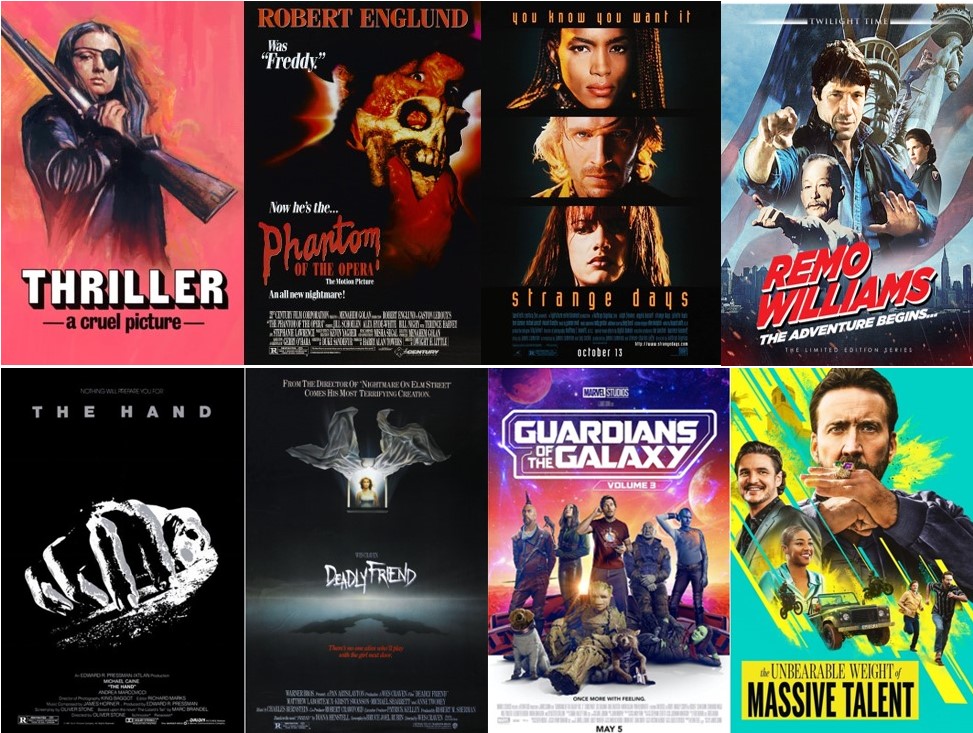
Thriller: A Cruel Picture (1973)
Thriller: A Cruel Picture, or They Call Her One Eye, as it was later named in the U.S., is a Swedish revenge exploitation film, written and directed by Bo Arne Vibenius. Although it was released in 1973, it didn’t arrive in English speaking countries until 1974 and 75.
Madeleine, as a young girl, was attacked and molested in the forest near her home. As a result, she can no longer speak. As a young adult (now played by Christina Lindberg) she still lives with her parents on their farm. Her parents used all their money to send Madeleine to specialists.
One day, she accepts a ride from a well-to-do, Tony (Heinz Hopf). Who takes her out to dinner, and then a drink at his house. Where she is roofied and later drugged to the eyeballs. Tony turns out to be a sex trafficking pimp, who gets Madeleine locked up, hooked on narcotics and forced to work as a prostitute. He even forces her to sign a mean letter to her parents to explain her disappearance. When she fights back against one of the ‘johns’, Tony takes her eye. She complies.
She is eventually let out on Mondays, and going home, finds that her elderly parents have both committed suicide over the loss of their daughter. She takes all the money she has saved and every Monday, she gets training in driving, weapons, and self-defence. She is planning bloody revenge against all the ‘johns’ and Tony himself.
This is an exploitation classic, and has influenced many filmmakers who like this kind of film, most famously Taratino. It’s a story of raw emotions that is sold by its star. Christina Lindberg is mesmerising in a completely silent performance, that holds your attention, even in the slower moments. Everything she is feeling is shown on her face and body. Probably one of the best performances I have ever seen. Direction is sold, as is the cinematography. Good fight scenes, stunt work and a great climax. There is a liberal use of slow motion in the action sequences, but it does seem out of place. As a matter of fact, it is a benefit.
Stylish, heartbreaking, uplifting, sexual, powerful, and ICONIC. Like its lead actress.
The Phantom of the Opera (1989)
Like Dracula and Frankenstein, there are many different versions of Gaston Leroux’s Phantom of the Opera in film and television. Some are faithful to the novel and some just take the general idea, and create something different. The 1989 version of Phantom of the Opera is somewhere in the middle.
This film starts in the present of 1989, a young opera singer and music student, Christine Day (Jill Schoelen) and her friend Meg (pre–SNL Molly Shannon) are looking for more original work by a lost composer named Erik Destler in an old musty book store. After finding the opera Don Juan Triumphant, Christine uses it as her audition piece the next day for a new opera. She stuns the director, but a stage hand accidentally drops a sandbag, narrowly missing her, but knocking her to the floor resulting not only in unconsciousness, but also having the side effect of her waking up in 1885, on a stage in London where a similar thing just happened.
Here, the film becomes a more faithful adaptation of the original tale. Even though the film is book ended by the present day, with a nice but predictable conclusion and singer, it follows many other filmed versions. The Phantom character stalks the opera house, training Christine behind closed doors, and his malicious and murderous protection and artistic advancement of Christine, who is the object of his affection. Except for one element, and a selling point that ramped the film up a few notches. The Phantom/Erik Destler is played by horror icon Robert Englund. His performance is amazing, and worthy of awards, in my opinion. He has moments of a serial killer, like some of his horror characters, but also has many quieter, almost childlike innocent moments that round out his character into a real person with trauma and not just a bogeyman.
There are some great makeup effects here, as the mask the phantom wears is a mask, he masks form human skin that he uses to cover his deformed face. The kills are less gory than other horror films of the time. But marvellously staged. It is a good mix of style and story. It also features Bill Nighy in an early role.
Strange Days (1995)
Damn this movie is hard to describe if you haven’t seen it. Strange Days is a sci-fi, cyberpunk, action thriller from director Kathryn Bigelow and writers James Cameron and Jay Cocks.
Set in the future time of 1999, Los Angeles is a war zone. For all the reasons you would expect. In this version of the future the main ‘drug’ is a device called a SQUID. It is a device that can record a portion of someone else’s life and can be ‘played’ back for others to experience what the wearer was experiencing. And it is addictive, but only like video games are today. But the devices can be set to overload, which creates feedback that fries the user’s brain. This is why it’s illegal.
Our protagonist is Lenny Nero (Ralph Fiennes) and ex-cop now SQUID hustler, who gets caught up in a mystery about a murdered rap icon, racist cops, a paranoid music executive and his thugs, and his ex-girlfriend. And it is all connected by a SQUID recording of the murder of the rap icon.
To add to the mystery and tension, someone starts sending Nero SQUID recordings featuring a murderer killing off all the people connected to the recording and to Nero. Helping out our ‘out of his depth’ hero is security expert Lornette ‘Mace’ Mason (Angela Bassett in a kick ass role) and old friend, ex-cop and now P.I. Max Peltier (Tom Sizemore).
Also in the cast: Juliette Lewis as Nero’s ex Faith, Michael Wincott and music mogul Philo Gant, Vincent D’Onofrio and William Fichtner as the racist cops, Glenn Plummer as Jeriko One, Brigitte Bako as Iris, Richard Edson as Tick and Josef Sommer as Strickland.
While this film is a science fiction thriller, it has more in common hardboiled detective fiction than the regular cyberpunk tales, but the exaggerated world and the SQUID tech elevates it to sci-fi gem.
Graeme Revell’s music and Matthew F Leonetti’s cinematography help create a movie that stands with Bigelow’s other cult classics Near Dark and Point Break. The first-person sequences are done better here than most first person shooter games.
This movie leaves an impression long after the film has ended and have you reaching for the SQUID headset.
Remo: The Adventure Begins (1985)
This action-adventure film from 1985 exists at a strange place in time. On one hand it is a product of the 1980s action movie excess, and on the other, it is firmly in the adventure films of the 1960s.
Remo: The Adventure Begins (or Remo: Unarmed and Dangerous) is based on the successful Destroyer pulp paperbacks written by Richard Sapir and Warren Murphy.
The film tells the story of Sam Makin, a tough New York Street cop and Vietnam vet special forces soldier who is unwillingly recruited as an assassin for a small clandestine agency named CURE. His features are altered and he is given a new name of Remo Williams (Fred Ward). Agent MacCleary (J.A. Preston) and CURE director Harold W. Smith (Wilford Brimley) explain his role and send him off to be trained by Chiun (Joel Grey), an ancient master of the fictional Korean martial art “Sinanju”, who is obsessed with American soap operas. A combative teacher student dynamic soon gives way to a father son relationship between the two men.
CURE is investigating a US military contracted weapons manufacturer George Grove (Charles Cioffi) and his corrupt dealings at the same time as Major Raynor Fleming (Kate Mulgrew) is. While Remo and MacCleary do some undercover work, they are photographed with Fleming and become targets. With his training not yet finished, Remo must step up and defeat the bad guys, and save the day.
This movie is ridiculously fun for me and it has a nostalgic place in my geeky heart. The movie is not perfect, the martial arts action is more the philosophy then fist to cuffs, but it is full of heart, humour and a decent story.
Fred Ward is wonderful, but Joel Grey’s performance steals the show as Chiun. Even if the casting of Grey, a white actor, is a throwback to white wash casting of the past. Due to the Oscar nominated make-up effects, I had no idea for over a decade. While I think Guy Hamilton (of Goldfinger fame) was the wrong choice to direct the film, the performances, concept, and Craig Safan score more than make up for that.
Best line:
Remo: Chiun, you’re incredible!
Chiun: No! I am better than that.
The Hand (1981)
The Hand is the second directorial effort from future icon Oliver Stone. This isn’t what you would usually associate with him. For this is a psychological horror film, with a bonkers premise and a lot of the B-movie aesthetic.
Michael Caine plays Jonathan Lansdale, a successful cartoonist and creator of the successful Conan like comic strip Mandro. His wife Anne (Andrea Marcovicci) is indifferent to her husband and is looking for something or somewhere else to be. Their daughter Lizzie (Mara Hobel) loves them both, but is confused by them.
When Anne drives Jon into town to post his finished boards, arguing all the way, they get into an accident. And Jon losses his hand, his drawing hand. Jon starts his painful recovery, both physical and mental. Feeling useless, Jon and family move to New York in a fresh start, and Jon starts working with a new artist on his Mandro strip. Not happy, he ends the strip and takes a teaching job in California without his family. Oh, and all through this, Jon has been having visions of his severed hand moving around on its own attacking people and pets.
An affair with Stella (Annie McEnroe) seems to be hope for Jon. But when he finds out she is planning to take a vacation with womaniser and Jon’s friend Brian (Bruce McGill), both of them turn up missing, after Jon has visions of the ‘hand’ killing them. Their bodies are found in the truck of Jon’s car. The ending is a gut punch.
The ambiguity of the killings in the film is key. Is there a supernatural element? Is the hand killing on its own? Or is it Jon’s damaged mind protecting him from the killing. And the visual switch from colour to black and white when the hand is about is a nice touch.
While this was one of Michael Caine’s “pay check” movies, he doesn’t phone it in. You believe the him as the proud and creative man slowing descending into madness. He will break your heart. It’s a flawed film, but with Caine front and centre and Stone in the director’s chair, those flaws are hard to focus on. Straddles the fence between good and great.
Deadly Friend (1986)
The trailer for this film, presents you with a teen serial killer thriller. But this is not that film. It was the marketing people trying to align this film with the slasher genre. This film is actually a science fiction horror film from director Wes Craven, written by Bruce Joel Rubin and based on the book ‘Friend’ by Diana Henstell.
Teen genius and roboticist Paul (Matthew Labyorteaux) and his mother Jeannie (Anne Twomey) move to a new town so Paul can start studying/researching neuroscience at the University. Along with the pair is BB, a robot with A.I. that Paul built and programmed. While moving in, Paul meets Tom (Michael Sharrett), the paper boy who crashes his bike after seeing BB, and Samantha (Kristy Swanson) the loveable but troubled girl next door. They all become fast friends.
When BB is shot by paranoid old grouch Elvira (Anne Ramsey) and destroyed after a prank gone wrong, Paul’s world starts to fall apart. But he uses some components and programming in his brain research to some success. When Sam is killed by her alcoholic father Harry (Richard Marcus), Paul hatches a plan to use his research to bring her back, blackmailing Tom into helping him. And it is a success. Paul resurrects Sam as a Sam/BB brain hybrid. The new Sam is confused and is learning as Paul keeps her a secret. And as always happens, Sam starts to venture out and kill all those who have done her wrong, including Harry and Elvira. And the ending is what you would expect.
I have always enjoyed this film, but I can’t call it good by any stretch. There are some good moments, but suffers from tonal inconsistencies, directionless performances, and shoehorn scenes of more violence and gore (Elvira’s death) to try and make a box office hit. Wes tried something different with this film, but with a mix of factors including low budget and studio/producer interference, a dud was produced, which he unfairly took the blame for. There are some good ideas here, especially the cyborg element and the grief of a genius. But it is more fun to riff on than to take seriously. An acquired taste.
Guardians of the Galaxy Vol. 3
Took me a while to get to the cinema, but I finally got there. Regardless of what anyone else thinks, It was worth the wait. I loved this flick.
James Gunn returns as writer and director as does the primary cast, we have all come to love. Chris Pratt, Zoe Saldana, Dave Bautista, Karen Gillan, Pom Klementieff and Sean Gunn as Quill, Gamora, Drax, Nebula, Mantis and Kraglin. Bradley Cooper and Vin Diesel return to lend their voice to Rocket and Groot respectively.
This film uses Rocket’s past to propel the story forward. We learn that he was created by The High Evolutionary (Chukwudi Iwuji) on his way to create the ultimate intelligent and peaceful race. There is something unique about Rocket’s brain, something the High Evolutionary can’t replicate in his new subject and he is obsessed with reacquiring Rocket to dissect him to find his answers.
To this end, he uses the Sovereign and their newly created champion Adam Warlock (Will Poulter) who is still a child in many ways. When Rocket is injured after the first fight with Warlock, the Guardians race the clock to save him by a daring heist with Gamora’s help.
Like the other films in the trilogy, this film is full of amazing visuals, fights scenes, actual character development, humour, a heart-felt story, great direction, good score (this time by John Murphy) and a kick-ass soundtrack that I am currently listening to.
Every one of the main cast by the end of the film, has either found their purpose or is journeying to find it. Everyone gets their moment. The flashback sequences with Rocket and the other subjects of Batch 89 will break your heart. Drax’s and Nebula’s makes me happy for the future (just in general). These characters are a family, and throw the telling of this story, you know that is never going to change regardless of their solo journeys.
The High Evolutionary is one of the best villains I have seen in a Marvel film. He thinks he is doing a noble thing; he is the most detestable antagonist in the franchise. Nods to Nathan Fillion’s Master Karja and Maria Bakalova’s vocal performance as Cosmo.
Yay, a Michael Rooker cameo.
The Unbearable Weight of Massive Talent (2022)
There is Meta filmmaking, and then there is this film. TUWOMT (as it will now be known) is a comedy action film co-written and directed by Tom Gormican and starring Nicolas Cage as a version of himself caught up in a weird, and strangely touching story.
Nick Cage (spot the different spelling here) in this universe is an actor who fears he is past his prime. Unable to get the role he wants, a difficult relationship with his ex-wife Olivia and daughter Abby (Sharon Horgan & Lily Mo Sheen), and mounting debts for his hotel, he is depressed. He unwillingly takes a gig offered to him by his manager/agent Richard Fink (Neal Patrick Harris) to attend the birthday party of a rich Spanish Nick Cage super fan Javi Gutierrez (Pedro Pascal) for the fee of one million dollars.
Getting off the private plane, he is instantly clocked by two CIA agents Vivian and Martin (Tiffany Haddish & Ike Barinholtz). According to the world, Javi is the head of a drug cartel and not his violent cousin Lucas (Paco Leon), and the two agents use Cage to get access to sensitive intel.
Cage and Javi become fast friends, both being massive film geeks, and start working on a script for a movie while Cage is looking for a kidnapped girl in Javi’s compound for the CIA. Things get weirder when Javi sends for Cage’s ex-wife and daughter. And spoiler: Javi is not the bad guy. But not other spoilers. But the action sequence at the end is awesome.
This is a ride. Both the leads, Cage and Pascal, shine here. Especially Pascal whose charming demeanour and kind nature add to the likeability of the character. The scene where Nick and Javi take LSD to get inspiration for their film script is one of the funniest pieces of cinema I have seen in ages. As is the pair watching Paddington 2.
There are elements from Cage’s real life in the story, a movie within a movie at the end and a younger version of Cage that the man talks to looking very much like 90s Wild at Heart Cage, called Nicky.
This movie experience is required for all lifeforms.
-
Lost in the 90s Part 1: Such Sights.
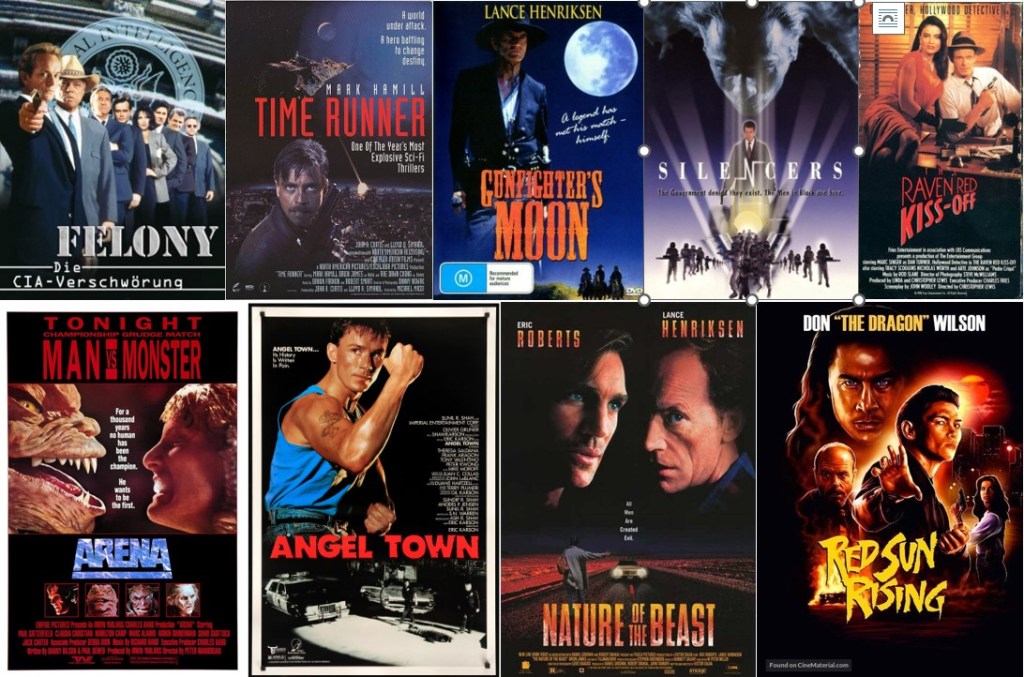
Lost in the 90s: Collection 01
In the 1990s, I hit the video store multiple times a week. It was my church, and the films that lay dormant in its hollowed isles, where my religion. I watched everything that caught my eye, and I watched so many films that will forever live in my head. Whether they live up to the fond memories or not. Often times, it’s a ‘not’.
But over the years, with the advent of DVD, Blu-Ray and streaming services, I began to notice that some of these titles where nowhere to be found anymore. But with many of these films being slowly released on YouTube, free services like Tubi, and even Amazon Prime, I have been able to relive the days when I began my film education and obsession. Some have become cult classics, either major or minor, or should really have been forgotten.
So, with this Lost in the 90s, I’m going to look at someone of these weird little oddities.
Felony (1994)
Felony is an action thriller from writer/director David A. Prior. The man responsible for the unintentionally hilarious action film Deadly Prey (1987), the gym slasher film Killer Workout (1987), and the action comedy Good Cop, Bad Cop (1994). He is a maestro of low budget genre flicks that often went straight to the video store shelves in the 80s and 90s. And I loved them.
You may scuff, but before streaming, you would take a chance on anything that looked appealing. It was a classier type of exploitation flick. Explosions, T&A, moustache twirling villains, and take no shit heroes were a mainstay, but every now then you would get something different. Felony is in that category. And cast alone would draw anyone’s attention.
At a taping of a “Cops” style reality show, cameraman Bill Knight (Jeffery Combs) and sound tech Robby (Patrick Gallagher) get more than they bargained for when, following the SWAT team in with the raid, the well-dressed Cooper (David Warner) appears with his henchmen and guns down the cops. The two TV tag-alongs barely escape as the house explodes, but Knight is knocked unconscious. Before he is taken away in the ambulance, Knight tells Robby to get the tape from the camera.
The killing makes the news and pisses off a lot of people. Especially when they all find out there could be a video tape of the event. Taft (Lance Henriksen) screams at his henchman, the well-dressed Cooper, over the incident, while creepily sexy bodyguard Sondra (Corinna Everson) looks on. They are a rogue element in the CIA that is selling drugs and all manner of illegal evil shit, to raise money to get some of their colleagues out of a South American prison.
On the other side of town, New Orleans Police Chief Edwards (Red West), and the detectives in charge of the case, Kincade (Leo Rossi) and Duke (Charles Napier) start making a plan of action. And on the top of the list in the currently hospitalised cameraman Knight. And guess what, the bad guys have the same idea.
At the hospital Knight wakes up, and meets one of his nurses, Laura (Ashley Laurence). Who tells him he is being discharged. There is much banter as Knight tries to pick her up. The cops arrive to question him, before he leaves. Laura gives him her phone number. And he is wheeled out of the hospital. Right in the path of two of Taft’s killers. After a brief chase in which Knight is shot in the arm, he is rescued by a Federal agent for Texas named Donovan (Joe Don Baker), who bundles him in his truck and lays out the whole story for him. And that Taft may not be raising the money to rescue fellow CIA, but keeping the cash. Knight, not trusting the big Texan, jumps out of the truck and off a bridge.
And after Robby tries to sell the tape to the bad guys and gets killed for it in a bonkers action chase sequence that makes on sense, Knight turns to the only person he can, Laura. And they go on the offensive. But they are in a world of spies, betrayal, big guns, and are out of their depths. There is also a trip to a strip club for no other reason to get a little T&A in the film. The climax is not a big one, giving over to tension and intrigue like the ending of a murder mystery, despite the nonsensical action that preceded it.
Seriously, I’m surprised Prior got so many amazing character actors to be in this little film, seen as either through away entertainment or now forgotten completely by most. I mean, wow. And having Henriksen in a film going nuts and chewing the scenery, and still being less menacing than Warner’s Cooper. It’s impressive. Rossi and Napier as cops is easy for these guys at this point, and Baker’s Donovan is riffing on modern day cowboy action stars he has already played.
But the hero of this film, Knight, played by cult horror icon Jeffery Combs which is the highlight. This kind of movie and this kind of role is something he rarely did. Combs carries the film well, and makes me wish he did more heroic action roles. I just wish it was a better film.
The movie, while a little baffling (both in story and the cast), will hold your attention for the 93-minute running time. But after the credits roll, you would have forgotten the whole thing. Fun but disposable.
Currently free to watch on YouTube.
Time Runner (1993)
When I first saw the box art for this film, I was instantly excited. A sci-fi action film with Mark Freakin’ Hamill looking badass holding an awesome gun in front of a futuristic cityscape. I knew this was not going to be a good film, but I was hoping a fun one. I was right on both counts. Looking back, this film did not age well.
It starts off set in the futuristic time of 2022. On the 6th October, an alien race invades the Earth and cleans the planet’s clock. Aboard a military space station, a specialist (specialist of what, I still don’t know) Captain Michael Raynor (Hamill) not taking enough time to deal with the loss of the crew (his wife among them), escapes in a pod headed to Earth. But as plot convenience would have it a wormhole appears and sends the pod to the past time of 1992. And crashes.
When Dr Karen Donaldson (Rae Dawn Chong) is pulled off the assignment of investigating the crash by MIBs with bad haircuts, she ends up helping Raynor stop the future invasion, with the help of mechanic Arnie (Gordon Tripple). But the MIBs are after them lead by Neila (Brion James) and henchman Freeman (Mark Baur).
I used to call films like this Idea or Concept Films. Because there is always a good idea at the centre of the story, but because these are smaller budget, straight to video releases, the quality or impact always falls by the wayside. These ideas would be done better in other studio films. And you can see elements of the story in the film 12 Monkeys and Looper.
Apart from Hamill, everyone is sleepwalking through this film, even Brion James who is usually amazing. And I love Hamills old James Dean look with stoner surfer dude hair. Weird but memorable.
The direction is uninspiring, the action scenes are pedestrian, there is weak optical compositing, lazy staging, and dumb dialogue. The music is repetitive and adds nothing to the story, and it’s so annoying. Time and money seem to have gone into the space sequences at the beginning, even if they lasted only five minutes.
Full of potential, fun to riff on, but ultimately forgettable. Rating: Limp Lightsaber.
Gunfighter’s Moon (1995)
I love Lance Henriksen. He is an actor who has never let me down in a film. Ever. And he did a little bit of everything in the 1990s. Even Westerns.
Gunfighter’s Moon is a Dramatic Western thriller written and directed by Larry Ferguson, who also wrote and directed the cop undercover in a biker gang movie Beyond the Law (aka Fixing The Shadow) in 1993.
In the film Henriksen plays Frank Morgan, a veteran gunslinger trying to become anonymous in Mexico. But his reputation still follows him as men and boys turn up to test their metal. When Frank gets a message from his former lover, he races back over the border to help. He arrives in Red Pine, Wyoming, and finds that Linda (Kay Lenz) does want him, but wants ‘The Frank Morgan’ to protect her new husband Jordan (David McIlwraith), store owner and temporary sheriff. Jordan refuses to release a member of an outlaw gang that killed the previous sheriff from the town jail at the bequest of the gang leader.
Frank doesn’t want to get involved, and is heartbroken because he still loves his former flame. But his reputation, the thing she left him for, still hangs over his neck. And things get tricker when he finds out that Linda’s daughter Kristen (Nikki Deloach) is also his. So, to keep this family unit together, Frank faces off against the gang. And after all is done, wounded, he rides off into the desert.
The sweepy cinematography is here showing off the landscape. But the violence has a feel of a samurai film of the 70s. It feels like a mix of the classic romantic style western and the harder and grittier modern westerns. There is a good story here, unlike many other straight-to-video or TV movie westerns, and uses everything that Henriksen brings to the table. Some remember his villains, more than his broken heroes or anti-heroes, which he was just as good at playing. And this is just such a role. It’s worth a watch for Henriksen alone.
With a larger budget and a few larger names in supporting, this could have been a massive box office hit. Currently on YouTube for free.
Silencers (1996)
I mentioned before that there are films that hit straight to video that contained plots, ideas, characters and scenes that would influence other, big budgeted studio films. I called them concept films. Well, this is a good example of one. Coming out in the middle of X-Files’ reign, The Silencers (not to be confused with the 1966 spy comedy) is a sci-fi action thriller, directed by Richard Pepin, and released straight to video from the awesome PM Entertainment.
The story sees Secret Service agent Rafferty (Jack Scalia) who, after losing a senator he was assigned to protect from terrorists with unusual abilities, is loaned out to the military to transport a mysterious cargo to a black site. That being Comdor (Dennis Christopher) an alien peace officer from the Pleiades system who is here to stop evil extraterrestrials, who have made a secret deal with the American government. Fearing the humans will back out of the deal (something they themselves plan to do) they attack the transport. With Comdor released, he had Rafferty team up to stop the alien threat. The alien leader looks like a buff evil Michael Jackson. Tell me I’m wrong.
The teaming up of a hard-bitten agent and his alien equivalent, is definitely buddy cop material. It’s a tried-and-true formula, and works well here. Comdor’s fish out of water observations and reactions could be overdone or overplayed for comedy, but seems natural and subdued compared to other films. Scalia has played roles like this before in the 90s, so he has the part down. But Dennis Christopher stands out in a role he doesn’t usually take on. I fell in love with this actor after the IT mini-series in 1990, and will always watch him. Seriously, check out Fade To Black (1980).
While the story is a simple one, the stunt work and pyrotechnics are above and beyond, rivalling anything the studios were doing at the time, and in a much smaller budget. The gun battles are dynamic, even if the fist-to-cuffs are pedestrian.
If you watch the cast of characters, the story structure and set pieces, your mind will automatically think of Men In Black, and The Matrix franchise. Not a great flick, but it’s fun. Deserves to be seen.
The Raven Red Kiss-Off (1990)
This film is a wonderful call back to the pulp detective film-noir thrillers of the 30s and 40s. It’s full of Private Eyes, femme fatales, seedy characters, betrayals, and all men wearing hats. Yeah, what was with that?
In L.A. in the 1930, Dan Turner, Hollywood Detective (Marc Singer), has made a name for himself working cases in and around the movie machine of Hollywood. He is on the outs as he had run afoul of movie mogul Bernie Ballantine (Danny Kamin). Helping out his old friend Roy Cromwell (Brandon Smith) out of a jam at an illegal gambling joint by escorting his mistress, film star Vala Duvalle (Tracy Scoggins), out before a raid because they can’t be seen together, events kick off.
The next day, Roy comes to see Dan with a check with a lot of zeros and a job offer from Ballantine. That job is to follow Vala and keep her safe on the set of their new movie they are shooting at a fair ground up state. Vala is also Ballantine’s mistress. But while there, an extra, an old flame of Dan’s, is killed. And with his gun it seems. So, Dan must go on the run to find out who the killer is, why all this happened in the first place, and to not get arrested before he can.
While this film feels more like a TV movie, it does a fine job with the look of the time period. The sets, costumes, and cars featured were all perfect. And the snappy dialogue delivered by Singer’s Dan is on point with the versions of classic P.I.s on screen. The story has some slow spots, but when Susan Brooks’ Cindy Lou, the wild country loving cab driver motors into Dan’s life, the film picks up.
The character of Dan Turner first appeared in the page of Spicy Detective Magazine in 1934, created by Robert Leslie Bellem. But this is the first and only film adaptation of the character, based on the short story “Homicide Highball”. Which I think is a shame. While the character might not be as famous as Chandler’s and Mammet’s creations, I think this could have had legs on screen.
Charming, despite its flaws.
Arena (1989)
Made in 1989, but not released until 1991, this low budget film is something different story wise. This is a sci-fi action sports movie. Yes, you read that correctly. A sports movie in space. Who knew that could be a thing. With the added spice of a Babylon 5, and two ST:DS9 actors, no less.
In a space station somewhere in the galaxy, a UFC type event known simply as the Arena has it home. The Arena is run by a criminal overload named Rogor (Marc Alaimo) and his slimy henchman Weezil (Armin Shimmerman). Alien races from all over the galaxy send fighters to compete in the bloody matches for fame and fortune. There hasn’t been a human champion in over 50 years.
Enter Steve Armstrong (Paul Satterfield), who has trained all his life for the Arena, but with no one wanting to give a human a chance, and with no way home, he has been working as a short order cook with his friend Shorty (Hamilton Camp). When they are fired for breaking up a fight, Steve and Shorty decide to blow off steam at an illegal casino. But they run afoul of Rogor. Steve then accepts an offer by Quinn (Claudia Christian) to train and sponsor him to fight in the arena. Steve becomes the underdog, and a symbol to the downtrodden, all leading up to the big fight.
The story has equal parts Rocky and Bloodsport, with a dash of the 1992 film Gladiator. But the fights themselves are where the film is lacking. The production seems to have put more time and money into the alien designs. And the puppets and prosthetics are damn impressive for such a low budget film, but with it being hard for the performers to see what is going on, the action suffers.
Christian, Shimmerman and Alaimo all excel in their roles, despite the rest of the cast. And Richard Band’s music makes the fights seem just that little bit more epic. And this would be one of the last films released under the Empire Pictures banner.
Arena is a fun TV style sci-fi of the late 80s. But if you are not a sci-fi geek, you will forget this film after watching it. Currently on YouTube.
Angel Town (1990)
French kick-boxing champion Olivier Gruner, was a mainstay of 90s action and sci-fi video flicks. In the 90s, he made 14 films, of varying quality, some are cult classics. And Angel town was his acting debut.
Gruner plays Jacques Montaigne, a professional kick-boxer who has been hired by the Olympic Committee to train the American team. But Jacques studies a new field everywhere he goes. This time he is studying Engineering at USC in L.A. Since he was late arriving to the campus, he takes a room in a dangerous part of town owned by Maria (Theresa Saldana) and her son Martin (Francisco Aragon). The gang lead by Angel (Tony Valentino) terrorises the neighbourhood but targets Martin specifically because they want him to join their gang.
Jacques at first defends his new friends from the gang members, then goes on the attack. He enlists the help of an old friend who runs a martial art school, Henry (Peter Kwong), who at first Hides Martin, then helps train him. When Angel and his gang declare war on the neighbourhood, Jacques, Martin, Henry, and Henry’s students defend the streets, with Maria’s house being the focal point. And it’s a hand-to-hand brawl.
The director of this film was Eric Karson, who directed the Chuck Norris film The Octagon (1980), but is mostly known as a producer of action movies. He produced the underrated Jean-Claude Van Damme film Lionheart (aka Wrong Bet or A.W.O.L.) in 1990. Which was also written by Stefani Warren, responsible for Angel Town’s script. And honestly, it is not as good as either of those other projects. It’s a story with a lot of heart, and a reliable premise which we have seen before, but its slow pace and an untrained actor in the lead definitely hurts the film. But Gruner is just as charismatic as Van Damme or Schwarzenegger, and has grown as a performer over the years, and while he never was as big as those guys, he is still working today.
Best character in the film is Frank, played by Mike Moroff. A wheelchair bound military vet and old friend of Martin’s dad. And he helps win the day. A good watch, but don’t expect a masterpiece.
The Nature of the Beast (1995)
Nature of the Beast is a 1995 direct-to-video Crime Thriller, with a mystery at its core and some horror elements, that left me speechless the first time I watched it. It is a good way. And all these years later it still holds water.
Set mostly on the road in desert and rural areas, the news over the airwaves is that a serial killer known only as the Hatchet Man has been killing along the highways. And in other news, $1.5 million dollars was stolen from a Las Vegas casino without a trace. And police are investigating both crimes.
Travelling paper salesman Jack (Lance Henriksen) moves from one stop after another along the highway. He has money worries, which may or may not be due to his wife’s spending, and has a drinking problem. After passing a hitchhiker, Jack runs into him at a roadside diner and Jack offers to buy him lunch. Adrian, Dusty to his friends (Eric Roberts) has a substance habit of his own, and seems a mysterious and dangerous person. Adrian is a freewheeling type looking for the next experience and Jack is a world-weary family man. But both have a secret. Adrain knows this and uses it to get a ride from Jack. And then the war of personalities, secrets, motivations begins.
Seriously, I love this movie. The performances given by both the film’s leads, Henriksen and Roberts, are thought out, emotional, creepy, and damn Oscar worthy. The events leading up to their meeting are left vague, and through staging and the dialogue, you are left wondering who did what and how, or if the ‘secrets’ alluded to are something else entirely. Regardless of the images with see. And the setting of desert landscapes, mostly seen through the car’s windows, adds to the tension. All this space and nowhere to go. And the ending. Oh, my God, the ending. M. Night Shyamalan wishes he was this good.
Everything works here: camera work, lighting, editing and music. All work to make this film standout. It’s a shame the director, Victor Slave, has tarnished his own work, which is something I won’t go into here.
A must for fans of mystery and serial killer fiction. Currently on YouTube.
Red Sun Rising (1994)
Don “The Dragon” Wilson is an 11-time kickboxing world champion. With skills, the looks and a charming nature, of course he became an action star. And from the beginning of the 90s, his films have covered every genre with 27 films in that decade.
Red Sun Rising sees him playing Thomas Hoshino, a Japanese American ling in Japan working as a police detective. When his partner Yuji (Yuji Okumoto) is killed by a dangerous Yakuza, Yamata (Soon-Tek Oh) and his mystical ninja assassin Jaho (James Lew), he travels to America to bring them to justice.
In L.A., police detective Karen Ryder (Terry Farrell) is trying to stop a gang war from happening, all the while dealing with the added stress of misogynist co-workers. And everything gets more complicated when Hoshino arrives. It seems that Yamata and Jaho are trying to start a gang war so they can sell guns to both sides to finance their take over of the Yakuza back home. But the way that Jaho is killing people forces Hoshino to go see his old teacher Buntoro Iga (Mako), now living in the city. It is here our heroes learn of a mystical form of fighting that uses magical energy and pressure points to kill.
So, Hoshino begins his training anew in order to defeat the criminals, stop a gang war, and reveal the identities of the dirty cops.
This film seems to have higher production values compared to most direct-to-video fare. Wilson’s fighting style in the film is not as showy as Lew’s villain, but that helps inform both characters. Mako is playing a role he has played before the honourable and knowledgeable master who is very irreverent compared to the Japanese strict stereotype. Farrell is also good, but some of the dialogue they give her to say paints the character like one of the sexist and racist asshats she works with. At the beginning anyway. And it’s always good to see Michael Ironside, as Captain Meister, not playing a villain.
This also has a lot in common with the formula of the Rush Hours films. While it’s not played for laughs, as it is darker in tone, it’s hard not to see. Above average movie, decent cast, decent action.
-
Re-Watch Collection 5 – Dracula is the True Lord of the Dead.
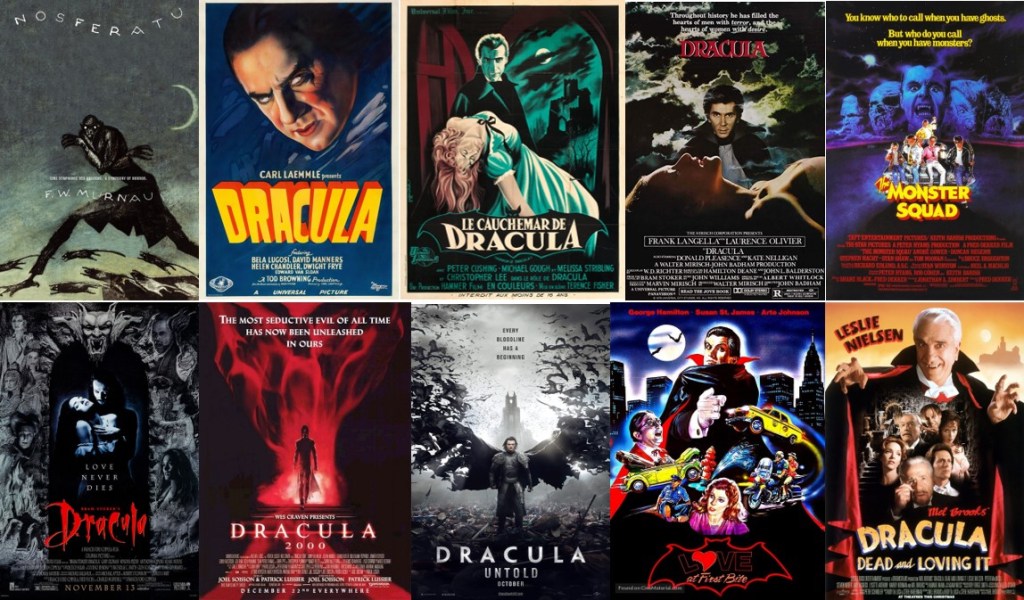
Let’s take a look at some of the notable films featuring the most famous vampire in popular fiction.
Nosferatu (1922)
Nosferatu (or as it’s sometimes-called Nosferatu: A Symphony of Horror) was released on the 4th March 1922, and is the earliest surviving vampire film based on Bram Stoker’s Dracula, albeit loosely.
It is directed by one of the great directors of the silent era, German born, FW Murnau. This was his tenth film, and while many are lost, its by the grace of the movie Gods that this film survives.
The film is set in the fictional town of Wisborg, Germany as Thomas Hutter (Gustav von Wangenheim) being sent Transylvania by his employer Herr Knock (Alexander Granach), to home of Count Orlock (Max Schrek) as he plans to buy property in Hutter’s home town. The locals are terrified by the mention of Orlock’s name and warn Hutter, but he makes his way to the castle and is greeted by Orlock. At dinner, Orlock signs the paperwork, then he notices a photo of Hutter wife Ellen (Greta Schroder), remarking that she has a lovely neck. Hutter begins to suspect Orlock is a vampire.
You can see this film seems to have the familiar story element of the novel, and later films. And the rest of the film follows suit. But the story is stripped down to bare essentials to focus on the otherworldly Count Orlock and his predatory nature, rather than the suave and sophisticated aristocrat. Here he is a killer. The characters have been changed, not just in name, but also in nature, but they are still recognisable, and some combined.
Murnau expertly uses the power of the image to not only tell the story, but without music or audible dialogue create a sense of mystery, suspense and dread as the story unfolds. Some of the images from this 100year old movie have become iconic in themselves. Orlock onboard the boat, Orlock and his shadow moving up the stairs, Orlock feeding on Ellen, and his death via sunlight (where it was first introduced). Amazing works of art in themselves, but in context tell a chilling horror story about an obsessed undead killer that still holds up today.
The film is often referred to as German Expressionism. But the film itself is presented as real, with only Orlock, in appearance and movement, being expressionistic. A masterpiece.
Sidenotes – Nosferatu (1922)
The iconic image of Max Schreck’s Count Orlock in Nosferatu has become as culturally recognisable as Lugosi’s Count Dracula. The bald bat-like features, pointy rat-like teeth, pointed ears and long fingers tipped with claw-like fingernails, paired with a slim physique clad in black. It has since been seen as the ultimate evil version of a vampire thanks to this film. It has been referenced in the Salem’s Lot mini-series from 1979, becoming the face of Kurt Barlow, the Master and the Lord of Lies in Buffy The Vampire Slayer and Angel also referenced the Orlock vampire, as does the short-lived TV show Kindred The Embraced. Even a character in the comedy What We Do in The Shadows is based on the now 100-year-old blood sucker.
Nosferatu was remade in 1979. Nosferatu The Vampyre written and directed by Werner Herzog, and starring Klaus Kinski as the undead Count. And the make-up they used recreated the image of the classic vampire. They put the make-up on the only actor I can think of that didn’t need prosthetics to scare the shit out of you, and in the loose 1988 sequel, Vampire in Venice, the same character, portrayed again by Kinski, was sans make-up. Herzog’s film is actually a great dramatic horror film. The Sequel, not so much.
The film was almost lost forever after a court case between Bram Stoker’s estate and the film’s producers. The court ordered all copies of the film to be destroyed. But luckily, some survived. This and the scarce details surrounding the film and its star, many wild theories surrounding them both, became the film equivalent to an urban legend. The most widely circulated was that Max Schreck was a real-life vampire that FW Murnau persuaded to be in the film. This was later used as the basis for the darkly comedic horror film, Shadow of the Vampire (2000) which starred Willem Dafoe as the Schreck vampire and John Malkovich as FW Murnau. It’s well worth tracking down.
There is currently in production a remake of the original film being written and directed by Robert Eggers and starring Nicholas Hoult, Arron Taylor-Johnson, Lily-Rose Depp, Willem Dafoe, and Bill Skarsgard as the undead Count Orlock.
Evil Never Dies.
Dracula (1931)
The period of the classic Universal horror cycle began in February 1931 with the release of the Tod Browning directed Dracula, starring the great Bela Lugosi.
It follows the novel, but due to the budgetary constraints amid concerns over producing a film in the horror genre, it is based more on the stage play of Dracula written by Irish playwright Hamilton Deane in 1924. Which explains the contained location on sets, the film almost being shot like a play. The play was a great success for Lugosi himself, and would directly lead him to getting the part due to the actor originally slated to play the role, Lon Chaney, became ill.
Thanks to Lugosi’s portrayal of the Count, Dracula was established as a cultural icon, and appearance and performance of the actor would become the archetype for years to come. And he is magnetic in the film. He oozes charm and sophistication of the old-world aristocracy but also the evil and violence just under the surface. Many times, just with a look. His delivery of the lines “I don’t drink…wine” and “The children of the night, what music they make” with such skill that they are some of the most quoted lines in film history.
While some may say that the Spanish language version that was made on the same sets, is the technically better film, it doesn’t have Lugosi. An element I can’t stress enough, is the reason this film was a success, and has lasted the test of time.
Don’t misunderstand, the filmmaking is top notch for the time. Browning, along with cinematographer Karl Freund, are masters of their craft. The framing and execution of the castle sequences when Renfield meets Dracula are amazing. Every frame is a work of art. As is the framing, especially in close up of the lead actor, and fellow co-stars, Dwight Frye’s Renfield, Helen Chandler’s Mina, and the great Edward Van Sloan as Van Helsing.
While Frankenstein has always been my favourite of the Universal Monster movies, this film was the basis, the foundation, for the studios later films. What a foundation it was. In 2000, the film was selected by the United States Library of Congress for preservation in the National Film Registry. Art in motion.
Horror of Dracula (1958)
Following the Curse of Frankenstein (1957), Hammer Studios wanted to do their version of Dracula. So, they did. In 1958, Hammer Studios released Dracula, (or as it was renamed in American Horror of Dracula). I’m using the alternate title here, as there are a lot of ‘Dracula’s out there.
All the same story elements are here, but director Terrence Fisher and screenwriter Jimmy Sangster, made some truly cinematic changes to the tale and its characters. And oh, they were good ones.
In the novel, Jonathan Harker is traveling to Transylvania to assist the Count in buying property in London. Here, his reasons are just a pretext. Harker is here to kill Dracula, and is revealed in his diary entry voice over. This unexpected element surprised audiences and gave the film a sense of urgency other adaptations lacked. Harker is an old friend and student of Van Helsing in this version, and is dispatched before the end of the first act. Starting here, all the characters have a personal stake in events from the start and there are consequences.
Christopher Lee’s Dracula is a different beast and just as surprising. He is a suave, charming aristocrat, and his personable and conversational tone is unlike other Dracula’s. It sets the audience on edge. There is a menace just under the surface from his first introduction, and not just because his footsteps make no sound.
Peter Cushing’s Van Helsing is not presented as an obsessed eccentric, but rather a kind and knowledgeable father figure with a quiet authority. Cushing plays this beautifully. The exact opposite of his Dr Frankenstein and that of Lee’s Dracula.
This film is also the first time sexuality is a prominent element of the story. The scene when Lucy prepares for Dracula’s arrival in her bedroom and the courtship of innocence corrupted is evidence of this. As is the seduction of Mina Homewood. These two victims, the unmarried virgin and the frustrated wife, are already victims of repressed Victorian morality, and Dracula’s turning of these women is a dark twisted eroticism.
This is not presented as theatrical, but operatic, without winking at the audience or unwanted humour. This film is one of my all-time favourites. 10 out of 10 Vampire bats.
Dracula (1979)
The 1979 version of Dracula directed by journeyman director John Badham, is similar to the 1931 production. Both are based both on the original novel and the 1924 play. The star of this film, Frank Langella appeared in a revival starting in the late 70s. There is more of the play in this film than the novel, but is it an amazing film that does things differently.
Apart from changing some of the names around, Lucy and Mina are switched, and combining characters or leaving a few out, this film still follows the same beats as you would expect. The film actually forgoes the Transylvania segment at the beginning, and starts on the ship Demeter on its way to England, where a supernatural dog kills the crew. The ship crashes, and Dracula is the only survivor. He is found on the beach in the middle of the night by Mina (Jan Francis). She is living with Lucy (Kate Nelligan) and Lucy’s father Dr Jack Seward (Donald Pleasence) at their home which is also an asylum. Sounds like fun. But Dracula’s “rescue” on the beach gives him an entrance into the lives of the well to do.
At a party, he is introduced to Lucy, and the sparks fly. And here is where it makes a major detour. From this point, the film becomes a tragic and fantastical love story. And Dracula’s seduction to Lucy, and her devotion to him, is the only good relationship in the whole film. You really do get that the two ‘star crossed’ lovers are meant for each other. Even if one half of the pair is a bloodthirsty killer.
And even that is toned down. Dracula is portrayed as an elegant gentleman, with honour and good humour. But also, as a man who has a terrible affliction that causes him to drink others blood to survive. Something that disgusts and pain the character. Langella steals the show and is hypnotic to watch. He embodies Dracula better than most, even Lugosi and Lee, to give the audience a truly tragic character, full of mystery, lust, passion and, dare I say it, love. Certainly, the most erotic Dracula.
The film is helped by John Williams score, and W.D. Richter’s script.
The Monster Squad (1987)
The Monster Squad is an action, comedy fantasy that works as a ‘Goonies’ like film with monsters. So why am I looking at this film in the middle of a Dracula kick? Well, it has one of the best film representations of Dracula in film. Seriously?
The Squad is a group of pre-teens who love monster movies, especially the Universal monster films. They are leader Sean Crenshaw (Andre Gower), his little sister Phoebe (Ashley Bank), Patrick (Robby Kiger), clumsy Horace (Brent Chalem), tough kid Rudy (Ryan Lambert) and little Eugene (Michael Faustino). Sean comes into possession of the diary of Dr Abraham Van Helsing. But it is written in German. The book contains spells and rituals that can give great power, which is why Count Dracula (Duncan Regehr) travels to America to get the book. But he doesn’t come alone. He has by his side, the Mummy, the Gill Man, the Wolf Man (Jon Gries in human form), and Frankenstein’s Monster (Tom Noonan).
Dracula’s first attempt to get the book sees him sending the monster to retrieve it, but old Frankie ends up befriending little Phoebe and then the rest of the Squad, becoming their newest member. He ends up being the heart of the story, and alongside an old German gentleman known only as German Guy (Leonardo Cimino), who helps them translate the diary, stands against the monsters of old to save their town. And better yet, this film is funny.
Duncan Regehr’s performance as Dracula, is something that we hadn’t seen very often until this point, a version of the Count that is both scary and menacing. And it is rare that you get a truly evil character like this in a comedy adventure film like this, one aimed at younger audiences. When he picks up little Phoebe and growls, “Give me the book, you bitch!” you do get the impression he will kill this adorable little girl. Something I never felt with other versions of the character.
Fred Dekker, who directed, co-wrote the script with Shane Black, and they film it with as much heart as humour. The effects are amazing. Especially the Wolf Man.
Best Line is from Horace: “Wolfman’s got Nards”
Bram Stoker’s Dracula (1992)
If you don’t already know the story of Dracula, then there is no hope for you. When this film was announced with legendary filmmaker Francis Ford Coppola directing back in the early 90s, fans of the novel, horror fans, and cinephiles went crazy on all fours. Coppola was determined to give us all a different take on the tale, and Dracula himself, while remaining as faithful as possible.
1462, Vlad Dracula returned victorious from a campaign against the Ottoman Empire. After a brief battle montage, he returns finds his wife Elisabete dead from suicide after she received misleading news of her Count’s death. Vlad, a devout believer in God, is told by the priest that she will never enter the kingdom of heaven. Vlad renounces God and desecrates the chapel. He is then forever cursed to live in darkness, and tormented to take lives to survive. Not God’s best move.
In 1897, as solicitor Jonathon Harker travels to the Transylvanian home of Count Dracula, replacing R.M. Renfield, to assist the Count in buying property in London. And you know the rest. I mention the opening, because it is very similar to the proposed opening to the Universal film Dracula’s Daughter from 1936, until it was changed.
The old school approach to filmmaking is what makes this film so interesting. There are no optical effects, computer compositing or CGI used. All of the effects are practical and, except for the makeup and prosthetics, all done in camera. Coppola and his crew achieved this through editing tricks, camera movement and placement, miniatures, forced perspectives, matte paintings and multiple exposures. These effects add to the otherworldly nature of the story, which is solidified by Wojciech Kilar’s haunting and terrifying score.
The performances are good, with Gary Oldman’s Dracula and Anthony Hopkins’ Van Helsing being standouts. I really do believe in the love story between Dracula and Winona Ryder’s Mina. Keanu Reeves was miscast as Harker, but luckily you have Richard E Grant, Cary Elwes, Billy Campbell, Sadie Frost and Tom Waits picking up the slack. And while I think the poster design is way better than the film deserves, I watch this every year. It’s a cocktail I keep coming back to. Bloody Mary anyone?
Dracula 2000 (2000)
Dracula 2000 is a horror fantasy film from writer Joel Soisson and director Patrick Lussier. The film does something different with all the familiar elements of the story.
The descendant of Abraham Van Helsing, Matthew (Chirstopher Plummer) owns an antique business built over the site of Carfax Abbey in London. He has two assistants, the super smart Simon (Johnny Lee Miller) and Solina (Jennifer Esposito). One night, Solina lets in her boyfriend Marcus (Omar Epps) and his crew into the building to break into Matthew’s high-tech vault thinking it will be full of treasures. They find a silver coffin. And a lot of booby-traps. They take the coffin with them, hoping there is something inside they can sell.
While transporting the coffin by plane, the occupant, Dracula (Gerald Butler), wakes up and kills the crew and takes Solina as the first of his new brides. We also see there is a connection between Dracula and a girl named Mary. Mary (Justine Waddell), we learn, is the estranged daughter of Matthew, currently living in New Orleans. So, guess where the plane crashes?
Matthrew, followed by Simon, travels to New Orleans, to hunt down and kill the undead. We learn two things here. Matthew is actually Abraham who has kept himself alive all these years by injecting himself with Dracula’s blood filtered through leeches, and that this very act has also made Mary of Dracula’s bloodline as well. And blood calls to blood. Everything heads to a very thrilling climax.
An element of this story that is intriguing is the true origin of Dracula the film puts forth. That he is actually Judas Iscariot, Jesus’ betrayer. After trying to kill himself, God cursed him to be the OG vampire. Explaining the aversion to silver and religious iconography.
The cast is rounded out with solid performances from Colleen Ann Fitzpatrick (aka Vitamin C), Jeri Ryan, Sean Patrick Thomas, Shane West and Nathan Fillion. While the story is merely okay, it is full of great ideas, and stunning visuals that elevate the film. As does the kick ass soundtrack and the haunting score. Reminds me as much of Italian horror and Giallo cinema of the 70s as the gothic horror traditions. Cult Classic dripping from every neck wound.
Dracula Untold (2014)
This film was to be the beginning of the Universal’s Dark Universe, based around the Universal Monsters. Written by Matt Sazama and Burk Sharpless, and directed by Gary Shore, this tale of Dracula is basically the backstory of the character. In the 15th century, Vlad Draculea, Prince of Wallachia and Transylvania, became a ward of the Sultan of the Ottoman Empire. He is trained to be a great warrior in the elite Janissary Corps. He becomes their most honoured and most feared warrior, earning the name Vlad The Impaler, Son of the Dragon. But after becoming disillusioned and sickened by war, he abandons his past and returns home.
Now ruling his lands in peace, Vlad (Luke Evans) and his men have a run-in with a vampire in a cave with devastating results. Following an Easter celebration with his wife Mirena (Sarah Gadon) and son Ingeras, an Ottoman contingent arrives for their tribute, but they also want an additional tribute of 1,000 boys to be trained as Janissaries. Vlad refuses. Knowing that Sultan Mehmed II (Dominic Cooper) is coming to not only take what he wants, which includes Vlad’s son, but to take revenge. Vlad in desperation seeks help from the Master Vampire (Charles Dance) in the Broken Tooth Mountain. Vlad becomes a vampire after a Faustian bargain, so he can protect his family, his people and his land.
The film that sounds like it could be the journey of a good man who, backed into a corner, becomes a creature of the night to defeat a villain, but becomes the monster himself in the process, seems to have been set aside for a dark superhero original story. Every version of the poster pushes this, looking more like retouched Batman posters than that of a dark tragic tale of a fallen character. The Trailers and the film continue the same way. I was surprised there wasn’t a bat signal.
The cast all do marvellous jobs here. The same with Ramin Djawadi’s score. But lack of story and direction, and inconsistent CGI, make this uninspiring and forgettable. Which is the same, there was potential here. Universal could have still used the film to build something impressive, but panicked. It will remain a lost opportunity on all fronts.
Love at First Bite (1979)
Love at First Bite is a comedy written by Robert Kaufman, and directed by Stan Dragoti.
In this tale, Dracula (George Hamilton), and his servant Renfield (Arte Johnson), are forced to leave Dracula’s ancestral home, because the Romanian communist government has seized it to transform it into a training facility for athletes. So, the Count decides on New York because he has become obsessed with a fashion model Cindy Sondheim (Susan Saint James) who lives and works in the city.
Dracula is continually frustrated with the modern world. But everything changes when Renfield manages to get Cindy’s schedule from her agent. When they meet in a nightclub, after the Count is initially mistaken for a waiter, the two hit it off. There is romantic banter, a dance number, and then a night of kinky sex at her apartment.
The next day, Cindy’s psychiatrist, and on again off again boyfriend, Jeffrey Rosenberg (Richard Benjamin), recognises the symptoms and the marks on Cindy’s neck. Being the great grandson of Van Helsing and because he is very jealous, vows to destroy Dracula. Every attempt backfires spectacularly either because people don’t believe him or he has gotten the lore wrong. Which has him end up in either the asylum or lockup. All of which brings Dracula and Cindy closer together. Now engaged they plan to leave the city. As they make those preparations, Jeffery makes a last-ditch effort to beat the count.
This movie is a fun one. It has a good general conceit with the forced relocation and fish-out-of-water elements, well written dialogue for the most part, and some rather solid comic performances (especially from Atre Johnson and Richard Benjamin). Even though Hamilton is playing the straight-man through all of it, he does get one moment to be outrageous, when he drinks the blood of an alcoholic.
The downside, apart from the dated nature of the fashion and ‘modern’ dialogue, is the puns and ‘Dad jokes’ its uses, and falling back on stereotypes, both racial and sexual. It was a successful film upon release, and is almost a cult classic. It is an example of how to use the iconic character in a different genre. Worth a watch. You’ll be laughing like Renfield in no time.
Dracula: Dead and Loving It (1995)
Three years after the success of Bram Stoker’s Dracula, Mel Brooks released his last directorial effort, Dracula: Dead and Loving It. With a cast of newbies and regulars to make the funny at the undead icon.
Unlike the spoof comedies that seem to get worse and worse, Mel always told a story and found the humour at the heart of the story, and exaggerated it. He never went into full parody, although there are parody elements in all of his movies based on an existing genre or specific film. It’s why I love him as a filmmaker.
It follows the story beats from other ‘serious’ adaptations, so you know the basics. What I like is the way the film comments on scenes from the Universal films. The opening with Renfield (Peter MacNicol) travelling to meet Dracula (Leslie Nielsen) on the coach and his interaction with the town’s folk are a great example of this. Chuck McCann’s Innkeeper comically long moustache and Anna Bancroft’s Gypsy Woman shaking her throat with her hand to sound ominous always make me laugh. As does MacNicol’s over the top hammy performance, especially after he becomes Dracula’s servant.
Steven Weber and Amy Yasbeck play Johnathon Harker and Mina respectively, and they are having fun in their roles, as is the man himself as Van Helsing playing the perfect Hammy foil for Dracula. Lysette Anthony as Lucy does get a few lines, but seems to be just a pair of boobs in a dress with barely a joke to contain them. It’s a shame that Brooks regular Harvey Korman as Dr Seward looks rather bored in his role.
I have two issues with the film. Scenes just kind of end without warning or humour, and nothing pushes the plot along in these instances. The second is Leslie Nielsen. He leans more into goofball territory instead of the straight man in ridiculous situations. It does work as well.
This film always made me laugh, loudly. I still quote it to this day. Jonathon being seduced by the undead Lucy is great. And the staking of Lucy by Jonathon and Van Helsing is always dangerous as I can’t breathe. Was the right film to end on. Love you Mr Brooks.
-
Re-Watch 4: Once More With Feeling.
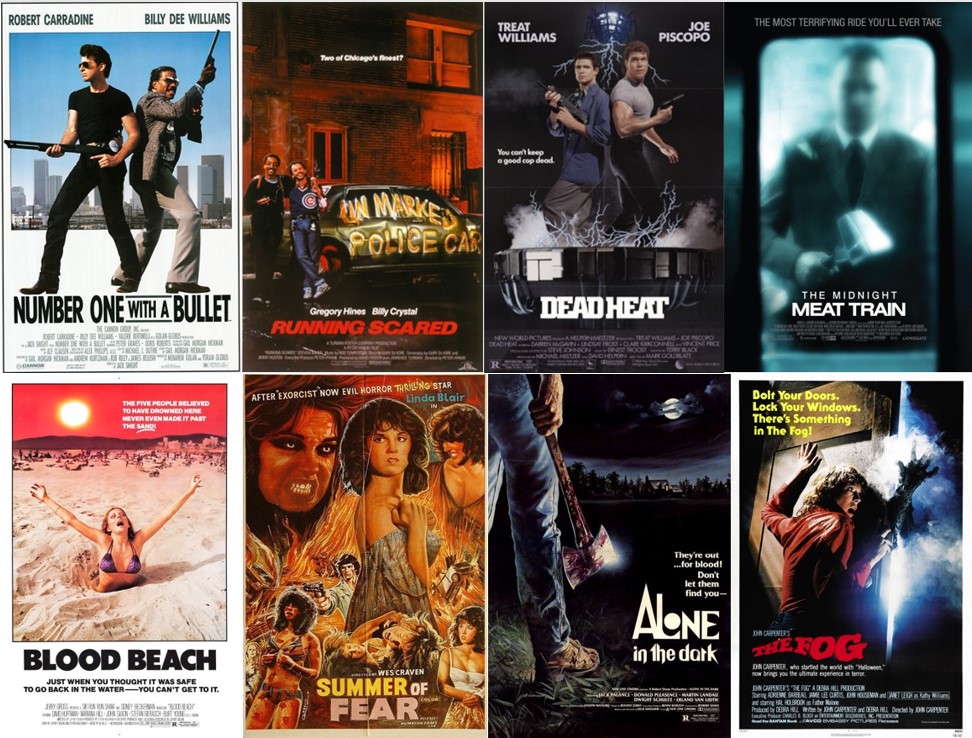
Number One With A Bullet (1987)
In the 80s, with films like 48 Hours and Running Scared, the buddy cop genre was starting to take off. Before Lethal Weapon would define the genre, Cannon films made their own. But unfortunately, it was Number One With a Bullet.
It features two cops with conflicting personalities (shock!). The irrational and unpredictable Nick Barzack (Robert Carradine) and the cultured, polite, and suave Frank Hazeltine (Billy Dee Williams), try to take down a major drug trafficker, DeCosta (Barry Sattels), who seems virtually untouchable.
Nick has a rocky, on and off again relationship with his ex-wife Teresa (Valerie Bertinelli), and a love hate relationship with his mother played by Doris Roberts. Frank on the other hand is a musician at heart playing trumpet at a local jazz club in his off hours, and is a ladies’ man of superhero proportions.
As the two cops navigate their personal lives, they are bested in their professional lives by the bad guy and his goons and hitmen. But after separate attempts on their lives that leave Frank hurt and another that almost kills Teresa, the two go on the offensive. Things get trickier when they find out there is a rat in the department.
The formula is not rocket science. It’s a by the numbers action thriller that could have used more comedy. The comedy is either pedestrian or mean spirited. Seriously, the character of Barzack is a complete dick with everyone around him, his treatment of his ex-wife is almost harassment, and he’s constantly derailing Frank’s lovelife. And this is a guy we are supposed to be rooting for.
The direction by Jack Smight is bland and uninspired. There are some slick action sequences and good stunt work. The script needed to be refined with another rewrite or two, because the story was thin without the budget to flesh the film out with more action.. The cast all do good jobs with the material they are given, but Carradine was miss casted and Billy Dee Williams dissevered better. But it was nice to see Peter Graves as the Captain and Mykelti T. Williamson as the flamboyant hood Casey.
Solid effort but falls short. This was another flop for Canon Films. Only for the curious.
Running Scared (1986)
From a failed buddy cop flick, to a great, yet underrated one. The film Running Scared is a buddy cop action comedy from director Peter Hyams, and written by Gary DeVore and Jimmy Huston.
Two Chicago cops, Ray Hughes and Danny Costanzo (Gregory Hines and Billy Crystal) attempt to put away drug dealer and smuggler Julio Gonzales (Jimmy Smits). We first see the part staking out the apartment building of drug runner Snake (Joe Pantoliano) and watching a neighbourhood basketball game. They arrest Snake, but he ends up inadvertently tagging along, hand cuffed of course, as the cops are almost mugged, investigate an apparent suicide and hastly make it to the funeral of Danny’s Aunt Rose. Where they run into Danny’s ex-wife Anna (Darlanne Fluegel), who Danny is still in love with.
When a bust goes wrong, Ray and Danny are forced to go on vacation by Captain Logan (Dan Hedaya). Using the $40,000 inherited from Aunt Rose, the pair head to Key West, where they live it up. They decided to retire early and buy a bar in Key West.
Returning to Chicago, they give their 30-day notice and then use that time to take down Gonzales once and for all. But they have short timers’ syndrome, and are worried about getting killed before they retire. Two over eager rookie detectives get in their way. And when Gonzales’ shipment is seized, he kidnaps Anna to exchange for the drugs. Que the action and quips.
This is one of the funniest action movies out there. But they don’t go down the parody route. The humour is all delivered by the interaction between the two old friends and partners. Crystal and Hines’ chemistry is amazing to watch. Crystal had permission to improvise many of his scenes, which elevate everything on offer. The fake phone calls Crystal makes always crack me up. This was also Smits’ first film role, and damn is he a good villain.
This movie was a success, and the studio backed every decision, even the car chase on the train tracks, which is a highlight. Not bad considering the director and the leads had never done anything like this before. The action is superb. Reviews and trailers are on YouTube. Indulge yourself.
Dead Heat (1988)
This film was released in the sweet spot of the 80s action boom and the buddy cop flick. But Dead Heat does it all differently. How? You ask. Well, it mixes the action buddy cop genre with a horror comedy. Don’t believe me. Go watch it and come back. All caught up? Good.
Detectives Roger Mortis and Doug Bigelow (Treat Williams and Joe Piscopo) are called to the scene of a jewellery store robbery in progress. They and the other cops get into a shoot out with the thieves who have impressive weaponry. Regardless of being shot multiple times, the bad guys just won’t go down, until our heroes use more extreme measures. Later, the corner Rebecca (Clare Kirkconnell) tells the duo that the bodies they brought in have been there before. A chemical compound found in the bodies is linked to a company that is doing experimental work.
While investigating the company, after finding a strange machine that can bring people back from the dead, Roger is locked in a decompression room and asphyxiated to death. He is brought back to life, well, kinda. He is still dead, but walking around. A company employee Randi James (Lindsay Frost) tells Roger that the machine can’t bring back people indefinitely. He only has 12 hours to find the people responsible for this death, and who is using the machine to commit crimes on a large scale using undead thugs. Is it Dr Ernest McNab (Darren McGavin) or the company’s founder Arthur P Loudermilk (Vincent Price)?
This film is a practical effects wonderland. Amazing creature design (the butcher shop scene), and stunning make-up effects on the reanimated people. Mix that with the typical 80s over the top action with its explosions and impressive stunt work, and this film is a visual treat.
When you also throw in a top-notch script by Terry Black that tells a great and goofy story, and is filled with a lot of humour. Most of that was delivered by Williams and Piscopo themselves (Piscopo improvised most of his lines. These dudes had chemistry. It’s good to see Darren McGavin play a villain. But we needed more Vincent Price.
Best Line:
Randi: Hey, you’re hurt.
Roger: Lady, I’m fucking dead.
The Midnight Meat Train (2008)
The Midnight Meat Train is a horror film based on a short story from Clive Barker that first appeared in his Books of Blood collection.
It’s the story of Leon (Bradley Cooper), a street photographer who is obsessed with capturing the essence of New York. His girlfriend Maya (Leslie Bibb) and friend and agent Jurgis (Roger Bart) get him an interview, of sorts, with high end gallery owner Susan (Brooke Shields). When she says he has a good eye, but his work is too safe, Leon is determined to capture something real and confronting. He does, in the form of an attempted mugging, which he takes photos of until his moral compass compels him to intervene. The woman thanks him and gets on the subway train. The next day, the woman turns up missing. But Susan loves the pictures.
Through his photos of that night, and the photos of an odd and imposing man named Mahogany (Vinnie Jones), he pieces together that Mahogany, a butcher by trade, has something to do with the disappearance. Leon quickly becomes curious, then obsessed.
Mahogany gets on the train every night at the same time and brutally kills whoever he finds there. A wider conspiracy is revealed that involves the train conductor (Tony Curran) and Detective Lynn Hadley (Barbara Eve Harris), that leads Leon and friends to discover the strange and supernatural secret of the city that never sleeps.
Directed by Japanese born Ryuhei Kitamura (the man behind Versus and Godzilla: Final Wars) doesn’t just create a film that is visually stunning, but visually intelligent. The images are strikingly brilliant, with the perfect shot composition (featuring colour, light and shadow), slow motion, every camera trick available, and some CGI for good measure, this horror film is one of the best I’ve seen that balances style and story. Oh, there are gory kills, but they are like a macabre ballet or a ritual lovingly performed, which isn’t far from the truth. The third act is a complete left turn, but still fits within the story. And the music by Robert Williamson and Johannes Kobilke, stitch it all together. The ending still leaves me speechless after all these years. Underrated modern classic.
Best kill goes to Ted Raimi.
Blood Beach (1982)
Blood Beach is a horror film written and directed by Jeffery Bloom. The film has this tagline, “Just when you thought it was safe to go back in the water—you can’t get to it.” Now what kind of film do you think this is?
On Venice Beach, California, harbour patrol officer Harry Caulder (David Huffman) heads out for his morning swim. He greets an old friend Ruth (Harriet Medin) and her dog on his way. Moments later Ruth is pulled under the sand by an unseen force. Harry reports Ruth’s scream and disappearance to two police detectives, Royko and Piantadosi (Burt Young & Otis Young). They later find Ruth’s dog dead on the beach.
More people start disappearing and attacked by unseen creatures, it becomes a major emergency. The authorities are at a loss to explain it, and people start to panic. Heading the investigation is Police Captain Pearson (John Saxon). He adds more cops and patrolmen, asks Caulder of harbour patrol to do the same, and even digs up the beach. Harry Caulder, and Ruth’s daughter Catherine (Marianna Hill), start their own investigation and rekindle their old romance.
There is a good idea here, a similar idea was used in Tremors to much success. Here the premise is wasted. There is too much of Harry and Catherine’s love story, that makes large sections of the story dull. Every time the cops are on screen, the film picks up. The clash of personalities between Chicago transplant Royko and Piantadosi was a delight to watch, as is Royko’s reactions to everything around him. John Saxon as the police captain kicks major ass, as usual, and is my favourite character in the film. The cops in this film are smart, competent, and relatable. The rest of the cast of characters, not so much. If the film was just about the police investigation into the strange disappearances and the creatures they find, then the film would have been a million times better.
The decision to never see the creature, except for a few shadow glimpses, was a mistake. They learnt the wrong lessons from Jaws, which this film is directly influenced by. It needed a bigger payoff.
Only for the hardcore horror hounds.
Summer of Fear (1978)
Did you know that horror maestro Wes Craven directed movies for television? No joke. This film, Summer of Fear (aka Stranger in the House) was the first of four TV movies that Wes helmed in his four decades in the film industry. That puts him in the company of Tobe Hooper, Mick Garis and John Carpenter.
After Tom and Leslie Bryant (Jeremy Slate & Carol Lawerance) tell the teenage daughter Rachael (Linda Blair) that her aunt and uncle are dead, killed in a car accident with their housekeeper, they are out the door flying to take care of the funeral and their niece Julia (Lee Purcell). They return with Julia, who is now joining the household. While she is shy and friendly at first, there is something about her Rachel doesn’t trust. She quickly becomes the golden child. Spending more time with the parents, stealing Rachel’s boyfriend Mike (Jeff McCracken), sabotaging Rachel’s horse-riding competition (resulting in Rachel’s horse being injured and put down), manipulates Leslie through guilt, and literally begins to seduce Tom. Why? Because Julia isn’t really Julia. She is an evil witch, just coming into her powers. She is Sarah Brown, housekeeper to the Grant’s, and not Rachel’s cousin. Rachel’s only allies are her nurse friend Carolyn (Fran Drescher) and kindly Professor Javis (Macdonald Carey), the local occult expert, as she figures out how to take her down.
Based on a novel by Lois Duncan, this is not a bad little film, for the time. It was around this time in the late 70s that TV movies and Mini-series were starting to become events and something that could stand on their own. A story about an outsider manipulating a family’s generosity is not a new one, but this one has a supernatural edge.
While there are a lot of melodramatic moments, and the characterizations are stereotypical (Blair’s spoiled child routine does get old), there is a lot to like here. Especially if you view it through the lens of when and how it was made.
Alas, there are not a lot of ‘Wes’ moments in the film, as he was a director of hire here. But when Julia goes full witch at the climax, Wes is clearly visible.
Alone in the Dark (1982)
This early 80s slasher flick is the first film produced by New Line Cinema before they would hit gold with Wes Craven’s dream demon.
This film centres around a psychiatric hospital run by Dr Leo Bain (Donald Pleasence) whose treatment program is experimental. We learn about it through new appointee Dr Dan Potter (Dwight Schultz). Everyone who is treated there can freely roam and interact. Except the patients on the third floor. They have experienced devastating trauma that has turned them into unpredictable killers. Pyromaniac evangelist Byron “Preacher” Sutcliff (Martin Landau), obese child molester Ronald Elster (Erland van Lidth), shy serial killer John “The Bleeder” Skaggs (Phillip Clark), and their leader, P.O.W. Frank Hawkes (Jack Palance).
After Dr Potter and family set up their new home, he starts work replacing Dr Merton, the psychiatrist of the four unstable men. These patients are angered by Merton’s departure and are convinced that Dr Potter is responsible. They steal his address from Bain’s office and escape during a black out intent on killing the doctor. They make short work of anyone who gets in their way.
Director Jack Sholder’s first feature is a good one. Nicely shot with great performances (two from future Oscar winners), the lighting, camera work, and score build the tension wonderfully, and is capped by Tom Savini’s excellent make-up effects. The story has some nice twists and turns. After a dream sequence at the beginning, we are led to believe that Donald Pleasence is the villain, but it is just part of the damaged psyche of these men. The four killers are the focus of this story, and they are not the usual murders typical in slasher films of the time. The ending with Palance proves as much.
Of the film Sholder said: “I was trying to make a statement about society. What’s normal and what isn’t? What if we break through the thin veneer of civilization? You have a bunch of people who are so-called crazy, and they’re out into the world and they fit right in. And also, what saves the family, is a moment of rationality on Hawkes’ part. He just says: ‘Sorry, I guess I was wrong.’”
If you haven’t seen it, it is definitely worth your time.
The Fog (1980)
Anyone who knows me, knows I love John Carpenter’s movies. The Fog sometimes gets left out of the conversation when people cover his movies.
The film centres around the town of Antonio Bay, California and a curse laid upon it in 1880. The story goes that the six founders of the town conspired to kill a rich man named Blake who wanted to start a leper colony near the original settlement. They sank Blake’s ship the Elizabeth Dane, with all hands aboard and stole a fortune in gold. Using the riches to fund the town’s creation. 100 years later the ghosts of Blake and his crew emerge from a supernatural fog to kill the ancestors of the six conspirators. The film is separated by four stories that come together at the climax. Nick Castle and the hitchhiker Liz (Tom Atkins & Jamie Lee Curtis) who investigate the first deaths on a fishing boat Nick owns, the town’s priest Father Malone (Hal Holbrook) who finds his great grandfather journal detailing the events that lead to the curse, the town’s mayor and her assistant (Janet Leigh & Nancy Loomis) as they prepared for the town’s 100-year celebration, and the town’s sexy voiced DJ Stevie Wayne (Adrienne Barbeau) as she attempts to inform the town.
Right from the start, the film has you hooked. It opens on a beach as an old sailor is telling ghost stories to a group of children, one being the story of Blake. This harkens the film’s story back to an old storytelling tradition, something that Carpenter and Debra Hill intended. The scenes of the town over the credits, mixed with Carpenter’s awesome score, shows creepy supernatural occurrences happening in the dead of night, foreshadowing the coming events.
The concept takes centre stage, instead of the characters. The story is a little uneven because of it. But I think the performances, the style of the filmmaking, the score, and the make-up and practical effects, more than make up for this. It has gotten a critical reappraisal over the years, despite Carpenter not loving the film. I have always enjoyed it. Especially Stevie Wayne’s tangle with the ghostly sailors and the stringer ending.
Not the best, but enough of the good stuff.
-
Re-Watch Collection: With a Vengeance.
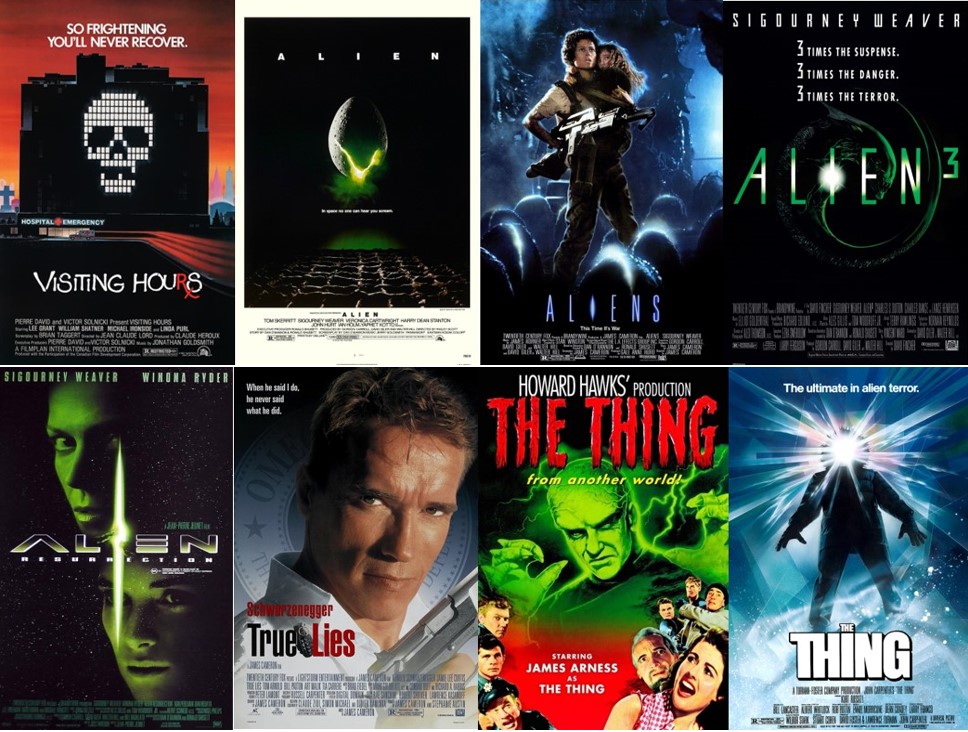
Visiting Hours (1982)
Visiting Hours is a Canadian psychological thriller directed by Jean-Claude Lord, that also sits comfortably in the slasher genre of horror films. It’s a film that I’ve only seen once before, and I remember not liking it. Well, I can confirm, my younger self was wrong.
Deborah Ballin (Lee Grant) is a feminist activist and television presenter. On air, she puts a misogynistic lawyer in his place as Deborah defends a woman who was on trial for defending herself against her abusive husband. Her friend and producer Gary (William Shatner, playing it straight here) is upset because Deborah went on the attack and didn’t remain impartial. Ah, those were the days.
The broadcast has drawn the eye of a misogynistic psychopathic killer, Colt Hawker (Michael Ironside), and he attacks her in her home, also killing the housekeeper. Neighbours come to her rescue, and Colt flees. Deborah is rushed to County General Hospital with cuts, a broken bone and surgery in her future.
Colt, after repeatedly entering the hospital, kills off any woman who’s supportive of Deborah, as well as a few men who get in the way. Until the inevitable confrontation between Deborah and Colt.
The psychological terror of the main character in this film, you can feel. For most of the film’s running time, Deborah is trapped in a hospital while Colt messes with her, killing off friends and her support. And Academy Award winner Lee Grant (yes, you read that right) does an amazing job here. You feel for what she is going through and you want her to succeed and be safe in the end.
Likewise, Michael Ironside is on point as the killer in this film. He just oozes sleaze and malevolence in every frame, chilling you to the bone. Not bad for a performance with hardly any dialogue.
A nice addition to this story, is the character of nurse Sheila Munroe (Linda Purl), who befriends Deborah. After a bad divorce, she is now in a same sex relationship, raising her children. And it is presented in a positive light. Something that didn’t get seen in the 70s and 80s all that often. While she becomes a target of Colt, she goes into Mama Bear mode and survives.
Well, worth a watch.
Alien (1979).
The Alien franchise is iconic in the sci-fi realm and in film history. So, with four films in the original series, let’s get started.
Onboard the commercial spacefaring tug Nostromo, the seven crew members are woken from statis by the ship’s computer, known as MOTHER. Captain Dallas (Tom Skerritt), Executive Officer Kane (John Hurt), Warrant Officer Ripley (Sigourney Weaver), Navigator Lambert (Veronica Cartwright), Science Officer Ash (Ian Holm), and engineers Parker (Yaphet Kotto) and Brett (Harry Dean Stanton) have all been woken early so they can investigate a mysterious signal of unknown origin. Upon reaching the source of the signal, a planetoid LV-426, they land with Dallas, Kane and Lambert venturing out in spacesuits to find the signal’s source.
They find a crashed alien spacecraft that looks like it has been there for some time. Inside they find a giant alien pilot (nicknamed the Space Jocky by the production) dead in his chair with a hole punched through his chest. They also come across a hole burnt into the floor leading down into another cavernous room. A room filled with leathery pod-like eggs. When Kane is lowered down to check it out, he gets too close to one and it opens, launching a creature like a fleshy mix of a spider and a grab at Kane. It smashes through his helmet and attaches itself to his face.
When Dallas and Lambert take Kane back to the ship, Ripley refuses to let them onboard citing company rules. But Ash disobeys and opens the door. This causes major tension between the crew. Finding they can’t remove the creature from Kane’s face without killing him, because the little critter has acid for blood, they monitor Kane and the creature and learn all they can. Later the creature falls off and dies, leaving Kane alive and well and with no memory of the events prior to the chamber on the ship. Later at dinner, an alien burst out of Kane’s chest, killing him, before racing off into the bowels of the ship. Waiting to exterminate the thing, they soon find it has grown to the size of a man, and starts picking them off one by one until only Ripley and the ship’s cats Jones remain.
Sci-fi horror films were nothing new when Alien arrived on screens in 1979, but they were never taken seriously. Apart from the original Godzilla, most of them were cheesy monster movies with atomic power and the cold war at the centre of the story. But as horror started to be taken seriously in the 70s, it was only natural to combine the two genres. Even if Alien was only greenlit because of the success of Star Wars.
Dan O’Bannon and Ronald Shusett’s script is full of ideas from all over sci-fi and horror, with many influences from novels, comics, film, and TV. But having H.R. Gieger come on board from very early on, (O’Bannon had Gieger’s designs in mind when writing), creating a movie monster that has been theorised about, critiqued, analysed, and then improved upon. Its biology is just as terrifying as its visage.
Ridley Scott, along with cinematographer Derek Vanlint, and the production designers, created a horror film full of atmosphere and tension, and like a classic road-based thriller, with nothing but empty space around them, the characters and the action are confined in an increasingly more claustrophobic structure. Having the sets be real, enclosed and as functional as possible sells that, as does the performances from the cast. Which is one of the best in the genre.
This film is often called a gothic horror or a ghost story in space. And I can’t say I disagree. That idea is telegraphed when you first see the Nostromo in space looking like a giant gothic cathedral. And the crew waking from stasis, evokes vampires rising from their coffins. It’s like gothic meets space age, and seeing that Ridley Scott always plans out his visuals, I don’t think either of these was an accident. And the visuals in the film are amazing. Ok, the explosion of the Nostromo at the end is a little weak.
It’s a film that starts slow and then ramps up to a fever pitch. Jerry Goldsmith’s score just adds to the effect with a mix of traditional orchestrations and romantic themes with an electric soundscape.
This movie was also the birthplace of the best female action hero in cinema.
I could talk about this film all day.
Sidenotes – Alien (1979)
In the Alien franchise, company Weyland-Yutani and its greed is just as big of a villain as the Xenomorphs. Maybe more so. Their mandate to seek out alien races and alien technologies to steal and/or destroy, for the company’s bottom line is what started this mess in the first place.
It starts in the original, with the computer MOTHER waking the crew from stasis to investigate a signal. MOTHER, whilst not A.I., is close. And company tech. When the company is informed of the possible hostile alien that they could use in their bioweapons division, it becomes all other objectives rescinded and crew expendable.
The company’s imperatives are embodied in the science officer Ash, who we find out is an android placed on the Nostromo by the company to protect their interests. And their interests here is procuring a xenomorph.
In the sequel, the company has a terraforming colony on LV-426, where the crew from the original found the alien spacecraft full of eggs. A salvage team to the coordinates, and find it they do. One of the team comes back with a face hugger attached. Starting the genocide of the human colonists. The aftermath Ripley and the Colonial Marines walk into. Burke, who accompanies them, doesn’t mind sacrificing everyone to get rich by bringing back a xeno. On both counts, it’s humans and facilities expendable. This could be the filmmaker commenting on the yuppy and consumer/business culture of the 80s. These business assholes were reading The Art of War like it was a manual for success. The corporation, like the alien hive, is every part working for the whole. But their goal is cult-ish and artificial.
In the third film, the company is not as evident, but it is a driving force moving Ripley along as she knows what is likely to happen when the “rescue” team arrives on Fury 161, that whole expendable thing again.
The fourth film, Weyland-Yutani is replaced with Combined Earth Military, but it’s basically the same cold heartless organisation. Money and military advantage trumps human life. They have to have the bigger dicks.
Ripley says it best: “You know, Burke, I don’t know which species is worse. You don’t see them fucking each other over for a goddamn percentage.”
Aliens (1986).
The film opens with a salvage team finding the Nostromo’s shuttle Narcissus floating in space. Inside they find the still alive and sleeping forms of Ripley (Sigourney Weaver) and Jones (the cat). When she wakes, she is in a space station hospital with stunning views of Earth, and a company rep Carter Burke (Paul Reiser) breaks the news that she has been sleeping for 57 years and her daughter Amanda is dead. After a hearing, she is stripped of her rank and flight status and blamed for the destruction of the Nostromo. The company man deciding her fate informs her that there are now hundreds of people living on LV-426 as it’s now a terraforming colony.
After the company loses contact with LV-426, Burke and Lt. Corman (William Hope) of the Colonial Marines, come to Ripley and ask for help. Accompany the Marines to the planetoid and advise them, and all rank and privileges will be restored. Still traumatised, she agrees on one condition. If the alien threat is there, they are to be wiped out.
On the spaceship Sulaco, Ripley, Burke and the marines wake up for stasis. We meet stoic bad-ass Corporal Hicks (Michael Biehn), over confident Private Hudson (Bill Paxton), science officer and android Bishop (the great Lance Henriksen), Sergeant Apone (Al Matthews), and the warriors of the group Privates Vasquez and Drake (Jenette Goldstein and Mark Rolston). There are others, but they are mainly alien fodder.
Landing, they get to work. They find the place deserted, evidence of a fight, makeshift barricades and strange burns on the floor. The only survivors are two face huggers in containment tubes in medlab and a frightened little girl named Newt (Carrie Henn), who has been using the air vents to stay alive. Ripley and Newt bond. And Burke, forever the company man, hatches a plan to take an alien back to Earth.
When the aliens reveal themselves, the marines fight back, losing many of their numbers. The rest make a plan, to escape the alien threat but also, they have to race against the clock to get off planet before the nuclear reactor goes critical. But the alien queen and her children won’t make their escape an easy one.
You would think that a sequel to Alien was a forgone conclusion, but it took 7 years before a follow up would be released. Mainly due to legal issues between 20th Century Fox and Brandywine Productions and no one at the studio thought a sequel had legs. But in 1986, James Cameron’s follow-up hit screens, pluralised no less.
If you have seen it, you will know that the sequel is a very different beast. The original had the pacing of a psychological thriller with a much slower pace. If the first was a haunted house in space, the sequel is definitely an allegory for the Vietnam war, but in space with creepy aliens. Superior technological force taken down by its opposite. Cameron’s sequel, while maintaining the sci-fi horror elements, is an action film. It is filled with gung-ho soldiers, guns, explosions, and a fast-paced story. But it also maintains the quieter dramatic moments and character development for all. It’s something that Cameron does better than most, you become invested in the characters, even the minor ones, and you feel it when they die.
While Bill Paxton’s Hudson steals every scene he is in, (and gives us on of the most quoted lines) and Lance Henriksen gives one of his best performances as Bishop, it’s the slowly evolving family dynamic between Ripley, Newt and Hicks that is the centre of the story and the element that sees them surviving the events. Because elements of family are present in this film more so than the original. Ripley finding out her daughter has died, and getting a second chance with this odd family unit are quite lovely. She feels she failed to be there for her daughter because of the events of the first film, and on some level, she blames the aliens. The alien Queen protecting her family is the dark mirror of this.
James Horner’s score enhances every scene perfectly, not bad considering he only had 3 weeks, and Stan Winton and his team effectively add to the aliens’ designs. This is a flawless sequel that delivers. Weaver was even nominated for an Oscar for her role in this. And it also gave us the most bad-ass line ever, “Get away from here, you bitch!”
Sidenotes – Aliens (1986)
There has been a lot said of the maternal nature of Ellen Ripley in the Alien franchise. The protective mother keeping her family safe. But I put it to you, in the course of the original four films that she had to become that warrior mother over time, and it wasn’t set in stone from the beginning.
In the first film, Ripley is part of a crew, and apart from her apparent friendship with Dallas, she doesn’t seem to be close with any of them. They are just ‘friends from work’. She seems more interested in doing her job by the book, than developing any lasting relationships on ship.
Her motivation is to get home for her daughter Amanda’s 11th birthday. Apart from this throw away piece of information, there is no other indication that she is maternal or even a hero, of any variety. She is just trying to survive the ordeal. She ends up starting to embody the maternal action hero that she is seen as, when, in the middle of a self-destructing ship, she goes back to rescue Jones the cat.
In the sequel, the pain and trauma Ripley goes through before returning to LV-426, is not only because of her encounter with the alien, but the feelings of guilt and failure at not being there for her daughter. Learning that her daughter had grown old and died while she was sleeping, adds to this.
The relationship she forms with the orphan Newt is her redemption of sorts. And the odd little family she ends up with by the films end of Newt, Hicks and Bishop, and them all sleeping peacefully, shows she has healed.
With rescuing Newt from the Alien hive, she evolves into the warrior action hero. She is set on burning the world down to find, for lack of a better term, her adopted daughter. Her only real obstacle is the Xenomorph Queen, who like Ripley, is protecting her family. It is one of the best action sequences ever put to film in my opinion.
When she again loses everything by the start of the third film, we feel her pain. We know it’s the end for her. One last act to protect other families is all she has left.
Alien 3 (1992)
After another 7 years, 20th Century Fox released another sequel in the Alien franchise. It hit screens in 1992, directed by David Fincher. It was not received well, and is still considered one of the weakest entries.
Set shortly after the events of Aliens, our survivors are sleeping in stasis on their trip back to Earth. Somehow, there are alien eggs on board. One of the face huggers causes a fire onboard. The ship’s computer seals off the stasis room, and since it also operates as a life pod, ejects it into space and programs it to head to the nearest planet.
That planet is Fury 161, a prison planet where the inhabitants have all been rehabilitated via a Christian fundamentalist faith. But the pod crashes and the prisoners rescue the only survivor, Ellen Ripley (Sigourney Weaver). The prison doctor, a former inmate, Dr Jonathan Clemens (Charles Dance), heals her wounds and when she wakes up informs her of her current situation.
After examinations on Hicks and an autopsy on Newt, to determine if there was an alien presence, she soon finds out that she has been impregnated with a new alien queen. Else were in the prison, an alien bursts out of a dog, and when grown to full size, starts picking off the prisoners. This further strains the relationship between her and the inmates, believing she and the alien are a punishment from God. After Clemens is killed, her only ally is Dillon (Charles S. Dutton), who convinces the prisoners to help Ripley kill the alien before the company reps/rescue team arrive on the planet. And the race begins, as does the screaming and the dying.
There are great actors in this film from America and England, such as: Paul McGann, Brian Glover, Ralph Brown, Danny Webb, Holt McCallany, Christopher Fairbank, Pete Postlethwaite, and Lance Henriksen reprising his role as Bishop and Bishop’s human creator.
Even with Fincher in the director’s chair and more money thrown at the production, this was a mis-step. Not only does everything look cheap, but the footage is edited badly, the SPFX doesn’t hold up, and the story logic is non-existent. Which is a shame, Fincher is a good director and there are good ideas here. Verdict: Skip it.
Sidenotes – Alien 3 (1992)
The making of this film would make an amazing film. Or at least a great book. The treatment of the film’s director, David Fincher, was so traumatic that he didn’t direct another feature film for three years. And he has disowned the film, not even returning to participate in the DVD and Blu-Ray Special Editions or audio commentaries. To find out more, check out these materials and the endless YouTube reviews.
Fincher isn’t the only one who didn’t have a good experience. Sci-fi novelist and father of modern cyberpunk, William Gibson, wrote an amazing script. Having a communist off-shoot creating their own empire and being at war with the Weyland-Yutani run Earth government was a nice touch. And having them encounter the Xenomorph and their eggs after boarding the Sulaco got the story rolling. Ripley is unconscious for most of the story, giving Hicks, Newt and Bishop control of the story. Many of the ideas about the origin of the Xenos, their continuing evolution, and how the company wanted to use them turned up in Alien Resurrection and the two Ridley Scott prequels. If you are curious about this story, the screenplay was published, and it was also adapted into a graphic novel and an Audible Original audio play with Michael Biehn and Lance Henriksen reprising their roles as Hicks and Bishop. I would have preferred this as the third movie.
Filmmaker Vincent Ward was the next one to tackle the script, and his idea of a strange wooden planet hanging in space with advanced technology at its core that none of the technology renouncing pacifist monks know how to operate, was an interesting idea. But a lot of this script was re-written into what Alien 3 became. And again, after watching documentaries on this aspect and doing some reading, I would like to see this too.
These are just three battles in the making of Alien 3, and none of them ended well for the creative artists who undertook them. The studio, trying to protect their investment, people who were not filmmakers, destroyed something wonderful. In the process, damaged their own I.P. and cause harm to the people they rely on to bring these tentpole attractions to life. And it hasn’t gotten better.
Alien Resurrection (1997)
At the end of 1997, Alien Resurrection was released at cinemas, directed by acclaimed French director Jean-Pierre Jeunet, and with Sigourney Weaver returning to her most iconic role.
Set 200 years after the events of Alien 3, military scientists on board the space vessel USM Auriga, led by Doctor’s Wren and Gediman (J.E. Freeman & Brad Dourif), have been using Ellen Ripley’s blood samples from Fury 161 to clone Ripley and the Xenomorph queen. The clone is the embodiment of Ripley, all her memories, feelings and her appearance. But also, something else. Even though the alien queen had been surgically removed, there has been some genetic crossover. Ripley now has increased strength, hearing, acid for blood, and the Xenomorph’s genetic memory. But Ripley is not the prize, just a side effect. The alien queen was the goal. And she has started producing eggs.
The military contracts the mercenary crew of The Betty for human test subjects for embryo implantation. The Betty’s grew, Captain Elgyn (Michael Wincott), Johner (Ron Pearlman), Christie (Gary Dourdan), Vriess (Dominique Pinon), Hillard (Kim Flowers), and Call (Winona Ryder) enjoy some R&R onboard the Auriga after delivering their human cargo. Call is carrying a secret.
In the lab, they lose control of the new Xenos. Ripley teams up with The Betty’s crew, a military grunt Distephano (Raymond Cruz), and Wren, to escape the ship and destroy it before it reaches Earth.
The fourth instalment is a little decisive, you either love it or you hate it. Personally, I love it. Unlike three, four went in a different direction but that direction was solidly built upon previous films. Along with cinematographer Darius Khondji, Jeunet delivers a visual feast of a movie that blends the elements of the first two entries with a crazy and dirty aesthetic more in line with his previous fantasy films. And it’s the reason I love this movie.
The cast is great, dialogue is quotable, John Frizzell’s music gives me chills, and the CGI elements are more competent then three. But it’s the new, improved but still traumatised Ripley that takes centre stage, and Weaver is the queen. The aliens are practical, as is the Xeno/Human hybrid at the film’s climax, which is stuff of nightmares.
Sidenotes – Alien Resurrection (1997)
There are just a few things I’d like to mention here.
While Jean-Pierre Jeunet was the director, all the major decisions were already made by the studio, and couldn’t be changed. So, he added his own look and feel to the film through the visuals, which cinematographer Darius Khondji and French effects wizard Pitof helped make a reality. And with the special effects and CGI crews, made the film look very different to the previous entries. Especially the colour palette. The sterile and cold blues and greys, mixed with Earth tones and greens. Both achieved mostly through lighting and costumes. And I like the way the light picks up on all the organic reflective surfaces, like water, blood, and the alien goo, of which there is a lot in this film. Just look at the sexualised imagery on display when you get to the alien hive.
Jeunet also uses kinetic camera movement and odd camera angles throughout the film which inform the action and horror element better than the first and third instalments.
There are a number of scenes where the Xenos are completely CGI. While some are jarring, some work well, and are their best in the underwater sequences, giving the Xenos a shark or eel like quality thanks to their tails.
But one thing that isn’t CGI, but all practical, is the Xeno/Human hybrid called The Newborn. It is a fully designed and articulated puppet. The amount of movement in the facial expressions, coupled with the sounds the creature makes, are frighteningly effective. It’s like a toddler from hell.
Joss Whedon’s script, while tailoring the story for what the studio wanted, has some great ideas and themes, but the dialogue is flat, with the exception of that spoken by the characters Johner, Vriess and Elgyn. But Weaver does get some good lines too. I watch this film now and I can’t help thinking that the crew of The Betty was an early run though for what would later become Firefly.
While I did mention in the main review that the film had quotable dialogue, it has only a few memorable lines, and they are not as epic as “Get away from her, you bitch!”. The script, personally, is where the film alternately fails.
True Lies (1994)
True Lies is an Action Comedy that I first saw when it was first released in cinemas. Then, as now, the enjoyment I have watching the film should be illegal.
Arnold Schwarzenegger plays Harry Tasker, a U.S. government agent/ super spy who struggles to balance his clandestine job with his life as a husband and father in suburbia. His introduction is on a mission where he is infiltrating a heavily guarded mansion in the middle of a party, to steal data. Harry’s best friend and partner in the agency, Gib (Tom Arnold) is running tech support in a nearby van with Faisil (Grant Heslov). To distract security on the way out, Harry tangos with sexy archaeologist Juno (Tia Carrere). Then there are explosions.
The data they retrieved points to a terrorist organisation, Grimson Jihad, led by Aziz (Art Malik), using Juno’s diplomatic connections to smuggle nuclear warheads into the United States to make a destructive statement.
What throws a spanner in the works, Harry finds out that his wife Helen (Jamie Lee Curtis) is having an affair. Which isn’t the case. She is being scammed by a car salesman who is trying to sleep with her. Harry uses his agencies’ resources to follow and spy on his wife and the sleazy Simon (Bill Paxton).
But the terrorists are not so distracted. They kidnap Harry and Helen for interrogation. Our heroes escape in a great sequence, but have to jump into action when Aziz’s big statement also involves kidnapping Harry’s daughter Dana (Eliza Dushku).
His film is what a fun cinematic experience should be. Directed By James Cameron, proving he can do comedy, it’s a perfect mix of action and comedy with everyone in the cast getting moments in the sun with the comic, dramatic and action elements. Jamie Lee Curtis even won a Golden Globe for her role. Curtis herself performs the film’s best stunt, for real. That is actually her hanging from the helicopter when her character is being rescued from the Florida Keys.
Arnold is believable as the family man/spy, and delivers the comedy better than any of his comedy film outings. But it’s Tom Arnold who steals the show with his improved and amazing line delivery.
Sidenotes – True Lies (1994)
Doing some reading on this 90s action classic, I found out a few things I have to mention.
Did you know that this is actually a remake? Well, it is. Cameron’s script was based on the screenplay for a French 1991 action comedy called La Totale! Written by Simon Micael, Didier Kaminka and Claude Zidi, who also directed. The Schwarzenegger remake follows many of the same story beats, but ramps up the action in true Hollywood style. I’ve only seen the trailer for the French film, but it is now on my list of movies to track down.
The items I found out were not always nice ones. In 2018, Eliza Dushku, who plays Dana Tasker, revealed that as a twelve-year-old working on the film, she was sexually molested by the then thirty-six-year-old stunt coordinator Joel Krammer. After an adult friend of Dushku’s confronted Krammer about this, Dushku was seriously injured in a stunt. When the director James Cameron and stars Schwarzenegger, Jamie Lee Curtis and Tom Arnold found out about it in 2018, they all stood behind her and praised her for her bravery. I think if Cameron found out about it back then, Krammer would have fallen victim to one of his own stunts. You don’t mess with Cameron or his stars. I considered Dushku an icon of sci-fi fantasy, now I think she deserves the title ‘Legend’.
Jamie Lee Curtis’ role, and the actual stunt she performed hanging from the bottom of a helicopter, are amazing, many critics at the time had issue with the sexy strip tease dance she does in the hotel room. That sequence has become iconic, and is now seen as a feminine empowerment moment. It was Curits who worked out exactly how that scene would be played out. Including all the mistakes her character makes.
And finally, did you know Schwarzenegger was nervous about performing an important element in his film. And not, it wasn’t the comedy. It was dancing. He trained for six months to be as good or better than Al Pacino was in Scent of a Woman at the tango.
This film is amazing. All the principal cast are still friends to this day. While no sequel materialised, there is a new TV series.
The Thing From Another World (1951)
John Carpenter’s The Thing wasn’t the first film to adapt John W Campbell’s 1938 novella “Who Goes There?” into a feature film. Released by RKO Pictures, produced by the legendary Howard Hawks, and directed by Christian Nyby, this nail-biting sci-fi horror film was released in 1951, in the middle of cold war paranoia.
The film centres around a group of US Air Force personnel, scientists and civilian crew at an Arctic research station investigating a crashed flying saucer buried in the ice. When the thermite charges they use to retrieve and examine the downed spacecraft inadvertently cause it to self-destruct, they start to head back. They discover a humanoid shape frozen in the ice. Playing it safe this time, the crew cut the alien out of the ice and transported it back to base.
While at the facility, the ice melts thanks to an electric blanket keeping one of the guards warm, and the alien begins to kill. Starting with the sled dogs. The scientist soon discovers that the alien is not an animal, but a plant. A humanoid, intelligent vegetable who feasts on animal protein, specifically blood. With the members of the research station now on the menu, they all band together to defeat the ‘walking carrot’ and win the day.
Okay, it does sound a little silly compared to the 1982 remake. But I assure you, it is actually a really good film. The black and white presentation allows for more interesting creature effects, for the time anyway, and the use of light and shadow with the black and white photography, is as stunning as it is atmospheric.
The cast of characters are the stock standard collection of sexes, ideological views, educational achievement, and socio-economic backgrounds. And they are all played by character actors and old school sci-fi stock players.
Robert Nichols and Douglas Spencer from This Island Earth, Kenneth Toby from everything, and the monster is played by future western TV icon James Arness.
There are many of Howard Hawks signature touches here too. The overlapping dialogue, conflicting authority figures and a strong female character (often called the Hawksian Woman).
It is an important film in science fiction, despite the killer vegetable. And still an enjoyable watch.
The Thing (1982)
In Antarctica, a team at an American Research Station witnesses a helicopter chasing a shed dog. The Norwegian’s onboard from a nearby research station, are shooting at the dog and dropping explosives to kill it. When the helicopter lands at the American camp, it doesn’t end well for the Norwegians. The dog is rescued by the dog handler, Clarke. Pilot MacReady and Dr Copper head to the Norwegian camp to investigate.
Once there, they find charred and frozen corpses, a giant block of ice that once had something large inside it and a burnt corpse of a malformed humanoid. Which they bring back to the American station for biologist Blaire to examine. This is the body of an alien creature that assimilates any living thing it touches and copies them completely. It only needs a few active cells to do this. Between the corpse and the rescued sled dog, the assimilation begins. The story becomes one of paranoia and survival as the creature hides in plain sight waiting to find a larger population and the human’s try to find all of this alien threat and destroy it before it gets to a large population.
This film is one of the best sci-fi horror movies ever made. A box office failure when it was first released, it has become a certified cult classic being studied, analysed, and discussed since it landed.
Like The Thing From Another World, this is also based on John W Campbell’s Who Goes There?, but it’s not a remake of the original film. To use a contemporary phrase, it’s a re-imagining, with callbacks and homages to the 1951 film. Directed by John Carpenter (my favourite filmmaker) he uses his amazing talent to bring this story to twisted life. With a script by Bill Lancaster, cinematography by Dean Cundey and music by the legendary Ennio Morricone, he crafts a tale that is visual stunning, but ultimately terrifying with the performances of the ensemble cast of character actor as front and centre as that of the creature effects created by the great Rob Bottin, which are some of the best put to celluloid. I seem to watch this twice a year, including the documentaries. I recommend it to every human and non-human on the planet.
Sidenotes – The Thing (1982)
This film has one of the best ensemble casts of any sci-fi horror film. Especially for the time. It’s a mix of film, television and theatre characters actors. And everyone gets a moment to shine. We have Kurt Russell, Wilford Brimley, Keith Daivd, Richard Masur, T.K. Carter, David Clennon, Richard Dysart, Charles Hallahan, Peter Maloney, Joel Polis, Thomas Waites, and Donald Moffat (who has my favourite line in the whole movie). And that line is, “I know you gentlemen have been through a lot, but when you find the time, I’d rather not spend the rest of this winter TIED TO THIS FUCKING COUGH!”
The Thing when it was first released, was a box office flop. Opening against E.T.’s box office strong hold, audiences were put off by the bleak story and the gory effects. And the critical reception wasn’t much better. Critics attacked its gory effects, tone, and characters. Vincent Canby, called it “too phony looking to be disgusting. It qualifies only as instant junk”. Dave Kehr wrote that it was “hard to tell who’s being attacked, and hard to care.” Likewise, Roger Ebert was disappointed by the “superficial characterizations and the implausible behaviour” and dismissed the film as nothing more than an Alien (1979) knockoff. All bullshit, and time has proven this. The film has gone on to be not only a cult classic, but one of the finest examples of the sci-fi and horror genres. It’s also John Carpenter’s favourite of all his films.
The studio that made The Thing, cancelled their multi-picture deal with Carpenter. Projects were cancelled. The only reason he took on the directing duties on Christine (1983), is because he needed a job, and so far, it’s one of the only studio experiences that didn’t end in disaster for Carpenter because of either box office or studio executive interference.
Carpenter is a storyteller. It’s a simple enough moniker for this creative cinematic titan. But the way he tells his tales is unique, and has influenced other filmmakers, writers, and artists. The Thing, like Ridley Scott’s Blade Runner, has influenced in, of been homage by, other creatives and their work.
Not bad for a man who was once called the Pornographer of Violence.
-
Films With Friends Collection Part 3: The Search For Spock
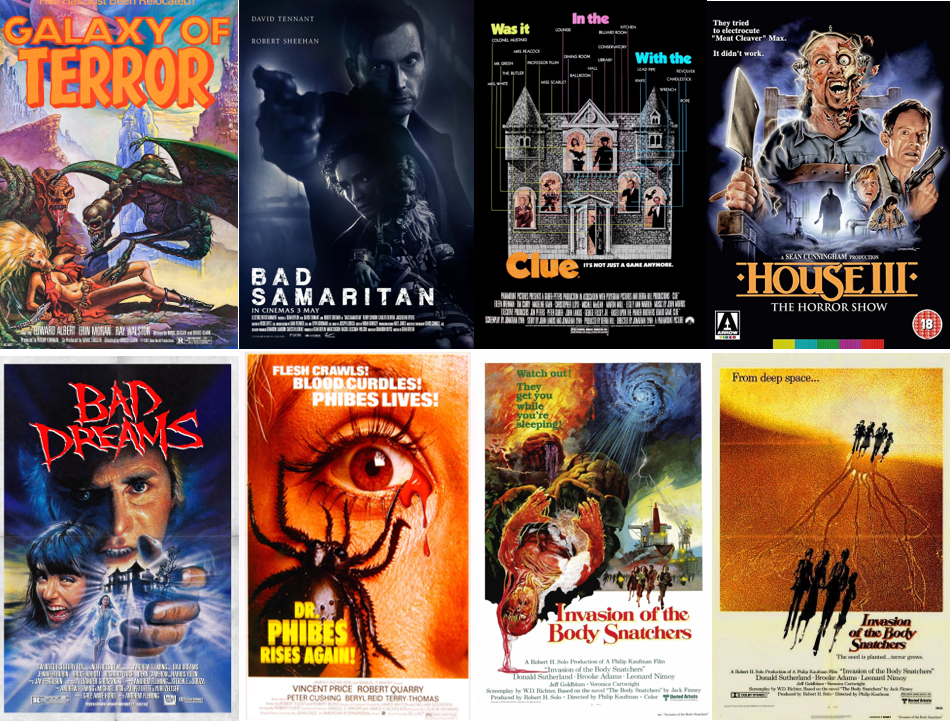
Galaxy of Terror (1981)
When your friend discovers a movie they haven’t seen, sometimes you just wanna be there and watch it with them just to see their reactions to the film. And today’s film is just one of those.
Galaxy of Terror is a 1981 sci-fi horror film from New World Pictures and Roger Corman. Usually called one to the Alien knock-offs that flooded the cinematic landscape, but that is selling the film short.
The story opens with the sole survivor of a mission on the planet Morganthus, being stalked and killed by an unseen killer. On the planet Xerxes, Planet Master, a mystic and leader, sends one of his military commanders to Morganthus, with a team, on the ship Quest, to investigate the lost mission. After crashing on the planet, the crew investigate the surface and a strange looking pyramid they find there. Inside, each member of the crew falls victim to their own worst fears made real.
The team is the classic rag tag team that covers the spectrum of the socio-political and cultural of the times. The characters are, over the hill commander (Bernard Behrens), the ‘hero’ Cabren (Edward Albert), his love interest and ship psychic Alluma (Erin Moran), ships mysterious cook Kore (Ray Walston), by the book asshole second in command Baelon (Zalman King), technician Ranger (Robert Englund), technician and pin up girl for the film Dameia (Taaffe O’Connell), warrior Quuhod (Sid Haig), the first to die Cos (Jack Blessing), and unhinged pilot Captain Trantor (Grace Zabriskie). All genre favourites and character actors.
The production shines, even if the direction and the story at times does not. The alien world and sets are very Gieger like, which is where, along with the diverse crew, the Alien comparison comes in, but this is a different beast altogether. On a small budget, the creatures and the special effects are just wonderful, and still hold up, even in HD. While one creature looks like a melted genetic experiment of a donkey and a lizard, all the deaths, especially the giant maggot death (you read that correctly) are executed masterfully. And why shouldn’t they be, James Cameron was responsible for those.
Not the best, looks amazing.
Bad Samaritan (2017)
Ever since David Tennent took over the Timelord duties in Doctor Who, there hasn’t been a role or genre he hasn’t tackled. I’ve always gone out of my way to watch everything he has appeared in or lent his voice too. The first season of Jessica Jones, and Good Omens are some of my favourites.
So, when I found out he did a small American independent film directed by Dean Devlin, my ears pricked up. And considering I heard about this film in 2020 and it was made in 2017, I wondered why it took so long. After a brief search, I landed a copy.
This crime thriller starts out with artist Sean Falco (Umbrella Academy’s Robert Sheehan) and his girlfriend Riley (Jacqueline Byers) sharing some quality time. Sean works as a valet with his best friend Derek (Carlito Olivero) at an expensive Italian restaurant. But they have a side hustle. The boys, before parking their cars of the restaurant’s patrons, drive to their houses with the use of GPS tech in most high-end cars and robs.
The second score of the night comes when Cale Erendreich (David Tennent, struggling with the American accent) pulls up in his Maserati (someone should have told him the 80s are over), and acts like a massive dick. But when Sean takes the car and arrives at Cale’s house, he finds something rather disturbing. A young woman, Katie (Kerry Condon) bound, gagged and chained to a chair in Cale’s blacked out office surrounded by security cameras. Sean freaks out, and after failing to free Katie, heads for the police.
But Cale is the smart and imaginative kind of psychopath. And as Sean goes from authority to authority to get someone to listen to him, Cale starts to systematically destroy Sean’s life. His family is financially ruined, and Derek and Riley attack.
While the climax is amazing and a little refreshing, it’s the performances that keep you watching. The story, while has an interesting idea, of a nutter using modern technology to carry out his plans (which I’ll keep secret), is where the film is let down. It never reaches the heights aimed for. There is a great film in here somewhere. As it is, this is just okay.
Clue (1985)
It always surprises me that films that fail at the box office on their initial release, become some of my favourites and cult classics. The endlessly quotable black comedy mystery film Clue, is one just film. Based on the classic board game of the same name (well, it’s called Cludeo out here), this comedy that constantly appears on the best comedies of all time lists, just missed the mark, only making $14.6 million on a budget of $15 million. Missed it by that much.
The film opens with the butler Wadsworth (the flawless Tim Curry) arriving at a mansion to prepare for a mysterious dinner party. The other servants, the maid Yvette (the busty Colleen Camp) and the cook Mrs Ho (Kellye Nakahara), are also preparing. As the guests arrive as instructed by letters, they all received, they all have been given pseudonyms for the evening. All the characters are here: Mrs Peacock (Eileen Brennan), Mrs White (Madeline Kahn), Professor Plum (Christopher Lloyd), Mr Green (Michael McKean), Colonel Mustard (Martin Mull), and Miss Scarlet (Lesley Ann Warren). The dinner party gets under way as they await Mr Body (Lee Ving) and the revelations that every guest is being blackmailed by My Body. When Mr Body seems to be killed, the comic insanity begins as the guests and staff try to figure out what happened and what is going on.
Directed by Jonathan Lynn (Nuns of the Run, My Cousin Vinny, The Whole Nine Yards) and co-written by Lynn and John Landis, I always wonder what exactly was scripted and what was improvised by this cast of comic talent. Because this movie is laugh out loud funny, quotable as hell, and features three endings. When originally released, different cinemas showed different endings. An odd piece of marketing, but home video releases had them all.
The word play is one of the best in 80s comedies. Tim Curry’s manic energy in the last third as he races around replaying the entire film in an effort to figure out the mystery, is the highlight of the film.
Random Quote:
– Wadsworth: I suggest we take the cook’s body into the study.
– Colonel Mustard: Why?
– Wadsworth: I’m the butler, I like to keep the kitchen tidy.”
House 3: The Horror Show (1989)
Entries in the House franchise have never been connected. Except for the central location of a house and ghosts of some description. One was horror comedy, two comic fantasy, but three one is horror all the way.
Directed by Jim Isaac (Jason X, Skinwalkers), this film sees Detective Lucas McCarthy (Lance Henriksen) and his family tormented by the recently executed serial killer Max Jenke (Brion James). The film opens with Lucas and his partner finally apprehending Meat Cleaver Max, but that is revealed to be a nightmare Lucas is having. Giving the impression the killer in this film is a riff on Freddy Kruger. But after watching Max executed in the electric chair, Lucas thinks it’s over. But Max has become a ghost, one based around electricity, that can physically interact with the physical world but can’t be hurt. Well, that is what parapsychologist Peter Campbell (Thom Bray) tells Lucas. He needs to be electrocuted for the ghost to become real. Apparently.
This film is damn amazing, and strangely pretty much unknown except by horror fans. The atmosphere is spooky, the tension remains thick, the creature and makeup effects are so inventive, memorable and well executed (the turkey scene anyone?), and the story is peppered with a sense of malicious fun from the villain.
The performances here are amazing, it makes you a little sad they were not recognised. Henriksen is always magnetic to watch on screen, but he is overshadowed by Brion James’ performance, who just seems to be having a fun time bringing Jenke to life. And his laugh is creepy as hell. Rita Taggart as Donna McCarthy is on point and has a lot to do in what could have been a nothing role. Dedee Pfeiffer and Aron Eisenberg are perfect as the McCarthy teenagers and have their own little character quirks. Character actors Matt Clark and Lewis Arquette pop up as Dr Tower and Lt. Miller respectively, and a cameo by Lawrence Tierney as the prison’s warden steals the scene with just his face.
This film may have similarities to the Nightmare on Elm Street franchise (It is called a knock-off), but I think it’s different enough to stand on its own as a horror classic.
Bad Dreams (1988)
Now Bad Dreams is another one of those films that is lumped in with the Nightmare on Elm Street Knock-offs or clones. But I think that is very unfair to this flick. It is a different beast, albeit with some similarities.
The film centres around the survivor of a cult called Unity. In the 1970s, their leader Harris (Richard Lynch), while preaching love and connection, douses himself and everyone else in fuel and burns them alive. Except young Cynthia (played by Melissa Francis in the flashbacks), who is rescued but remains in a coma for thirteen years.
When Cynthia wakes in 1988, (now played by Jennifer Rubin), she finds herself in hospital and later in a psychiatric hospital, because she has no memory but has nightmares of Harris. She is placed in group therapy with a bunch of patients that fill the quarter of cinematic oddballs, led by Dr Alex Karmen (Bruce Abbott). The head of the hospital, Dr Berrisford (Harris Yulin) also has a special interest in her case. But as Cynthia starts to remember more about her past, she is seeing visions of Harris, both as he was and as a horribly burnt nightmare man. And her visions of Harris directly proceed with her fellow patients and staff dying in gruesome ways. But is it really Harris back from the dead, is it Cynitha or one of the medical staff doing the killing?
While being called a knock-off of Elm Street 3, especially since they case Rubin from that entry and it takes place in a hospital, is a different kind of horror film, Despite the similarities. This is a psychological film masquerading as a slasher film. And after a WTF moment is expertly explained, the film takes a left turn. And in the wildly creative time of the 1980s, this stands out for me.
Director Andrew Fleming and cinematographer Alexander Cruszynski use the hospital set well, but the transitions from set to the brightly lit California of the 70s are wondrous and dream-like. If not unsettling.
Apart from the main cast being on point, extra mention to Dean Cameron as Ralph and a cameo by the voice of Roger Rabbit himself Charles Fleischer as a fast-talking pharmacist.
Highly recommend.
Dr. Phibes Rises Again (1972)
Okay, you knew talking about the sequel to The Abominable Dr. Phibes was going to happen. So, here it is.
One year after the original graced cinema screens, director Robert Fuest and star Vincent Price returned for Dr. Phibes Rises Again. And we all should be grateful. Returning is the strange mix of tongue in cheek humour and horror filtered through psychedelic and camp imagery. While it does have the same level of humour as the first, everyone is having so much fun here, regardless of the film’s flaws.
The first film saw Phibes taking revenge on the doctors and medical staff he felt were responsible for the death of his wife and his own disfigurement. In the sequel, Phibes, newly resurrected for three years, sets out to travel to Egypt to find the River of Life, fabled to give long life and restore the dead. But upon waking, with the aid of his mute and beautiful assistant Vulnavia (Valli Kemp), he finds his house which had hidden his underground crypt, has been destroyed. And the safe which held the ancient scroll has been ransacked.
Phibes tracks the scroll to a collector, Darius Biederbeck (Robert Quarry) who has his own reasons for finding the River of Life. After a few imaginative murders, Phibes has what he needs and heads to Egypt. But so is Biederbeck, who already has a dig in progress. And so, the battle of wills begins, with workers and friends caught in the middle.
Also returning to the sequel is Detective Inspector Trout (Peter Jeffery and his amazing nose) and his superior Superintendent Waverly (John Cater), who are once again after Phibes. Some good new additions also include the beautiful Fiona Lewis as Diana Trowbridge. As well as Peter Cushing and Terry-Thomas in small but memorable roles. Plus, a small non-speaking part for Inspector Morse himself, John Thaw.
While Phibe’s main adversary is kind of bland, he does look like a camp vampire lounge singer, so that’s something, I guess. But Price delivers a good performance and the director delivers the eye-popping visuals.
Not as good as the original, but still twisted fun. 9/10 melted faces.
Invasion of the Body Snatchers (1978)
There are a few great films that are often called remakes, and cited as good examples of such. Films like The Thing, The Fly, The Blob (all in the 80s), and today’s film, the 1978 sci-fi film Invasion of the Body Snatchers. This is a different interpretation of the original Jack Finney novel. But it also has influences from the 1956 film of the same name directed by Don Siegel.
If you don’t know anything about the story’s premise, basically, alien pods or spoors (depending on the version) arrive on Earth and grow. They grow into duplicate humans, perfect in body and mind, when someone falls asleep in their proximity. But they have no emotions. They plan to replace us as the dominant species.
The film kicks off with the spoors arriving on Earth, and attaching themselves to the planet life in San Francisco with some marvellous practical effects. And they start duplicating. Scientist Elizabeth Driscoll (Brooke Adams) brings one of the small pods home with her because of the pretty flower blooming from it. Her boyfriend Jeffery (Art Hindle) wakes up the next day as a pod person. Her best friend and city health inspector Matthew (Donald Sutherland) tries to help her, even as he notices strange things going on. He takes her to see his friend and pop psychiatrist David Kibner (Leonard Nimoy) at a book signing. Kibner makes the idea of duplicates seem ridiculous and offers other, more sound reasons for what Elizabeth is feeling. We also meet Matthew’s friend and struggling poet Jack (Jeff Goldblum) who hates Kibner’s work with a passion.
Across town, Jack’s wife Nancy (Veronica Cartwright), works in the spa she owns, and after a few weird goings on, finds a strange grotesque body in one of the stalls shortly after Jack arrives. They call Matthew. They examine the body. It is similar in height and weight to Jack, even a similar face, but not details. Like it is unfinished. After they call Kibner in to help, the action really gets going as Matthew, Elizabeth, Jack and Nancy go on the run as people are changing all around them. Can they get out of the city before it’s too late?
The way the film is structured, it isn’t always obvious when a character has been duplicated. This adds to the tension of the protagonist’s plight as the film goes on. And it’s fun to rewatch the film and figure out when the change happens. Director Philip Kaufman (The Right Stuff, Henry & June, Rising Sun) handles the material seriously and with respect. And a lot of the time the film comes off more like a political thriller from the 70s than a sci-fi film. W.D Richter’s script works well with the existing elements in a new location, from small town of the original to big city and writes the dialogue for the individual characters nicely to separate them from each other. Which makes the uniform way the pod people talk after they turn all the more unsettling. The camera work by Michael Chapman, while utilising film noir lighting on occasion, and the use of seemingly out of place camera angles (oh, and POV steadicam work), give the film an engaging visual quality that isn’t distracting and informs the emotional state of the characters. And the experimental score by Denny Zeitlin (his only film score) is amazing and a cult classic on its own.
The low budget didn’t stop them from creating some visually great and disturbing practical effects for the pod people transformations. It is dangerously close to Cronenberg style body horror, and creeped me the fuck out when I watched it as a 12-year-old. A pure triumph of genre filmmaking. And while it is maybe heresy to say this, I prefer it to the original film. Sorry film snobs.
Under the surface, the film is an examination of paranoia, loss of identity, and the effects of lack of sleep on the human body. And all versions of the story have a connection to a big cultural and political fear of their time. The story and themes are similar to Robert A Heinlein’s The Puppet Masters and the film adaptation, and Robert Rodriguez’s teen sci-fi horror film, The Faculty. They all ask, who can you trust? And in this story, that fear is real.
-
Films With Friends Collection 2: Electric Boogaloo.

The second set of reviews originally posted to social media detailing the eclectic and baffling taste in film by myself and my long-suffering friends. Enjoy.
The Batman (2022)
Yeah, I know. I’m a bad movie/comic book geek. I only got around to watching this film a week ago, despite the fact that I had bought the film on disc before Christmas. It was one of those very busy periods, struggling mental health journeys and concern about R-Patz stepping into the Bruce Wayne/Batman role. And especially with this last one, much like the Heath Ledger Joker concern, my worries seem silly now.
Wow!
I enjoy this movie on so many levels. This film is set up like a Murder Mystery/How Done It with a dash of the hunt for a serial killer. Yeah, I know. A film about the world’s greatest detective (no, not Columbo) who actually does some detecting.
Set in the second year of Batman’s (Robert Patterson) existence as a crimefighter, we see he is already a known commodity in Gotham. He is affecting the way criminals operate and he has a working relationship with James Gordon (Jeffery Wright), here a Lieutenant, as he is brought in to consultant on the recent death of the mayor by a character, we later find out is The Riddler (Paul Dano).
This leads the Batman on a investigation wear he meets Selina Kyle before Catwoman (Zoe Kravitz), mob boss Carmine Falcone (John Turturro), and he under boss Oswald “The Penguin” Cobblepot. The investigation also leads to secrets about his parents Thomas and Martha, that my tarnish Bruce’s memory of them. Alfred, played perfectly by Andy Serkis, is the only constant in his life, and the best parent you could hope for.
Personally, I didn’t think Matt Reeves could direct this movie. I was wrong there too. Handling the technical side and story and performance side of production wonderfully. While, I do have notes, they are not many. Grieg Fraser’s cinematography is fucking amazing. Hitting every shot like is a moving painting of mayhem. He truly commands light and shadow, like a wizard of silent film.
I do rate this. Highly. Can’t wait for the next one.
Cocaine Bear (2023)
Sometimes when you go to the cinema, you want an event. Or at the very least something odd and fun. When myself and one of the best humans on the planet headed to the air-conditioned comfort of the movie theatre, that is exactly what we got in Cocaine Bear. After the trailer was a jaw dropping WTF moment, we had to see this.
The film is loosely based on a true story of a black bear that ingested 75 lbs or 34 kg of lost cocaine in a national forest in 1985 and died of a resulting overdose.
These facts, except the bear dying, are all elements in the story within the film. Drug smuggler Thronton (Matthew Rhys) coked up, dumps millions of dollars of cocaine out of the plane into the national forest. But he doesn’t make it. The bear finds cocaine, eats it and goes apeshit. Attacking anyone it finds, and searching the forest for more of the white powder.
Syd (Ray Liotta, in his last role) tasks Daveed (O’Shea Jackson Jr) to collect his grieving son Eddie (Alden Ehrenreich) and get into that forest and find the drugs before the drug cartels find out.
Also crossing the bear’s path are detective Bod (Isiah Whitlock Jr), trying to find the drugs, two park rangers, two hikers (one played by GOT star Kristofer Hivju), three delinquent punks, two paramedics and a worried mother Sari (Keri Russell) trying to find her daughter Dee Dee (Brooklynn Prince) and her friend Henry (Christian Convery).
Now, if you didn’t already know, this is a comedy. An irreverent dark comedy that plays not only on the nature run amok and slasher genres, but also on your expectations. It’s almost like a ‘what if’ that got out of hand, or a coked-up movie pitch that went too far. Either way, this movie is wild. It has cult classic written all over it. The scene with the paramedics is my fav. The CGI elements to the bear are not distracting. And the soundtrack is freaking amazing. This is Elizabeth Bank’s best directorial effort so far and I hope she gives us more like this inspired lunacy.
5 out of 5 severed limbs.
Tales From The Crypt (1972)
Years before cable television, Warner Bros and a group of talented producers created one of the best and most iconic television shows in modern history based on EC Comics, a little British production studio gave it a shot.
In 1972, Amicus Studios, Hammer Studios major competition, made an anthology horror film based on stories from the (also) iconic comics book series. Directed by Oscar winning cinematographer Freddie Francis, the film is made up of five stories with a linking wrap around.
That is, a group of five tourists enjoying a guided tour of historical caves, get separated from the others and find themselves in a larger chamber with a stone throne. And on that throne is the Crypt Keeper (Sir Ralph Richardson). And one by one he shows them each the manner of their ending
Story #1 Joan Collins gets shown a terrifying Christmas nightmare after she kills her husband. Story #2 A businessman leaves his family for his secretary only to get into a car accident, wakes up with everything different and finds he was dead all along. #4 This is a rift on the old monkey’s paw tales, but in a middle-class English household. #5 Being the most vicious tale, it takes place in a home for the blind, as the patients get bloody revenge on the new head of administration. But it is the 3rd tale which is the most effective. This revolves around an arrogant elitist who takes a dislike to a kind old garbage man who lives across the road. The old man (Peter Cushing), opens his home to everyone in the neighbourhood, especially children as he and his late wife never had any of their own. But his neighbour thinks he is basically an eye saw, and systematically destroys his life. And it seems to end the old man’s suicide. That is until the old man comes back from the grave. Cushing’s zombie makeup alone is worth admission.
Old school British horror is a weakness with me. It’s bloody, atmospheric, a little campy, and always packed with good performances. It’s like comforting childhood cartoons for this horror geek.
Castle Freak (1995)
This little horror film was produced and released by the amazing Full Moon Features, led by the only independent filmmaker to rival Roger Corman, the beautiful oddball that is Charles Band. If you don’t know Full Moon or Charles Band, the google search bar awaits you.
But this film also reunites cult director Stuart Gordon with his Re-Animator/From Beyond leads Jeffery Combs and Barbara Crampton. It’s also the third HP Lovecraft adaptation from the trio.
The story centres around John Reilly (Combs) and his family as they travel to Italy to take possession of a castle that John has inherited. But hidden in the castle is a secret (isn’t there always). John’s half-brother Giorgio, thought dead as an infant, who had been beaten and torture by his mother Duchess D’Orsire from a young age, has been transformed into a brutal and deformed monster. And he is still chained up in the bowels of the castle. And of course, he frees himself when the new arrivals move in, and not understanding the world, wreaks havoc.
Another element to the tale which is a story that works well is that John is a recovering alcoholic after hitting rock bottom with a car accident that killed his young son and blinded his teenage daughter Rebecca (Jessica Dollarhide). Something his wife Susan (Crampton) can’t forgive him for.
This is not as iconic a horror film as Re-Animator or From Beyond, and is not a great film compared to the other at all (probably down to budget) but it is a good story and damn entertaining. Combs and Crampton’s performances elevate all. The film’s themes of grief and redemption are well grafted as is the idea that the damage parents can inflict on the children can have devastating effects.
The gothic visuals are amazing as they set an old school horror feel to a modern story, and it is largely down to filming in a real European castle. The creature and make-up effects deserve a mention, as they are some of the best I have seen in a straight to video film of the 90s. Bloody Marvellous.
Blood Simple (1984)
Blood Simple, is simply put, a classic film. At least in my little twisted little mind. This American neo-noir crime thriller was written, directed, produced and edited by (under the name Roderick James) Joel and Ethan Coen. After watching the film for the first time, you may be surprised that it was the duo’s debut feature. It shocked me. The film is stunning.
It is a simple story, but some of the best olds are. Ray (John Getz) and Abby (Francis McDormand) are in love and having an affair. And Abby’s husband, the rich and sleazy bar owner Marty (Dan Hedaya) is not happy about it. He hires a PI, Loren Visser (M Emmet Walsh) to find them. Which he does, complete with photos. After Marty is humiliated when he tries to get revenge, he hires Visser again. This time to kill the pair for the grand sum of $10,000. But Visser double crosses Marty, and sets in motion a course of events that not only puts the lovers in compromising situations, test their love and faith in each other, but also puts them in Visser’s crosshairs.
The film has been celebrated for its cocktail of neo-noir (Film Noir with the lights on), pulp crime fiction and low-budget horror. The last one can be seen in the use of shadows smoke in certain shots, moving cameras and extreme close ups used throughout the film. The Coen’s replicated some of these from the film of their friend and horror movie icon Sam Raimi’s Evil Dead.
A big shout out to the climax of this film. Not only are the performances from Francis McDormand and M Emmet Walsh amazing and vesical, (this also being an against type role for Walsh), but the cinematography by future director Barry Sonnenfeld make this ending one film geeks go ape crazy and film academics have analysed for years. Still one of my favourite endings. EVER.
If you are lucky enough to have the DVD or Blu-Ray, check out the fake trailer the Coen’s made to sell the film to investors, featuring a blink and you’ll miss him, Bruce Campbell.
The Abominable Dr. Phibes (1971)
Okay, when old horror hounds sit down and watch a movie, there is no telling what we are going to choose. Silent era maybe, or a universal monster flick? A Hammer horror classic perhaps, or something more serious and art house? No, this time he watched a little cult film from American International Picture neither of us had seen. The Vincent Price vehicle The Abominable Dr Phibes.
Directed by Robert Fuest, the film sees Price’s Dr Phibes killing off doctors and medical staff he deems responsible for the death of his wife (an uncredited Caroline Munro) following a car accident that left him without a face. His killing spree is inspired by the ten plagues of Egypt from the Old Testament. He even leaves amulets featuring Hebrew characters behind at every very strange and elaborate killing. The police, led by Inspector Trout (Peter Jeffery, and his amazing nose) and the head doctor that tried to save Phibes’ wife, Dr Vesalius (the legendary Joseph Cotton).
To say this is a strange movie is an understatement. It’s batshit loopy. The beautiful and seeming out of place visuals are a treat to look at. From the murder set pieces, to the sets and costumes (the clockwork musicians stand out). It has a psychedelic, dream-like quality from some of Roger Corman late 60s and early 70s work. So not only does Vincent Price fit right in, so does the comedy. Because the humour runs from the puns and visual quips to some rather viciously dark humour.
The scene where a doctor is run through but a catapulted brass unicorn head as the police try to protect him is hilarious enough. But the police have to screw the victim out of the wall. I seriously lost it at that point. I thought I was going to wet myself. And Vincent Price’s physical performance is outstanding. And there are also elements that seem to have inspire scenes in Saw and V For Vedetta.
This movie is awesomely cool. And I have no idea why I hadn’t seen it before. Can’t wait to watch the sequel.
Cut (2000)
I remember reading about this Australian horror film in the Filmink magazine many years ago, and I so wanted to watch it. And I did, duh. I do recall really digging this little flick. But I hadn’t watched it since its release 23 years ago. Shit, I feel old.
Directed by Kimble Rendall, this film sees a bunch of film school students setting up a film shoot to finish an abandoned 20-year-old horror film called Hot Blooded where the director Hilary Jacobs (Kylie Minogue, yeah you read that right) was killed on set by the actor playing the killer Scarman. And ever since the original film was shut down, every time someone has tried to finish the movie, people die. So, there is this curse element to the story which sets up the tension and the kills.
Our final girls are the student director Raffy (Jessica Napier) who wants to finish her mother’s movie and the original star from the production Vanessa Turnbill (Molly Ringwald, yeah you read that right again), who killed the bad guy 20 years ago. The other students/cannon fodder are played by Australian talent like Stephen Curry, Sarah Kants, Cathy Adamek, and Geoff Revell.
It is a solid little movie, but some of the edited montages and soundtrack scream of trying way too hard, and are a little distracting. It is not as gory as other entries in the slasher genre, even the M rated (PG-13 in the U.S.) variety.
Spoiler Alert Ahead. But the biggest misstep is the revelation that the killer Scarman, is the evil born of all the creativity poured into the original film. That’s right. The killer is a fictional character, like a tulpa, given form by the filmmakers. There is no lead up or foreshadowing, it is just dropped in our laps like a severed head in the last 20 minutes. It is a concept handled better by Wes Craven in New Nightmare six years previous. Which is sad because the film seems to be riffing on that film and Craven’s Scream franchise. There is a great movie in here, but as it stands it is merely a fun one. Which is still okay by me.
Blind Date (1987)
In the early 80s, Bruce Willis was first an extra then a TV guest star, before landing the role of David Addison in the amazing TV comic drama Moonlighting in 1985. But before he landed the career exploding role of John McClane in Die Hard in 1988 (a controversial choice at the time), Bruce appeared in his first leading role in a feature film in the Blake Edwards comedy, Blind Date.
Busy workaholic executive Walter Davis (Willis) needs a date for a big work dinner function to make a good impression of his boss. He allows his brother, Ted (Phil Hartman) and his sister-in-law Susie (Stephine Faracy) to set him up on a blind date with Susie’s cousin, Nadia (Kim Basinger) who just moved into town. He finally agrees, but he is warned by his brother not to let Nadia drink alcohol because it causes a chemical imbalance and she gets ‘wild’. Can you see what happens yet?
First they go to an art exhibit where they connect so you can see their chemistry, but flee after Nadia’s insane ex-boyfriend, David (John Larroquette) turns up and causes a scene. They stop off at a record studio and share a glass of champagne. And then the sweet Nadia’s behaviour starts to change.
The business dinner is a nightmare, Walter gets fired, they are stalked all night by David, they are mugged, David gets into a fight, his car is stripped, and later arrested. The ending is a triumph that I will not spoil.
The film is full of slapstick, physical comedy, wild reactions and witty word play. This is like a classic screwball comedy of the 40s and 50s. It’s Blake Edwards, most famous for the Pink Panther series and the movie ‘10’, doing a romantic comedy that is heavy on the comedy.
Willis has never been cooler on screen and handles the comedy like a pro, as does Basinger. But it’s the line delivery of William Davis who plays David’s father, Judge Harold Bedford, that really steals the show. My friends and I have been quoting the character for days.
It’s a really fun film, made by a master filmmaker, that makes you wonder why Willis didn’t do more comedies like this.
-
Re-Watch: The First Collection.
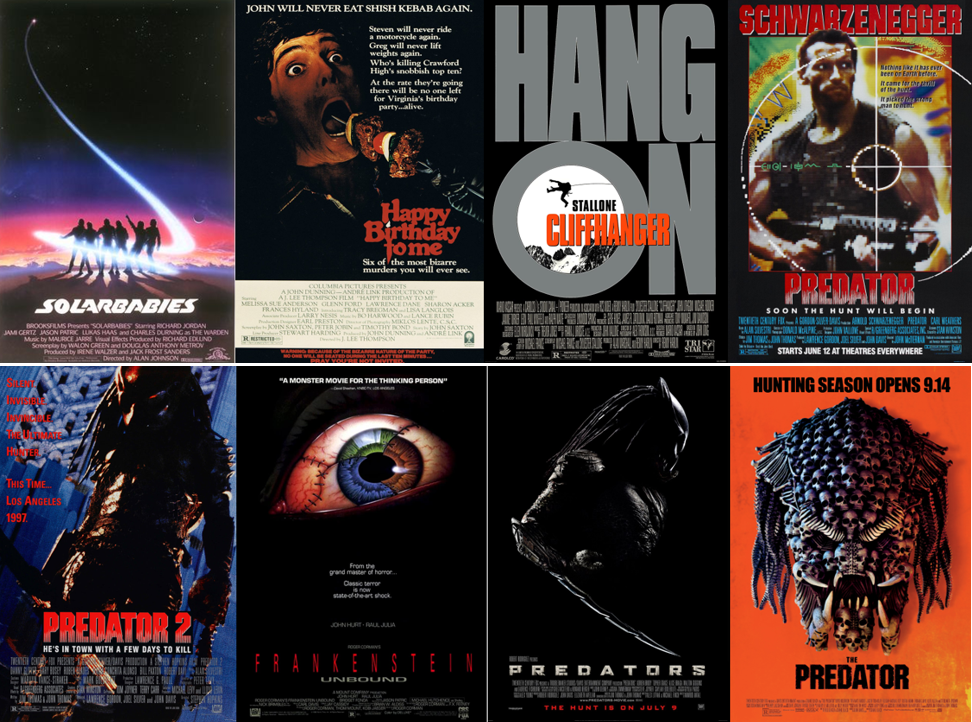
Re-Watch Part 1
You know the feeling when a scene from a film pops in your head and kind of replays behind your eyes like the first song you hear on the radio in the morning. Well, when that happen, I have to watch that movie or that scene in my head won’t bugger off.
And sometimes I rewatch movies because they are my happy place and I need a friend. These films have taken up permanent residence in my heart and soul (we have already mentioned the unreliable mind). The result of all of this is I watch a lot of movies. What else is new. Here is some of the Re-Watch social media posted reviews. You know the ones. Like the Films With Friends reviews, the ones that don’t go over 380 words. Enjoy you awesome nerds.
Re-Watch – Solarbabies (1986)
When I first saw this film, it was a random pick by one of my sisters at the video store that we watched on a weekend in the middle of school holidays in the 90s. Yeah, I know I’m old. Shut up!
And I just thought it was one of the coolest things I’d seen at that point. And on re-watching the film recently, I can honestly say that it is still a lot of fun. This film throws a lot of sci-fi tropes into a blender, adds two shots of teen drama and serves with action and adventure.
The story is set in the far future in the classic 1980s post-apocalyptic wasteland. Water is a rare commodity and has been placed under containment by the Eco Protectorate. And by doing so, they control what is left of humanity. The fascist army they employ helps too.
But in this world, orphans live in state-controlled orphanages designed to indoctrinate them into being ‘productive’ members of society. You know that old chestnut. To amuse themselves the orphans, play a game that is a hybrid of hockey and lacrosse that gives off serious Rollerball vibes. The skating sequences are awesome.
After a late-night game is broken up by the cops, the youngest member of the team, the Solarbabies, gets separated from that other in caves and finds a mysterious glowing orb. Its alien, intelligent and its name is Bohdai. And with the help of Bohdai, and another mysterious orphan named Darstar, they escape the orphanage, avoid the cops and destroy the Eco Protectorate and save the world.
This is only two films directed by Alan Johnson, the other being Mel Brooks’ To Be Or Not To Be. And he does a good job here mixing the sci-fi and action elements of the story. The cast is top notch with Jamie Gertz, Jason Patric, Lukas Haas, James Le Gros, Claude Brooks, Peter DeLuise and Adrian Pasdar as the Solarbabies. The supporting cast is just as great with Richard Jordan playing the villain, Sarah Douglas, Charles During and Terrance Mann adding colour. And even Alexei Sayle and Bruce Payne playing comically evil bounty hunters. This movie is a treat. Hunt it down.
Re-Watch – Happy Birthday to Me
I recently passed another rotation on the planet, and I thought to myself, what cool birthday themed movies are out there. The was only one that came to mind, the 1981 mystery slasher flick Happy Birthday to Me. I’ll try to avoid it, but I’m throwing out a spoiler warning just in case.
This film was one of so many Canadian horror films that were released in the 70s and 80s, taking advantage of that country’s tax breaks for film production. And they gave us so many superstar directors like David Cronenberg and cult classic flicks like Scanners, My Bloody Valentine and this little gem.
Directed by veteran J Lee Thompson (Guns of Navarone, Cape Fear, Conquest of the Planet of The Apes), as a director for hire, he brings all his experience to bear here.
The film centres around a group of friends at university who call themselves the “Top Ten”, who all start being knocked off one by one. Our main character/final girl is Ginny Wainwright (Melissa Sue Anderson) who years earlier survived a car accident in which her mother died. She received experimental brain surgery to correct complications which affected her memory and mental health. So much so that she may be the killer. We actually saw her kill off two of the group, but have no memory of it later. This is quite well done throughout the film, with the ‘is she/isn’t she’ plot device, and is one of the film’s red herrings. It is a good mystery, until the end, that is.
The ending of this film is a little stupid or a little weak, depending on personal preference. The end of the film was altered at the 11th hour it seems. The original ending of Ginny actually being the killer, being possessed by the spirit of her dead mother, makes so much more sense than the one we got on release. But those original elements linking to the original ending are still present.
Great tension, good gore, a drunk Hollywood legend and a silly ending. A treat, full of sugar that goes right to the hips.
Re-Watch – Cliffhanger (1993)
It’s hard to believe that in the early 1990s, Sylvester Stallone’s career was sliding downhill. Lock Up and Tango and Cash didn’t do big business and were not favoured by critics at the time. Rocky V, despite being a good entry in the franchise, was a disaster. And his journey into comedy with Stop! Or My Mom Will Shoot and Oscar were tragic. Sly needed a hit.
Luckily 1993 gave the man a one two punch of sweet success with the amazing and underrated Demolition Man and the action thriller Cliffhanger. The latter was so successful that it was even granted the parody treatment in the second Ace Ventura movie.
The film opens with Gabe Walker (Stallone) and Jessie (Janine Turner), members of the Rocky Mountain Rescue, heading up into the mountains to rescue their friend and fellow ranger Hal (Michael Rooker) and his inexperienced girlfriend Sarah (Michelle Joyner) after Hal blows out his knee. In the rescue, Sarah falls to her death. Hal blames Gabe, and Gabe, racked with guilt, leaves town.
Cut to a year later. Gabe comes back into town to ask Jessie to leave with him. Meanwhile, a group of terrorists and mercenaries, led by Qualen (John Lithgow), hijack over 100 million dollars from the U.S. Treasury plane in mid-flight. The heist hits a little ‘turbulence’ and the cases fly out into the blue and land over the mountains. When the bad guys crash their own plane, they call in the Rocky Mountain Rescue. Hal goes up, and Jessie persuades Gabe to go too. And then the cat and mouse action adventure starts with Gabe racing to each case and Hall being held hostage by the villains.
This Renny Harlin directed flick is a lot of fun. And there is very little that has aged the film. The story is a basic one and it allows the visuals to do all the work. No CGI, very few opticals, some good model work and some fucking amazing stunts (one of which is in the Guinness Book of World Records). Best thing about this flick for me is: 1) Stallone is not a celluloid superhero who takes a lot of damage, and 2) John Lithgow plays the scene chewing villain perfection.
Re-Watch – Predator (1987)
Predator has launched a juggernaut. Seven films (two being versus films with the Xenomorphs from Alien), comics, novels, video games, and every type of merchandise you can imagine. The image of the alien hunter is recognizable like other popular franchises like Alien, The Terminator and Robocop.
But the original film stands head and shoulders, not because the story was a better story, but because there is very little in the film to date it as with the other entries.
The film opens with Dutch (Arnold Schwarzenegger) and his team of badass recovery and rescue experts landing in South America somewhere to take on their next mission. There Dutch meets with General Phillips (R.G. Armstrong) and CIA operative and old friend of Dutch’s Dillon (Carl Weathers). Their mission is to go into the jungle, find a downed chopper and rescue the occupants, ‘take out’ the guerrillas, and get out. All with Dillon tagging along.
They find the chopper, but something is not right. On the way, they find the remains of another extraction team, skinned, and strung up in the trees. After they take out the guerrillas in classic 80s fashion full of bullets, bravado and banter, the real movie begins. The soldiers, along with a female guerrilla, are stalked and killed one by one by an unseen foe as they head for the extraction point. Until there is only one left.
The slow build-up of the alien hunter through POV shots and glimpses of its camouflaged form, where perfect, almost Jaws like. Because when you first see the alien, audiences were not prepared for it. And the subversion of the big beefy 80s action hero types being picked off by an almost slasher type alien always tickles me.
This was only John McTiernan’s second feature (his third would be Die Hard a year later) and he delivered a visual feast. The Predator himself was given life (and nightmare fuel for a young me) by actor Kevin Peter Hall and special effects master Stan Winston. It’s a freaking ride of a movie that Alan Silvestri’s score elevates this exciting and uncomplicated film. This has always been a personal favourite.
Most memorable line: If it bleeds, we can kill it.
Re-Watch – Predator 2 (1990)
When it comes to films being unfairly judged, from my view point anyway, Predator 2 always comes to mind. When I watched it in cinemas as a teenager, I thought it was a great sci-fi action film, with solid performances all round. But as I got older, I heard from friends, film critics and pretentious know-it-all’s, that this was a bad movie. I was confused by this reaction. Still am really. It does what a good sequel should do. Adds to the story and entertains. I just think people were a bit salty that Arnold wasn’t in it. And to this day, even after the amazing Prey brought new life to the franchise, it remains my favourite of the Predator films.
The film takes place in the near future of 1997 in Los Angeles, where the city is in the middle of a massive heat wave, and the cops have to deal with an out-of-control gang war between the Colombian and Jamaican drug cartels. We follow Lieutenant Mike Harrigan (Danny Glover) and his team, Danny Archuleta (Ruben Blades), Leona Cantrell (Maria Conchita Alsono) and new comer to the team, Jerry Lambert (Bill Paxton) as they try to get a handle on the mayhem. And also investigate the strange ritual slays on members of both gangs.
Also in the mix, and making Harrigan’s job harder is shadowy agent Peter Keyes (Gary Busey) and his team who want the police out of the way for their own investigation into the killing. Turns out, the agents are hunting the Predator, and unbeknownst to Harrigan, so is he.
The cat and mouse between Harrigan and the Predator is a highlight, as is the battle between the Predator and the agents. And the ending had many fans going wild and prompted the Alien Vs Predator comics from Dark Horse Comics. The banter and the lived in feel of the city adds to the story. The film is peppered with good character actors: Robert Davi, Adam Baldwin, Kent McCord Morton Downey Jr, Calvin Lockhart, Lilyan Chauvin, and Lethal Weapon’s Captain Ed Murphy himself, Steve Kahan. And having the late Kevin Peter Hall back to play a different Predator, was just a treat.
Re-Watch – Frankenstein Unbound (1990)
Roger Corman is an icon, a true independent in the industry. In 12 years, he directed somewhere around 55 films. In the early 1970s, he stepped back from directing and started New World Pictures. Names like Ron Howard, Joe Dante, Jonathon Demme, and James Cameron owe their careers to him. His influence is felt in almost every film made from the 1970s to now.
In 1990, Corman came back to direct one last time. That film is Frankenstein Unbound, directed by Corman from the Brian Aldiss story of the same name. The story starts off in the future, where Dr Buchanan (John Hurt) is developing an energy weapon that completely removes whatever the beam is aimed at. Hoping it will end war and have no effect on the surrounding environment. But an unforeseen side effect of the project is the creation of random and violent weather patterns and rifts in time causing people and objects to disappear.
On his way home, Buchanan and his AI equipped ‘future’ car are transported back to Switzerland in 1817. Here he meets Dr Victor Frankenstein (Raul Julia), not a fictitious character like first thought. He has created his creature, and it not only killed Victor’s brother, but many others. The monster (Nick Brimble) wants a mate and will kill to get it.
Buchanan also crosses paths with Mary Godwin (Bridget Fonda), later becoming Mary Shelly and writes the famous story, who he hopes will help him save a condemned girl that Victor is responsible for. Percy Shelly (Michael Hutchence) and Lord Byron (Jason Patric) are also here. There is betrayal, misunderstanding and a clash of ideologies leading to a showdown between the monsters and the creators.
This sci-fi cult classic blends the original Frankenstein story with the life of the original novel’s creator, while adding an extra cautionary tale of scientific advancement. The film looks great, with the make-up and production design looking damn impressive for such a low budget flick. The gore is effective, but not lingered on. The performances are on point from an unexpected cast, and the ending is pure science fiction poetry written large with light and colour at 24 frames a second.
You can currently watch the entire film on YouTube for free.
Re-Watch – Predators (2010)
Predators is a 2010 second sequel to the original, the first in the franchise for 20 years. The script was written by producer Robert Rodriguez in 1994, but wasn’t greenlight until 2009. Which is puzzling, because, while it has its flaws, it is a much better film than the Alien Vs Predator films from 2004 and 2007. And if 20th Century Fox had the script for this for 20 years, why ignore it for so long?
The story of this Sci-fi action film hits the ground running. It opens up with Royce (Adrien Brody) waking up in free fall in the upper atmosphere heading towards the ground. After reaching terra firma (jungle), he meets other hard cases who were also given the skydiving treatment. All these characters are mercenaries, freedom fighters, special forces soldiers, hitmen, cartel enforcers, yakuza, killers, death row convicts and an out of place young doctor. And they are played by character actors, action stars and genre icons. And what a cast: Alice Braga, Walton Goggins, Oleg Taktarov, Danny Trejo, Louis Ozawa, Mahershala Ali and Topher Grace.
The characters figure out they are on another planet that is a game preserve, and they are the prey. They discover the predator camp and the predators. But there are two factions. The smaller ones (which we have seen before), and larger more brutal predators. And as a past human survivor, Ronald (Laurence Fishburne) says, the big ones hunt the little ones. Then betrayal, explosions and the running for their lives.
Exciting and engaging, but not original. But having every human character in the film a bad character from misguided, to asshole, to unredeemable killer, is an interesting touch but isn’t used nearly enough. The film does give a few twists and a big reveal. But with no definable hero and little humour to break the serious elements, it falls short of a great entry. But the addition of two separate alien factions of the predator species, it adds to the mythology like a good sequel should.
While critics ran hot and cold, the film was successful, making $127.2 million on a $40 million budget. Not amazing numbers but enough to give us another unconnected sequel in 2018.
Good just for the cast.
Re-Watch – The Predator (2018)
We didn’t have to wait too long for the next entry in the Predator franchise. Only eight years this time. This time, the director has some history with the franchise. Shane Black, was, at one point, the highest paid screenwriter in Hollywood. Recently he has become an amazing director too with Iron Man 3 and neo-noir classics Kiss Kiss, Bang Bang and The Nice Guys. But in 1987, he was hired to be an actor in a little film called the Predator playing the character of Hawkins.
So, a Predator movie directed by Black and co-written by Black’s long-time friend Fred Dekker (The Monster Squad) has to be good right?
Army sniper Quinn McKenna (Boyd Holbrook), after witnessing a UFO crash, tries avoiding the military and a shady U.S. government agency, but gets captured and sent to the secret shady facility where they secret shady military UFO things. And oh, look. They have a predator. Which is why Trager (Sterling K Brown), the head shady guy, sent for scientist Professor Casey Brackett (Olivia Munn). But guess what, the predator escapes. Ask me how shocked I am. Brackett teams up with McKenna and a bus load of mentally unstable types, such as: Nebraska (Trevante Rhodes), Coyle (Keegan-Michael Key), Baxley (Thomas Jane), Lynch (Alfie Allen), and Nettles (Augusto Aguilera). They set out to stop the predator and save McKenna’s autistic son Rory (Jacob Tremblay), who has figured out the alien tech. But something else is hunting, not only Rory, but the predator. A monster Predator, and he brought dogs. See, the captured predator good, monster predator bad.
The performances and the action beats are fine, the comedy is well executed, and for the most part the visuals are stunning. But the film falls down in a few places. The introduction of the second larger Predator being a completely CGI creation, while the smaller predator remains practical. Also, the depiction of Rory’s autism in the film is not great. I can see what the intentions were, but a conversation and some research would have improved that aspect of the story. And the coda at the end is rather silly.
This film does seem a little hollow, but like chocolate eggs at easter, it is a treat. Even if its fleeting.
-
Films With Friends. Part 1: The Beginning.
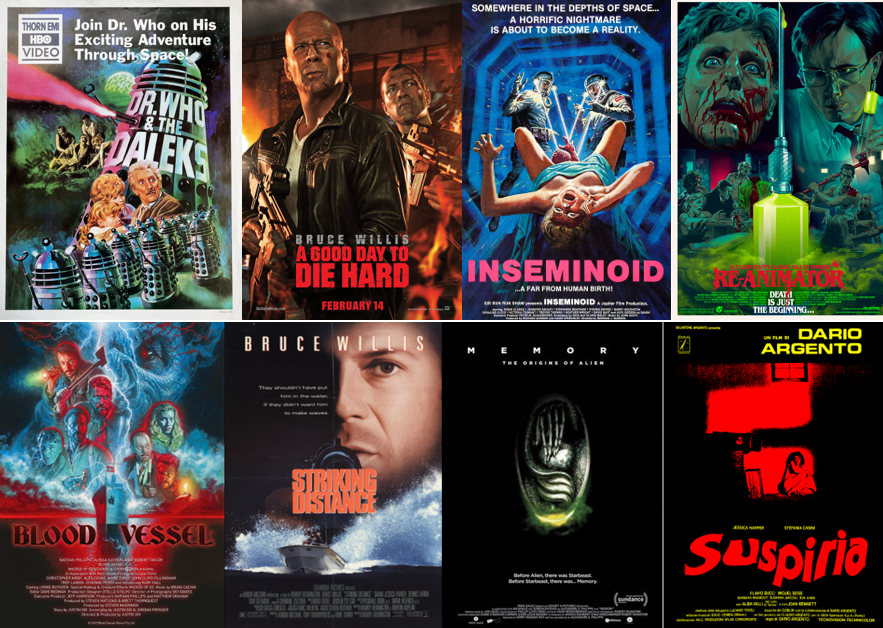
Films With Friends – Part 01
Hello there people of the mystical land called Internet. I have returned. Well, kind of. Two thirds of my brain are arguing with each other, so the other bit (that’s me. HELLO) just popped out to post this. So, here is the first collection of my Films With Friends social media posts. Much like the seasonal Halloween and Christmas collections, this is, quite simply, talking about certain films I watch with people who can stand being in the same room with me. Hope you enjoy. And if not, keep it to yourself.
Doctor Who and the Daleks (1965)
So, if you did not know, there were two theatrical released Doctor Who films in the 1960s.
The first is Doctor Who and the Daleks from 1965 and it is a little different from the canon of the much-loved TV show. For starters, the Doctor is actually a human inventor who created the TARDIS himself. And not an alien who stole the mysterious blue box to go on adventures to see the world. And his name is really Doctor Who, and not the one-word name of the Doctor from the show. But, being played by the amazing Peter Cushing, I don’t mind.
In this little film that could, the Doctor is living with his two granddaughters, Barabra and Susan (Jennie Linden and Roberta Tovey). When Barbara’s bumbling, good natured boyfriend Ian (Roy Castle) visits, the Doctor must show off his invention. But Ian accidentally activates the time machine without setting coordinates and they find themselves in a far future planet that has been decimated. Here that meet the remaining inhabitants, the Thals. But they also discover the evil pepper pots, the Daleks. The doctor and his friends must stop the Daleks from destroying the Thals, and themselves and somehow get home.
This film, while very 60s camp, is really fun. It won’t blow your socks off, compared to today’s releases, or by DW television standards, but enjoyable.
The Thals costumes and make is unintentionally hilarious looking like someone melted David Bowie and Adam Ant together. But it is presented with a little wink to the audience. The colours are bright, lighting adds mood and character.
This is akin to an alternate universe Doctor Who that actually exists in this one. And the remastered re-releases are fantastic.
A Good Day To Die Hard
Once a week I hang out with two of the best people I know. We eat dinner and watch a movie after their kids have gone to bed. Recently, we watched the fifth Die Hard film, A Good Day to Die Hard. Neither had seen it.
My reaction was the same as theirs after their first viewing. And that reaction: ‘Meh’. Complete with shoulder shrug.
None of us can say it was a bad film. But we couldn’t say the opposite. It’s the same reaction many people have when talking about Terminator Salvation. Not bad but not a Terminator film. Not bad, but not a Die Hard film. The fifth entry of this iconic action franchise seems to have removed the precis things that made the other films enjoyable. A diplomatic way of putting it, it’s muted. A less diplomatic way, a good idea had all the life sucked out of it, and the skin left flapping in the wind of the flagpole.
In this entry, John McClane (Bruce Willis) travels to Russia to aid his wayward son Jack (Jai Courtney) as he has been arrested for murder. But what McClane doesn’t know is that Jack works for the CIA, and it was a ploy to get him close to a Russian political prisoner and aid his escape. McClane’s messes up the plan and they are hunted down by the bad guys before turning the tables.
Sounds like something that would have been made in the 80s. But without the visceral visuals and macho soul actions movies of the era where famous for. Its just comes off as sanitised and bland. After the amazing opening chase sequence, the film never recovers. Don’t feel bad skipping this one.
Best Quote: Keep looking people, there isn’t one. That’s how ‘Bluh’ the movie is.
Inseminoid (1981)
Hanging with a fellow lover of bad 80s movies, and we recently watched this gem. Norman J Warren’s English made, budget Alien rip-off Inseminoid.
This film, which also goes by Doom Seed, Horrorplanet and about a dozen others, is a sci-fi horror film set on a freezing planet where the team of the 12 Xeno Project archaeologists and scientists are excavating the ruins of an ancient city. Upon finding wall paints and strange crystals, they postulate that the dead civilization was ruled by a chemical intelligence (whatever that is). After one of the team is ‘infected’ by an otherworldly force, much carnage ensues, resulting in several of the team dead. Then, with no warning, a monstrous alien rapes team member Sandy with what looks like a giant transparent drinking straw and impregnates her.
This is the ‘Alien Rip-Off’ portion of our story. But unlike that film, Sandy becomes more possessed by the aliens living inside her then just used as an incubator. It is Sandy herself who does most of the killing and the destruction of the base. That is until the alien babies are born at the end of the film and get their chance to munch on some humans.
This movie is such fun. The story is a good one. At least there is a good story in there somewhere. The effects don’t hold up well, the sets look like leftovers from Doctor Who or Blake 7, and the acting is awful. Well, except for Judy Gleeson as Sandy. She fucking goes for it in every scene. There is a charm and earnest quality to the film I find rather endearing. This is the first time I’ve seen this film and I will definitely watch it again. Perfect to enjoy on its own or riff the shit out of it with friends.
And watch out for the character of Holly played by Jennifer Ashley. She is a statue-eque who seems to be impersonating Sigourney Weaver, including stripping down to white t-shirt and panties in the middle of the film.
3 out of 5 ‘Roger Corman’s.
Re-Animator.
This movie rocks. Everybody I have shown this film to, loves it for one reason or another.
Stuart Gordon’s debut feature is the perfect blend of horror and black comedy filled with over the top effects and gore, scene chewing actors hamming it up with some of the best line deliveries in film, a bonkers script based on a H.P. Lovecraft story, groovy sets featuring a little foreshadowing and flawless directing.
Have you figured out I love this film yet?
Okay. The story is of a hapless, handsome and kind-hearted medical student Dan (Bruce Abbott), who gets caught up in the discoveries and obsessions of his new roommate Dr Herbert West (the iconic Jeffery Combs), even at the warning of his fiancée Megan (Barbara Crampton). West is trying to perfect a formula to reanimate the dead. He has been successful but the reanimated come back as mindless killers.
One of the teachers at the Miskatonic University Medical School, Dr Carl Hill (David Gale), who has made a career out of stealing the ideas of others, wants Dr West’s discovery. And will do anything to get it. He also has a creepy, almost stalker-like obsession with Megan. Everything builds, the comedy as well as the stakes, all heading to a climax that has to be seen to be believed. Complete with a wonderfully graphic visual pun. And a whammy of a final scene.
This must be on the list of every horror fan. Whether you are hard core or a casual viewer. This is a must.
Best Quote:
Dr West: You’ll never get credit for my discovery. Who’s going to believe a talking head? Get a job in a sideshow.
Blood Vessel
I love me some Australian and New Zealand genre movies. Thriller, action, horror, sci-fi, and all the other oddball releases. Over the last 10 to 15 years there have been a lot to get excited about. And when you sit down and watch one of these films with a fellow oddball, it’s an experience.
Blood Vessel is an Australian horror thriller from 2019 directed by and co-written by Justin Dix.
The story for this little gem is after their transport ship was attacked and sunk near the end of WWII, an odd collection of allies float in the middle of the ocean in a wooden row boat. When I say collection, I mean collection. British scientist, English nurse, American cook and engineer, Russian sniper, and a couple of Australian soldiers. And yes, they are all played by Australian actors.
Just as all their supplies run out, they come across an abandoned German Navy ship. After getting onboard, losing one of their numbers in the effort, they come across a bunch of weird. There are strange dead bodies on the bridge, the absence of anyone else, and the classic feelings of dread. They find creepy books, artifacts and film reels suggesting a supernatural obsession the Nazis have. And they find a lone child on the boat just as people start disappearing. And everything points to vampires. When the vampires are discovered, known only as The Patriarch and The Matriarch (which makes you wonder how old these creatures are), bad things happen, delivered with inventiveness and gore.
This film is made with passion for the subject matter and the horror genre. The cinematography is wonderful, the acting is good, the make-up effects on the vampires is unique and disturbing (something F.W. Murnau would be proud off), and the filmmakers went with a gut punch ending instead of the over used ‘stringer’ ending. That made me smile. In front of the camera, you have Nathan Phillips, Alyssa Sutherland, Robert Taylor, Christopher Kiby, Alex Cooke, Mark Diaco and John Lloyd Fillingham.
Worth every ounce of your blood. Time….I meant time.
Striking Distance.
After finishing the Die Hard franchise what we started around Christmas, one of us thought it would be a cool idea to revisit some of Bruce Willis’ other lesser known or forgotten films. And we all agreed. First up was, what was half remembered as ‘the boat movie’. So, today I give you, the 1993 action thriller, Striking Distance.
Originally titled Three Rivers, Striking Distance centres around Pittsburgh cop Tom Hardy (Willis), who after he turns in his partner for excessive force, has become alienated from the rest of the force. When he and his police captain father Vincent (John Mahoney), get a call about a high-speed pursuit involving the serial killer The Polish Hill Stranger, they join the chase, and it ends badly. Killer escaped, cars crashed, Hardy injured and his father dead. Hardy believes a cop is the killer. He loses his shield and is busted down to the River Rescue Squad.
After getting a new partner Jo Christman (Sarah Jessica Parker), the killer, officially though to be behind bars, starts killing woman connected to Hardy and dumping their bodies in the river where Hardy will find them. No one believes him, fellow cops are hostile toward him, even being under investigation at one point, until he must go it alone.
Directed by Rowdy Herrington, the director of cult classics like Jack’s Back (1988), Roadhouse (1990) and Gladiator (1992), uses the thriller to touch on topics like trauma, honour, family, and addiction. But while this film does hold your attention, this is not the best film in the world, and had production problems that almost halted production. But the all-star cast saves it from being a mere footnote, as it comes off as a thriller by numbers without them. The director’s other films I mention are a better choice for a fun ride.
Memory: The Origins of Alien.
Every now and then, my friends surprise me. I’m not talking about jumping out from behind a wall and screaming BOO! Or suddenly finding them dressed as a furry eating out of a dog bowl (which I would pay to see). No, I’m talking about the selection of movies they decide on when we hang and indulge in cinematic marvels. Today’s movie is one of those. Because it is a documentary on a famous film in a franchise. Watching these docos is something I usually do alone.
But I had so much fun watching and discussing this film. Memory: The Origins of Alien is a documentary written and directed by Alexander O. Philippe. It delves into the origins of Ridley Scott’s 1979 Alien. From the beginnings of the idea by screenwriter Dan O’Bannon and the influences that lead to it, like EC Comics and H P Lovecraft. Some of which I already knew but so much I didn’t. O’Bannon was a genius and a wild man who was extremely well read.
It also touches on the making of the original film. O’Bannon meeting Ronald Shusett and their professional relationship. Also, the involvement of the producers like Walter Hill and David Giler, when H R Giger got hired and his relationship with O’Bannon and the other filmmakers, and the hiring of Ridley Scott and the amazing cast.
And in between all this, there are experts in film, philosophy, literature lecturing about the impact of this film on popular culture, the important connection to history and mythology.
Honestly, I can’t really say too much about the film. There is just too much information delivered here to summarise successfully. But if you are a film geek or cinephile, this movie has to be on your viewing list. Or you have to hand in your membership card and all your graphic tees.
It is available on DVD relatively cheap, and it is also on several streaming services. Check it out and learn something in a fun way.
Suspiria (1977)
Hitting the way back machine here to 2019, before the lockdown. I showed friends of mine one of my favourite horror flicks. That being Dario Argento’s 1977 horror crime, and sometimes Gaello, Suspiria. Now, with Dario’s work influencing so many filmmakers, many of which my friends like, or even love, I was expecting a better reception when the credits started rolling. Despite saying this, this was not the case. They didn’t like it.
The story centres around an American dance student, Suzy Bannion (Jessica Harper), attending a prestigious Tanz Akademie dance school in Germany. She arrives in a downpour at night, and after seeing someone fleeing from the school, she finds she cannot gain entry. She returns the next day to start her schooling only to find out the girl she saw leaving was killed. Everyone one of the teachers at the school are weird (I think Coocoo for Cocoa-Puffs is the correct saying) and students and staff start dying as well as a maggot infestation which is rather icky, and strange noise and sounds like breathing and walking echo loudly through the halls.
Surprise to no one, the teachers are a coven of witches (the evil kind) and the school was started by one of the evillest decades ago, Helena Markos, who is still alive and is responsible for much of the goings on.
This film is a classic for a reason. It is the first in the Three Mothers trilogy from Argento (Inferno in 1980 and Mother of Tears in 2007 being the others), but this is by far the most visually striking and most unsettling. The lighting and cinematography have a stylistic flare with its use of vibrant colours set the stage. The onscreen deaths are inventive, almost beautiful. The score is by the progressive Italian rock band Goblin, and it’s wicked effective.
The film uses Dream Logic, a term people use when the film doesn’t make sense, but it doesn’t have to. The ride you go on watching this movie is unlike any other. It’s not boring, it is engaging, and the music rocks. This flick and its follow up are in my top ten.
Sad that others don’t have the same love for this as I do.
-
Subscribe
Subscribed
Have a WordPress.com account? Log in now.

