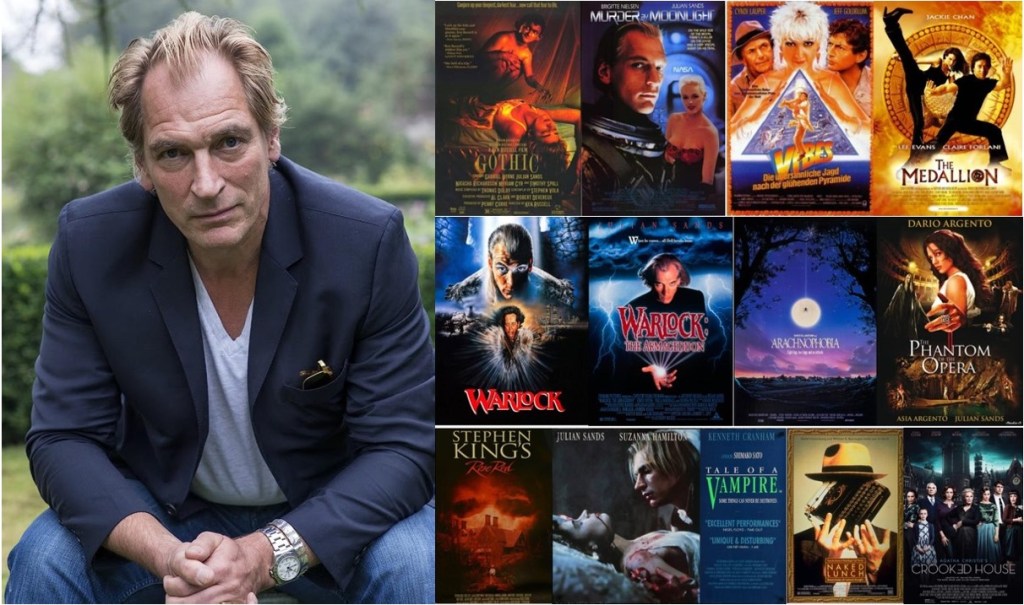
Today, with a heavy heart and the eyes of a clairvoyant guiding the way, I have to mention the passing of an actor whose work I have loved and admired for a long while, Julian Sands.
Sands got a career boost in two critically acclaimed films in the 80s, the war drama The Killing Fields and the romantic lead in A Room With a View. And while there were other drama roles in films like Impromptu, The Browning Version and Leaving Las Vegas, it is his work in the Sci-Fi and Horror genres that left its impact on me. Ken Russell’s Gothic, the Warlock films (of which are some of my all-time favourites), and Arachnophobia cemented the actor in the hearts of horror fans. Sci-fi films and TV like The Tomorrow Man and Stargate SG-1, movies like The Naked Lunch and Boxing Helena proved he was a creative actor who could think outside the box. He also has done an impressive amount of voice work for animation and video games. He was even the voice of Q in James Bond radio plays.
I’ve seen most of his 156 credits because Sands was electric on screen. If I saw his name anywhere attached to a project, I’d go out of my way to watch it. And if he popped up unexpectedly, like playing Superman’s dad Jor-El in Smallville, it made me love the show just that little bit more.
But sadly…
On 13th January 2023, just after his 65th birthday, Sands, who was an avid mountaineer, went missing in Mount Baldy, California, in the San Gabriel Mountains, northwest of Los Angeles. Despite an investigation and intensive search, which were often hindered by storms, he was lost, disappeared in the wilderness.
Five months later, on 24th June 2023, human remains were found by hikers in the area where Sands disappeared. The remains were soon positively identified as the talented actor three days later.
He was a romantic lead, a villain, an action star, a dramatic thespian, a leading man, a character actor, a vampire, a werewolf, a phantom and a warlock. His unique voice will forever ring in my ears. I will miss him.
So, I’m going to review twelve of Julian Sand’s more unique, forgotten, and genre favourite films.
Gothic (1986)
Gothic is a 1986 British psychological horror film from artist and filmmaker Ken Russell. The film is a fictionalised retelling of Mary Shelly, her future husband Percy Bysshe Shelly, her stepsister Claire Clairmont as they visit Lord Byron, and his personal doctor John Polidori, at Bryon’s in Villa Diodati by Lake Geneva during the summer of 1816. This famous meeting of minds, cut off by a savage storm, engaged in a game of storytelling that led to the creation of the novel Frankenstein.
After dinner and drinks, Byron (Gabriel Byrne) presents a book of Phantasmagoria (ghost stories) and they all take turns from the book. This and the following séance performed around a human skull, unleash a force into the house that uses the most hidden fears of the house’s occupants against them. Claire (Myriam Cyr) fears loneliness and rats, Mary (Nastasha Richardson) fears death of loved ones and the loss of her child, Shelly (Julian Sands) fears losing his mind and Polidori (Timothy Spall) fears damnation for his homosexuality. I haven’t figured out Bryon’s fear in the movie yet. But he is an ego driven hedonist who loves playing games with people’s minds. So, there is that.
What the characters experience might all be hallucinations from the large amount of opium they consumed. It is never spelled out, which I think makes it all the more wickedly delightful. The camera work, lighting and imagery (especially that based on Henry Fuseli’s 1781 painting The Nightmare) are amazing to witness. And made more hypnotic and disturbing in places by the sound design and the music by Thomas Dolby whose synth-based score adds an otherworldly nature to the period piece. Sands and Richardson are standouts, acting out past traumas with heart wrenching brilliance.
Sands had this to say about the film:
I think these portraits are rooted in reality. If people think otherwise, it’s because of the later Victorian whitewash of them. These were not simply beautiful Romantic poets. They were subversive, anarchic hedonists pursuing a particular line of amorality. The film portrays Lord Byron as demonic and Shelley as on the verge of madness, but the film is an expressionist piece, and that’s not an unreasonable expression of their realities.
Murder on the Moon / Murder by Moonlight (1989)
Whichever title you remember, this is a 1989 Sci-Fi Murder Mystery TV movie directed by director Michael Lindsay-Hogg.
The film takes place in the future time of 2015. On a mining facility on the moon, an American mining corporation has leased land rights from the Russian government in return for a piece of the profits from the operation. After the facility’s security chief turns up dead outside on the lunar surface in a mine shaft without a spacesuit, an investigation takes place. But his being Russian territory, they have jurisdiction. But after the head of the facility Dennis Huff (Gerald McRaney) throws a fit, NASA sends up an investigator, Maggie Bartok (Brigitte Nielsen) to assist.
The Russian investigator, KGB Specialist Maj. Stepan Gregorivitj Kirilenko (Julian Sands) at first sees her as an obstacle and a nuisance, but after dealing by NASA’s Alvarado (Ricco Ross) and Russia’s General Voronov (Brian Cox) things are smoothed out on both sides to allow the two mismatched investigators to continue to take down the murderer without government or company interference.
With suspicions around evidence (or lack thereof), political tensions, who is sleeping with whom, embezzlement that could lead to the bribery of a high ranking Russian official, Bartok and Kirilenko are at a loss. Until a half-remembered conversion from one of the miners leads them to a clue involving a South American terrorist who was responsible from starting World War 3 hiding on the base after surgery to alter their appearance.
Even with an interesting premise, this remains a basic murder mystery story that could have taken place anywhere or when. The novelty of the sci-fi setting gives the film a fresh, if dated, look. Although it does stuffer from an 80s TV movie budget. The model of the station on the lunar surface looks like a G.I. Joe playset.
Sands once again stands out in his role, with Nielsen’s stature and beauty doing most of the work for her. And the reveal of who the killer/terrorist is, was an interesting twist, well for the time anyway. Some could say it is problematic in today’s climate, but I think it was back then too.
Check it out on YouTube to see what I mean.
Tale of a Vampire (1992)
This film is often classed as a horror film, but it is more of a dark romantic drama with some horror, that being the main character is a vampire. Co-written and directed by Shimako Sato, based on the writings of Edgar Allan Poe, is a beautiful and tragic story of an immortal man searching for his lost love.
The tale centres around Alex (Julian Sands), the titular vampire, who survives for the most part on the blood of animals and spends his evenings in a charmingly antiquated library where he is researching his PhD thesis on religious martyrs. Which is a ruse for searching for information on his lost vampire lover Virginia Clemm (Suzanna Hamilton), who went missing centuries ago after they were chased out of the town they were living in by an angry mob.
In another part of town Anne (also played by Hamilton) mourns the death of her boyfriend who died in a tragic accident. After receiving a mysterious message informing her that a position has opened at the library that Alex frequents, she is soon hired. Alex is enchanted by Anne, seeing his lost love in her.
In the city, a series of strange deaths have been taking place, some directly around Alex. His low profile is in danger of slipping. Soon a mysterious man in a hat named Edgar (Kenneth Cranham) starts visiting the library, and tries befriending Anne. He is an intriguing figure who is not what he appears. As Alex and Anne get closer, Edgar tells Anne that Alex is a vampire. With both of the leads in pain for the loss of lovers, Anne begs Alex to turn her. Which he refuses. When Edgar turns out to also be a vampire, and the husband of Virginia who. He is seeking revenge, and Anne is his collateral damage.
This is a slow and mediative story. With its very deliberate staging, lighting, camerawork and quirky characters all experience a different pain derived from loss, it’s not a film you can digest easily. But it is worth it. Sato does a marvellous job with the story she wants to tell. Sands is heartbreaking as Alex. A lyrically beautiful and overlooked film. Flaws and all.
Vibes (1988)
This is one of those movies that flopped when it was released in the 80s, and has become a cult favourite since. Vibes is a romantic adventure comedy directed by Ken Kwapis starring an eclectic collection of actors, featuring a perfectly weird story.
After a pre-credit sequence showing an ill-fated expedition into a ruined city somewhere, we open at a research facility in New York where Dr Harrison Steele (Julian Sands) and his team are running tests on different types of psychics. Among them is the un-lucky in love quirky girls from Queens Sylvia Pickel (Cyndi Lauper) who is a trance-medium, and the neurotic Nick Deezy (Jeff Goldblum) who is a psychometrist (he touches things and knows its history). While Syliva’s overly flirtatious nature turns some people off, she is a good person.
One night, after returning home helping ungrateful ex-boyfriend Fred (Steve Buscemi), she finds a strange man in her apartment. Harry (Peter Falk) wants her help to travel to Ecuador to find his missing son for the sum of $50,000. Syliva and Harry then convince the unwilling Nick to accompany them. Once in Ecuador, they discover Harry lied about the lost son, as is really there to find a lost city with a mythical room of gold somewhere in the mountains. When they are all on the same page, and after people start trying to kill them, including a fellow member of the psychic study Ingo (Googy Gress), a psychopath with an ever-changing accent, they journey into the mountains. Soon the villain behind everything is revealed to be Dr Steele who forces our reluctant heroes to help him find the lost city and its powerful psychic force so he can bring ‘order’ to the world.
This film feels like a film of the 80s and a screwball comedy of the glory days of Hollywood, mixing the snappy dialogue and witty one lines with the balls to the walls story excess of the decade with the most. Lauper (in her first movie role), Goldblum and Falk are the best they have ever been. The comedy and word play is wonderfully delivered, even with a weak story. Sands and the other villains don’t really have much to do here. Always a favourite.
The Medallion (2003)
The Medallion is fantasy action comedy from 2003 directed by Gordon Chan, who co-wrote the script with four other people, and stars the action legend Jackie Chan.
Eddie Yang (Chan) is a Hong Kong detective who has been assigned to work with Interpol in the capture of an infamous crime lord AJ “Snakehead” Staul (played with moustache twirling perfection by Julian Sands). The head of the Interpol operation in Hong Kong is Agent Arther Warson (Lee Evans) who is at odds with Eddie in how to do things. The team rush to a tip that Snakehead is at a nearby temple. The villain steals a mystical medallion and the chosen one who guards it, an otherworldly child. Eddie messes up their plans, but gets away. But Eddie has seen his face.
Eddie back with Hong Kong Police, stakes out Snakeheads local operations and witnesses the thugs kidnapping the boy he saw in the temple and smuggle him out of the country, heading for Snakehead’s compound in Dublin. Eddie is on the next plane.
Once in Ireland at Interpol headquarters, he is greeted with a slap by old flame Nicole (Claire Forlani) and the head of operations Cmdr. Hammerstock-Smythe (John Ryhs-Davies), who assigns Eddie to work with Nicole and Watson, who remains reluctant.
In the course of the investigation, they find and attempt to rescue the boy, but Eddie is killed. The chosen one uses the medallion and later in the morgue, Eddie is back from the dead, along with incredible strength and supernatural powers. This is the very power Snakehead wants for himself. Which he does later in the film. DUH! Which makes the final battle all the much more fun.
This is a unique superhero origin story and a classic Jackie Chan style action film with the well-choreographed fight scenes and humour. While some of the wire work and early 2000s CGI is a little distracting, it’s a fun little film. But it is not one of my favourites. While all the actors get their chance to shine, especially the main cast, the story does not live up to the potential of the premise. The film didn’t know who its audience was. Evans is funny as always. But needed more Sands.
Warlock (1989)
Warlock is a 1989 supernatural fantasy action horror film directed by Steve Miner (Friday the 13th 2 & 3, Halloween H2O) and written by David Twohy (The Fugitive, Pitch Black).
In 1691 in Boston, Massachusetts, the witch-hunter Redferne (Richard E Grant) captured the Warlock (Julian Sands). The evil doer is imprisoned awaiting trial and execution by hanging and burning over a basket of live cats. Why are the puritans such dicks to cats? The Warlock escapes his binds and is propelled into the future, accidentally taking Redferne with him.
In modern day Los Angeles, the Warlock crashes through the window of a house where Chas and his roommate Kassandra (Lori Singer) live, waking them both up. They take care of him and the next morning after Kass leaves for work, the Warlock kills Chas. The Warlock visits a psychic to speak to a demon. The dark lord reveals to the Warlock that he is here to find the pagers of the Grand Grimoire, separated centuries ago into three pieces and holds the power to un-do creation.
When Redferne finally turns up, and after a run in with L.A. finest, he and Kassandra (who has been cursed) head across the country in pursuit of the Warlock and prevent him from getting the book.
This film is a little hard to categorise, but I think that works for the film. The story does do what is unexpected, by somehow adheres to genre conventions. Singer’s old age make-up doesn’t hold up well, and some of the opticals needed more work, but these are small concerns. A good premise, a fine cast and a kick ass score from Jerry Goldsmith make it worth your while, even if it does have the occasional pacing issue.
Grant, in a rare hero role, is wonderful and it’s a shame he didn’t get more roles like this. His accent slips here and there, but he is able to deliver ridiculous lines with a straight face and kick ass. But it’s the charming and disarming villain played by Sands which was the stand out of this film. This role elevated him to star status, and he would dip into the horror genre regularly after this. A devilish cult classic worth your time.
Warlock: The Armageddon (1993)
Directed by Anthony Hickox, the sequel to the 1989 film is a far superior flick.
The film centres around a new Warlock, and Satan’s son, (again played by Julian Sands) as he journeys from New York to a small town in California searching for the Infinity Stones… Sorry, I mean, six magical Druid rune stones. When brought together in the right place can free Satan from the pit. So, for our evil doer, it’s like a supernatural heist as he tries to bust daddy out of prison. The current owners of each of the stones come to an elaborate and creative end when they meet the charming Warlock.
The other part of the story is about Kenny Travis and Samantha Ellison (Christ Young & Paula Marshall), two kids living a small-town America who just so happen to be the last line of Druids, and predestined Druidic Warriors. Kenny’s father Will (the motherfucking Captain himself, Steve Kahan), and his two friends, Franks and Ethan (R.G. Armstrong and Charles Hallahan) have kept the Druidic faith, but Sam’s father Ted (Bruce Glover) split away after the death of his wife, and fearing for his daughter’s Destiny, became the town priest. Hehe, he’s Father Ted.
But to fulfill their destinies of becoming Jedi Knights… Sorry, Druid warriors, the teenagers may die and be reborn before they can be trained to face the Warlock and save the world. So that is what they do, but then the Warlock arrives in his Armani suit and starts fucking shit up.
This film is way more fun than the first. The story moves at a good pace, there is good development for the principal characters, the production design is damn impressive, as are the dream-like temptation sequences the Warlock puts the owners of the stones through, like something out of an Elm Street sequel. The gore effects, especially the Warlock’s death, is dripping gross and cool looking. The only place the film has not aged well, is with the early CGI effects used in the sequences where the characters are using magic or telekinesis to move objects. Hickox knocks it out of the park
Imaginative, full of wicked fun, cool performances and Sands steals the show with his evil cool.
Arachnophobia (1990)
Itsy Bitsy spider went up the water spout, down came the blood and flushed the humans out…
Arachnophobia is a certified cult classic horror comedy from director Frank Marshall and Spielberg’s Amblin Entertainment. And it’s not a film you want to be watching if you don’t like creepy crawlies.
The film opens in Venezuelan tepui, and British entomologist James Atherton (Julian Sands) welcomes his new photographer Jerry Manley (Mark L Taylor) to the jungle. He has been hired to take photos of the specimens they find and the surrounding jungle. They find a previously undiscovered species of spider that is aggressive, intelligent and works in a hive (atypical of spiders).
Back at camp, Manely is bitten by one of these beasties and dies. His body is packed in a coffin and sent home to Canaima, California, but with a stowaway.
In Canaima, the same day the body arrives from Venezuela, the new doctor and his family arrive in town and to their new home. Dr Ross Jennings (Jeff Daniels), wife Molly (Harley Jane Kozak) are unaware that the Venezuelan super spider takes residence in their barn. It mates with a local breed of spider and creates a very deadly strain. Which spread out into the town and start doing the bitey bitey thing with people turning up dead being a side effect.
After the spider’s are determined to be the cause of death, Dr Atherton and his assistant Chris Collins (Brian McNamara) are called in to investigate and help eradicate the infestation, with a little help from the local and eccentric pest exterminator Delbert McClintock (John Goodman). But the two spider parents won’t give up without a fight.
The creature effects here are wonderful. The dead bodies, especially Manley’s desiccated corpse, are creepy, and the fertile male and queen spiders when interacting with humans, are effective puppets. But for the most part, they used real spiders. Some big tarantulas for the angry parents, and a lot of Australian and New Zealand Huntsman spiders, because of their unique look, their galloping stride and the ease to work with.
The cinematography and Trevor Jones’s score build the tension until bursting. Great performances across the board with Daniels and Goodman standing out, and Sands playing it straight.
The Phantom of the Opera (1998)
This is Italian director Dario Argento’s adaptation of Gaston Leroux’s gothic romantic novel about love and obsession, Le Fantôme de l’Opéra. This is where the once brilliant director that influenced many starts to lose his creative moxie.
In 1877 Paris, an abandoned newborn baby is sent floating down the river and is rescued and raised by rats in the catacombs under the Paris opera house. Think Oswald Cobblepot without the penguins. He becomes the Phantom (Julian Sands), a misanthrope who is more handsome than his other film counterparts, who kills anyone who ventures into his underground world. He falls in love with Christine Daae (Asia Argento) who entranced him with her singing voice. He reveals himself to her, and she is intrigued by this stranger. He can speak to her via telepathy too. Which is useful, I suppose. And the two start a romantic relationship. The aristocratic Baron Raoul De Chagny (Andrea Di Stefano), looking like a cross between an angsty teenager and a goth date rapist, is also in love with Christine.
The Phantom uses his knowledge of the catacombs and the opera house to kill, traumatise and threaten, so advance Christine’s career. But this and the tragic love story, seem to be the only real elements lifted from the classic story. The obsession with rats gets creepy, the kills are gut churning gory, and the subplots, one about a crazed rat catcher and the other about a rich paedophile trying to bed the pre-pubescent opera students are unnecessary. There seems to be about 30mins worth of story, and the rest is a series of sex scenes and on-screen deaths that have little to do with the overall story.
That being said, Argento’s films always look amazing, and this one is not different. A wonderful use of light, colour and shadows give the environments an otherworldly and claustrophobic feel. The two leads, Sands and Asia Argento do their utmost best with the material and are highlights. Especially Sands who portrays barely contained rage to skin crawling brilliance. Also effective is his gentle reactions with Christine, until it all goes belly up. Unfortunately, these elements are not enough to save the film. The film is not boring, but it’s a mess.
Rose Red (2002)
Rose Red is a 2002 mini-series written by Stephen King (an original screenplay) and directed by Craig R. Baxley. The story takes inspiration from the Winchester Mystery House and Shirley Jackson’s The Haunting.
It centres around Dr. Joyce Reardon’s (Nancy Travis) obsession with the haunted Rose Red mansion and her desire to find proof of paranormal phenomena. She continually has to defend her field of paranormal psychology from cruel and dismissive people, not more so the head of the University’s Psych department, Professor Carl Miller (David Dukes). The current owner of the Rose Red estate, Steve Rimbauer (Matt Keeslar) agrees to rent her the property over a weekend and Reardon assembles her team to wake up the now dormant house and get her proof.
Her team of traumatised psychics are Victor “Vic” Kamdinsky (Kevin Tighe), and elderly precognate with a heart condition; Pam Asbury (Emily Deschanel), a young psychometric; Cathy Kramer (Judith Ivey), a middle aged automatic writer, Nick Hardaway (Julian Sands), a telepath with remote viewing capabilities; and Emery Waterman (Matt Ross), a young post-cognate with mother and financial issues, and an autistic teenager Annie Wheaton (Kimberly J Brown), accompanied by her big sister Rachel (Melanie Lynsky), who maybe be the most power psychic on the lot and the key to finding answers and getting the team out alive.
We learn about the history of the house and its eccentric and haunted owner Ellen Rimbauer (Julia Campbell), the evil consciousness of the house, and the personalities of the team and their backstories as the first and second parts play out. The tension builds at a steady pace as the supernatural gets stronger and the characters start to lose it, and then start getting bumped off.
King’s original mini-series, this and Storm of the Century, are beautifully made and creepy stories. And Rose Red is a great ghost story. Baxley does a get job behind the camera, as he did with Storm and Kingdom Hospital, and the score is effective, but some of the effects were limited by a TV budget.
Shout out to Travis who’s obsessed Reardon loses it in spectacular fashion, and Sands as a Yoda-like, charming and caring good guy. In a genre property? Yeah, who knew that was allowed.
Naked Lunch (1991)
When Alice went down the rabbit hole, she found a world of beauty, danger, imagination, and mad characters (because the best people are). But some trips down the rabbit hole are subtle, twisted and strange, populated by nightmarish but charming characters and dream logic. Ladies and gentlemen, I give you Naked Lunch.
David Cronenberg’s adaptation of William S. Burrow’s supposedly un-filmable novel is a mind-bending tale in a league of its own, featuring talking insect typewriters, strange green creatures with a nicotine habit, covert government operations, sex the Cenobites would approve of, and a pest control power that conventionally doubles as a narcotic. So, fun for the whole family.
In 1953, exterminator William Lee (Peter Weller) finds out his wife Joan (Judy Davis) is stealing his bug power and shooting up with it. Later, he is taken into police custody on drug charges and is introduced to a giant beetle-like insect in a box that informs him through an asshole-like mouth behind its wings, that Lee is a secret agent and must kill his wife Joan who is a spy for Interzone Inc. Shortly after he accidentally kills her doing the old William Tell routine and flees, after buying a typewriter, to Interzone, a city located somewhere in North Africa.
In Interzone, his typewriter morphs into a different kind of insect and gives him instructions as he writes his reports. He meets drug manufacturer Hans (Robert A Silverman), two American writers, Tom and Joan Frost (Ian Holm and Davis), who are both her for the boys and the drugs. See, Interzone has a somewhat relaxed environment when it comes to homosexuality and drugs, and officials are paid to look elsewhere. Which is the ideal place for rich, charming and predatory Yves (Julian Sands) who becomes a giant bug and eats his sexual conquests, and Dr Benway (Roy Scheider) the mastermind of everything.
This movie is an experience, as the original book is. Full of trippy hallucinations, otherworldly creatures, snappy dialogue, unique performances from the talented cast, and beautiful and unsettling production design. And it’s wrapped up in an old school film noir aesthetic, right down to the saxophone driven score and the opening titles.
Like the film says, “Exterminate all rational thought”.
Crooked House (2017)
Crooked House is a film adaptation of the Agatha Christie novel of the same name. It was first broadcast digitally in England on Channel 5 in December 2017, and a week later on cinema screens in the U.S.
Sophia Leonides (Stefanie Martini) hires old flame, now private detective, Charles Hayward (Max Irons) to investigate the death of her grandfather Greek-British business tycoon Aristide Leonides, whom she believes has been murdered but one of her other family members. After a conversation with his father’s old friend at Scotland Yard, Chief Inspector Taverner (Terance Stamp), he agrees to take the case, but keeping Taverner informed.
When Hayward arrives at the Leonides estate, he finds all the family live under the same roof. And he meets them in the course of starting his investigation. The marvellously eccentric Lady Edith de Haviland (Glen Close), Sophia’s parents Phillip and Magda (Julian Sands and Gillian Anderson) a failed academic and actress respectively, and their other children, the extremely intelligent Josephine (Honor Kneafsey) and Eustace (Preston Nyman). There is also failed business man Roger and his botanist wife Clemency (Christian McKay and Amanda Abbington), and the second wife of Aristide, the American ex-showgirl Brenda (Christina Hendrick), who has been having an affair with her late husband’s biographer, Laurence Brown (John Heffernan).
The mystery unfolds as Hayward weaves his way through the bitter hateful family, all with their own axes to grind and all with their secrets to keep. And it all comes to a climax with one of Christie’s best endings.
This is a very well-made film directed by Gilles Paquet-Brenner, and sits perfectly between the locked room mysteries and the hard-boiled pulp gumshoes of the American P.I. style fiction. It may not be as flashy as the more recent Kenneth Branagh’s Hercule Poirot adaptations, but there is enough here to keep you invested in the story.
The performances are what we are here for. Close is good as always, the two leads played by Irons and Martini are perfectly cast, but it’s the characters of the youngest daughter Josephine played by Kneafsey, are her failed artistic parents played by Sands and Anderson, which are the most interesting. The latter two not having as much screen time as they deserved. Recommended.
 Exploiting Wonderland
Leave a comment