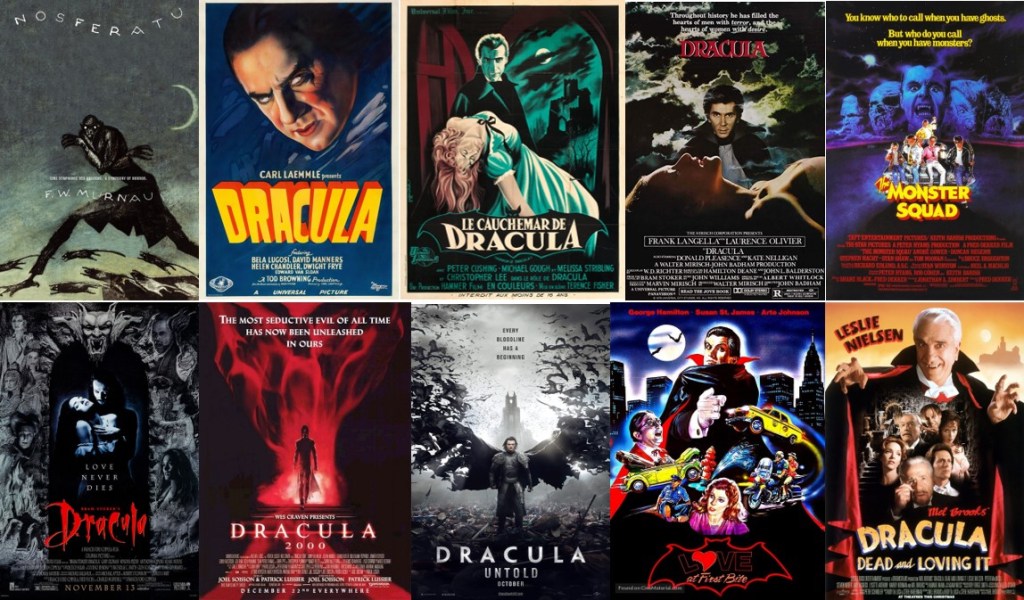
Let’s take a look at some of the notable films featuring the most famous vampire in popular fiction.
Nosferatu (1922)
Nosferatu (or as it’s sometimes-called Nosferatu: A Symphony of Horror) was released on the 4th March 1922, and is the earliest surviving vampire film based on Bram Stoker’s Dracula, albeit loosely.
It is directed by one of the great directors of the silent era, German born, FW Murnau. This was his tenth film, and while many are lost, its by the grace of the movie Gods that this film survives.
The film is set in the fictional town of Wisborg, Germany as Thomas Hutter (Gustav von Wangenheim) being sent Transylvania by his employer Herr Knock (Alexander Granach), to home of Count Orlock (Max Schrek) as he plans to buy property in Hutter’s home town. The locals are terrified by the mention of Orlock’s name and warn Hutter, but he makes his way to the castle and is greeted by Orlock. At dinner, Orlock signs the paperwork, then he notices a photo of Hutter wife Ellen (Greta Schroder), remarking that she has a lovely neck. Hutter begins to suspect Orlock is a vampire.
You can see this film seems to have the familiar story element of the novel, and later films. And the rest of the film follows suit. But the story is stripped down to bare essentials to focus on the otherworldly Count Orlock and his predatory nature, rather than the suave and sophisticated aristocrat. Here he is a killer. The characters have been changed, not just in name, but also in nature, but they are still recognisable, and some combined.
Murnau expertly uses the power of the image to not only tell the story, but without music or audible dialogue create a sense of mystery, suspense and dread as the story unfolds. Some of the images from this 100year old movie have become iconic in themselves. Orlock onboard the boat, Orlock and his shadow moving up the stairs, Orlock feeding on Ellen, and his death via sunlight (where it was first introduced). Amazing works of art in themselves, but in context tell a chilling horror story about an obsessed undead killer that still holds up today.
The film is often referred to as German Expressionism. But the film itself is presented as real, with only Orlock, in appearance and movement, being expressionistic. A masterpiece.
Sidenotes – Nosferatu (1922)
The iconic image of Max Schreck’s Count Orlock in Nosferatu has become as culturally recognisable as Lugosi’s Count Dracula. The bald bat-like features, pointy rat-like teeth, pointed ears and long fingers tipped with claw-like fingernails, paired with a slim physique clad in black. It has since been seen as the ultimate evil version of a vampire thanks to this film. It has been referenced in the Salem’s Lot mini-series from 1979, becoming the face of Kurt Barlow, the Master and the Lord of Lies in Buffy The Vampire Slayer and Angel also referenced the Orlock vampire, as does the short-lived TV show Kindred The Embraced. Even a character in the comedy What We Do in The Shadows is based on the now 100-year-old blood sucker.
Nosferatu was remade in 1979. Nosferatu The Vampyre written and directed by Werner Herzog, and starring Klaus Kinski as the undead Count. And the make-up they used recreated the image of the classic vampire. They put the make-up on the only actor I can think of that didn’t need prosthetics to scare the shit out of you, and in the loose 1988 sequel, Vampire in Venice, the same character, portrayed again by Kinski, was sans make-up. Herzog’s film is actually a great dramatic horror film. The Sequel, not so much.
The film was almost lost forever after a court case between Bram Stoker’s estate and the film’s producers. The court ordered all copies of the film to be destroyed. But luckily, some survived. This and the scarce details surrounding the film and its star, many wild theories surrounding them both, became the film equivalent to an urban legend. The most widely circulated was that Max Schreck was a real-life vampire that FW Murnau persuaded to be in the film. This was later used as the basis for the darkly comedic horror film, Shadow of the Vampire (2000) which starred Willem Dafoe as the Schreck vampire and John Malkovich as FW Murnau. It’s well worth tracking down.
There is currently in production a remake of the original film being written and directed by Robert Eggers and starring Nicholas Hoult, Arron Taylor-Johnson, Lily-Rose Depp, Willem Dafoe, and Bill Skarsgard as the undead Count Orlock.
Evil Never Dies.
Dracula (1931)
The period of the classic Universal horror cycle began in February 1931 with the release of the Tod Browning directed Dracula, starring the great Bela Lugosi.
It follows the novel, but due to the budgetary constraints amid concerns over producing a film in the horror genre, it is based more on the stage play of Dracula written by Irish playwright Hamilton Deane in 1924. Which explains the contained location on sets, the film almost being shot like a play. The play was a great success for Lugosi himself, and would directly lead him to getting the part due to the actor originally slated to play the role, Lon Chaney, became ill.
Thanks to Lugosi’s portrayal of the Count, Dracula was established as a cultural icon, and appearance and performance of the actor would become the archetype for years to come. And he is magnetic in the film. He oozes charm and sophistication of the old-world aristocracy but also the evil and violence just under the surface. Many times, just with a look. His delivery of the lines “I don’t drink…wine” and “The children of the night, what music they make” with such skill that they are some of the most quoted lines in film history.
While some may say that the Spanish language version that was made on the same sets, is the technically better film, it doesn’t have Lugosi. An element I can’t stress enough, is the reason this film was a success, and has lasted the test of time.
Don’t misunderstand, the filmmaking is top notch for the time. Browning, along with cinematographer Karl Freund, are masters of their craft. The framing and execution of the castle sequences when Renfield meets Dracula are amazing. Every frame is a work of art. As is the framing, especially in close up of the lead actor, and fellow co-stars, Dwight Frye’s Renfield, Helen Chandler’s Mina, and the great Edward Van Sloan as Van Helsing.
While Frankenstein has always been my favourite of the Universal Monster movies, this film was the basis, the foundation, for the studios later films. What a foundation it was. In 2000, the film was selected by the United States Library of Congress for preservation in the National Film Registry. Art in motion.
Horror of Dracula (1958)
Following the Curse of Frankenstein (1957), Hammer Studios wanted to do their version of Dracula. So, they did. In 1958, Hammer Studios released Dracula, (or as it was renamed in American Horror of Dracula). I’m using the alternate title here, as there are a lot of ‘Dracula’s out there.
All the same story elements are here, but director Terrence Fisher and screenwriter Jimmy Sangster, made some truly cinematic changes to the tale and its characters. And oh, they were good ones.
In the novel, Jonathan Harker is traveling to Transylvania to assist the Count in buying property in London. Here, his reasons are just a pretext. Harker is here to kill Dracula, and is revealed in his diary entry voice over. This unexpected element surprised audiences and gave the film a sense of urgency other adaptations lacked. Harker is an old friend and student of Van Helsing in this version, and is dispatched before the end of the first act. Starting here, all the characters have a personal stake in events from the start and there are consequences.
Christopher Lee’s Dracula is a different beast and just as surprising. He is a suave, charming aristocrat, and his personable and conversational tone is unlike other Dracula’s. It sets the audience on edge. There is a menace just under the surface from his first introduction, and not just because his footsteps make no sound.
Peter Cushing’s Van Helsing is not presented as an obsessed eccentric, but rather a kind and knowledgeable father figure with a quiet authority. Cushing plays this beautifully. The exact opposite of his Dr Frankenstein and that of Lee’s Dracula.
This film is also the first time sexuality is a prominent element of the story. The scene when Lucy prepares for Dracula’s arrival in her bedroom and the courtship of innocence corrupted is evidence of this. As is the seduction of Mina Homewood. These two victims, the unmarried virgin and the frustrated wife, are already victims of repressed Victorian morality, and Dracula’s turning of these women is a dark twisted eroticism.
This is not presented as theatrical, but operatic, without winking at the audience or unwanted humour. This film is one of my all-time favourites. 10 out of 10 Vampire bats.
Dracula (1979)
The 1979 version of Dracula directed by journeyman director John Badham, is similar to the 1931 production. Both are based both on the original novel and the 1924 play. The star of this film, Frank Langella appeared in a revival starting in the late 70s. There is more of the play in this film than the novel, but is it an amazing film that does things differently.
Apart from changing some of the names around, Lucy and Mina are switched, and combining characters or leaving a few out, this film still follows the same beats as you would expect. The film actually forgoes the Transylvania segment at the beginning, and starts on the ship Demeter on its way to England, where a supernatural dog kills the crew. The ship crashes, and Dracula is the only survivor. He is found on the beach in the middle of the night by Mina (Jan Francis). She is living with Lucy (Kate Nelligan) and Lucy’s father Dr Jack Seward (Donald Pleasence) at their home which is also an asylum. Sounds like fun. But Dracula’s “rescue” on the beach gives him an entrance into the lives of the well to do.
At a party, he is introduced to Lucy, and the sparks fly. And here is where it makes a major detour. From this point, the film becomes a tragic and fantastical love story. And Dracula’s seduction to Lucy, and her devotion to him, is the only good relationship in the whole film. You really do get that the two ‘star crossed’ lovers are meant for each other. Even if one half of the pair is a bloodthirsty killer.
And even that is toned down. Dracula is portrayed as an elegant gentleman, with honour and good humour. But also, as a man who has a terrible affliction that causes him to drink others blood to survive. Something that disgusts and pain the character. Langella steals the show and is hypnotic to watch. He embodies Dracula better than most, even Lugosi and Lee, to give the audience a truly tragic character, full of mystery, lust, passion and, dare I say it, love. Certainly, the most erotic Dracula.
The film is helped by John Williams score, and W.D. Richter’s script.
The Monster Squad (1987)
The Monster Squad is an action, comedy fantasy that works as a ‘Goonies’ like film with monsters. So why am I looking at this film in the middle of a Dracula kick? Well, it has one of the best film representations of Dracula in film. Seriously?
The Squad is a group of pre-teens who love monster movies, especially the Universal monster films. They are leader Sean Crenshaw (Andre Gower), his little sister Phoebe (Ashley Bank), Patrick (Robby Kiger), clumsy Horace (Brent Chalem), tough kid Rudy (Ryan Lambert) and little Eugene (Michael Faustino). Sean comes into possession of the diary of Dr Abraham Van Helsing. But it is written in German. The book contains spells and rituals that can give great power, which is why Count Dracula (Duncan Regehr) travels to America to get the book. But he doesn’t come alone. He has by his side, the Mummy, the Gill Man, the Wolf Man (Jon Gries in human form), and Frankenstein’s Monster (Tom Noonan).
Dracula’s first attempt to get the book sees him sending the monster to retrieve it, but old Frankie ends up befriending little Phoebe and then the rest of the Squad, becoming their newest member. He ends up being the heart of the story, and alongside an old German gentleman known only as German Guy (Leonardo Cimino), who helps them translate the diary, stands against the monsters of old to save their town. And better yet, this film is funny.
Duncan Regehr’s performance as Dracula, is something that we hadn’t seen very often until this point, a version of the Count that is both scary and menacing. And it is rare that you get a truly evil character like this in a comedy adventure film like this, one aimed at younger audiences. When he picks up little Phoebe and growls, “Give me the book, you bitch!” you do get the impression he will kill this adorable little girl. Something I never felt with other versions of the character.
Fred Dekker, who directed, co-wrote the script with Shane Black, and they film it with as much heart as humour. The effects are amazing. Especially the Wolf Man.
Best Line is from Horace: “Wolfman’s got Nards”
Bram Stoker’s Dracula (1992)
If you don’t already know the story of Dracula, then there is no hope for you. When this film was announced with legendary filmmaker Francis Ford Coppola directing back in the early 90s, fans of the novel, horror fans, and cinephiles went crazy on all fours. Coppola was determined to give us all a different take on the tale, and Dracula himself, while remaining as faithful as possible.
1462, Vlad Dracula returned victorious from a campaign against the Ottoman Empire. After a brief battle montage, he returns finds his wife Elisabete dead from suicide after she received misleading news of her Count’s death. Vlad, a devout believer in God, is told by the priest that she will never enter the kingdom of heaven. Vlad renounces God and desecrates the chapel. He is then forever cursed to live in darkness, and tormented to take lives to survive. Not God’s best move.
In 1897, as solicitor Jonathon Harker travels to the Transylvanian home of Count Dracula, replacing R.M. Renfield, to assist the Count in buying property in London. And you know the rest. I mention the opening, because it is very similar to the proposed opening to the Universal film Dracula’s Daughter from 1936, until it was changed.
The old school approach to filmmaking is what makes this film so interesting. There are no optical effects, computer compositing or CGI used. All of the effects are practical and, except for the makeup and prosthetics, all done in camera. Coppola and his crew achieved this through editing tricks, camera movement and placement, miniatures, forced perspectives, matte paintings and multiple exposures. These effects add to the otherworldly nature of the story, which is solidified by Wojciech Kilar’s haunting and terrifying score.
The performances are good, with Gary Oldman’s Dracula and Anthony Hopkins’ Van Helsing being standouts. I really do believe in the love story between Dracula and Winona Ryder’s Mina. Keanu Reeves was miscast as Harker, but luckily you have Richard E Grant, Cary Elwes, Billy Campbell, Sadie Frost and Tom Waits picking up the slack. And while I think the poster design is way better than the film deserves, I watch this every year. It’s a cocktail I keep coming back to. Bloody Mary anyone?
Dracula 2000 (2000)
Dracula 2000 is a horror fantasy film from writer Joel Soisson and director Patrick Lussier. The film does something different with all the familiar elements of the story.
The descendant of Abraham Van Helsing, Matthew (Chirstopher Plummer) owns an antique business built over the site of Carfax Abbey in London. He has two assistants, the super smart Simon (Johnny Lee Miller) and Solina (Jennifer Esposito). One night, Solina lets in her boyfriend Marcus (Omar Epps) and his crew into the building to break into Matthew’s high-tech vault thinking it will be full of treasures. They find a silver coffin. And a lot of booby-traps. They take the coffin with them, hoping there is something inside they can sell.
While transporting the coffin by plane, the occupant, Dracula (Gerald Butler), wakes up and kills the crew and takes Solina as the first of his new brides. We also see there is a connection between Dracula and a girl named Mary. Mary (Justine Waddell), we learn, is the estranged daughter of Matthew, currently living in New Orleans. So, guess where the plane crashes?
Matthrew, followed by Simon, travels to New Orleans, to hunt down and kill the undead. We learn two things here. Matthew is actually Abraham who has kept himself alive all these years by injecting himself with Dracula’s blood filtered through leeches, and that this very act has also made Mary of Dracula’s bloodline as well. And blood calls to blood. Everything heads to a very thrilling climax.
An element of this story that is intriguing is the true origin of Dracula the film puts forth. That he is actually Judas Iscariot, Jesus’ betrayer. After trying to kill himself, God cursed him to be the OG vampire. Explaining the aversion to silver and religious iconography.
The cast is rounded out with solid performances from Colleen Ann Fitzpatrick (aka Vitamin C), Jeri Ryan, Sean Patrick Thomas, Shane West and Nathan Fillion. While the story is merely okay, it is full of great ideas, and stunning visuals that elevate the film. As does the kick ass soundtrack and the haunting score. Reminds me as much of Italian horror and Giallo cinema of the 70s as the gothic horror traditions. Cult Classic dripping from every neck wound.
Dracula Untold (2014)
This film was to be the beginning of the Universal’s Dark Universe, based around the Universal Monsters. Written by Matt Sazama and Burk Sharpless, and directed by Gary Shore, this tale of Dracula is basically the backstory of the character. In the 15th century, Vlad Draculea, Prince of Wallachia and Transylvania, became a ward of the Sultan of the Ottoman Empire. He is trained to be a great warrior in the elite Janissary Corps. He becomes their most honoured and most feared warrior, earning the name Vlad The Impaler, Son of the Dragon. But after becoming disillusioned and sickened by war, he abandons his past and returns home.
Now ruling his lands in peace, Vlad (Luke Evans) and his men have a run-in with a vampire in a cave with devastating results. Following an Easter celebration with his wife Mirena (Sarah Gadon) and son Ingeras, an Ottoman contingent arrives for their tribute, but they also want an additional tribute of 1,000 boys to be trained as Janissaries. Vlad refuses. Knowing that Sultan Mehmed II (Dominic Cooper) is coming to not only take what he wants, which includes Vlad’s son, but to take revenge. Vlad in desperation seeks help from the Master Vampire (Charles Dance) in the Broken Tooth Mountain. Vlad becomes a vampire after a Faustian bargain, so he can protect his family, his people and his land.
The film that sounds like it could be the journey of a good man who, backed into a corner, becomes a creature of the night to defeat a villain, but becomes the monster himself in the process, seems to have been set aside for a dark superhero original story. Every version of the poster pushes this, looking more like retouched Batman posters than that of a dark tragic tale of a fallen character. The Trailers and the film continue the same way. I was surprised there wasn’t a bat signal.
The cast all do marvellous jobs here. The same with Ramin Djawadi’s score. But lack of story and direction, and inconsistent CGI, make this uninspiring and forgettable. Which is the same, there was potential here. Universal could have still used the film to build something impressive, but panicked. It will remain a lost opportunity on all fronts.
Love at First Bite (1979)
Love at First Bite is a comedy written by Robert Kaufman, and directed by Stan Dragoti.
In this tale, Dracula (George Hamilton), and his servant Renfield (Arte Johnson), are forced to leave Dracula’s ancestral home, because the Romanian communist government has seized it to transform it into a training facility for athletes. So, the Count decides on New York because he has become obsessed with a fashion model Cindy Sondheim (Susan Saint James) who lives and works in the city.
Dracula is continually frustrated with the modern world. But everything changes when Renfield manages to get Cindy’s schedule from her agent. When they meet in a nightclub, after the Count is initially mistaken for a waiter, the two hit it off. There is romantic banter, a dance number, and then a night of kinky sex at her apartment.
The next day, Cindy’s psychiatrist, and on again off again boyfriend, Jeffrey Rosenberg (Richard Benjamin), recognises the symptoms and the marks on Cindy’s neck. Being the great grandson of Van Helsing and because he is very jealous, vows to destroy Dracula. Every attempt backfires spectacularly either because people don’t believe him or he has gotten the lore wrong. Which has him end up in either the asylum or lockup. All of which brings Dracula and Cindy closer together. Now engaged they plan to leave the city. As they make those preparations, Jeffery makes a last-ditch effort to beat the count.
This movie is a fun one. It has a good general conceit with the forced relocation and fish-out-of-water elements, well written dialogue for the most part, and some rather solid comic performances (especially from Atre Johnson and Richard Benjamin). Even though Hamilton is playing the straight-man through all of it, he does get one moment to be outrageous, when he drinks the blood of an alcoholic.
The downside, apart from the dated nature of the fashion and ‘modern’ dialogue, is the puns and ‘Dad jokes’ its uses, and falling back on stereotypes, both racial and sexual. It was a successful film upon release, and is almost a cult classic. It is an example of how to use the iconic character in a different genre. Worth a watch. You’ll be laughing like Renfield in no time.
Dracula: Dead and Loving It (1995)
Three years after the success of Bram Stoker’s Dracula, Mel Brooks released his last directorial effort, Dracula: Dead and Loving It. With a cast of newbies and regulars to make the funny at the undead icon.
Unlike the spoof comedies that seem to get worse and worse, Mel always told a story and found the humour at the heart of the story, and exaggerated it. He never went into full parody, although there are parody elements in all of his movies based on an existing genre or specific film. It’s why I love him as a filmmaker.
It follows the story beats from other ‘serious’ adaptations, so you know the basics. What I like is the way the film comments on scenes from the Universal films. The opening with Renfield (Peter MacNicol) travelling to meet Dracula (Leslie Nielsen) on the coach and his interaction with the town’s folk are a great example of this. Chuck McCann’s Innkeeper comically long moustache and Anna Bancroft’s Gypsy Woman shaking her throat with her hand to sound ominous always make me laugh. As does MacNicol’s over the top hammy performance, especially after he becomes Dracula’s servant.
Steven Weber and Amy Yasbeck play Johnathon Harker and Mina respectively, and they are having fun in their roles, as is the man himself as Van Helsing playing the perfect Hammy foil for Dracula. Lysette Anthony as Lucy does get a few lines, but seems to be just a pair of boobs in a dress with barely a joke to contain them. It’s a shame that Brooks regular Harvey Korman as Dr Seward looks rather bored in his role.
I have two issues with the film. Scenes just kind of end without warning or humour, and nothing pushes the plot along in these instances. The second is Leslie Nielsen. He leans more into goofball territory instead of the straight man in ridiculous situations. It does work as well.
This film always made me laugh, loudly. I still quote it to this day. Jonathon being seduced by the undead Lucy is great. And the staking of Lucy by Jonathon and Van Helsing is always dangerous as I can’t breathe. Was the right film to end on. Love you Mr Brooks.
 Exploiting Wonderland
Leave a comment