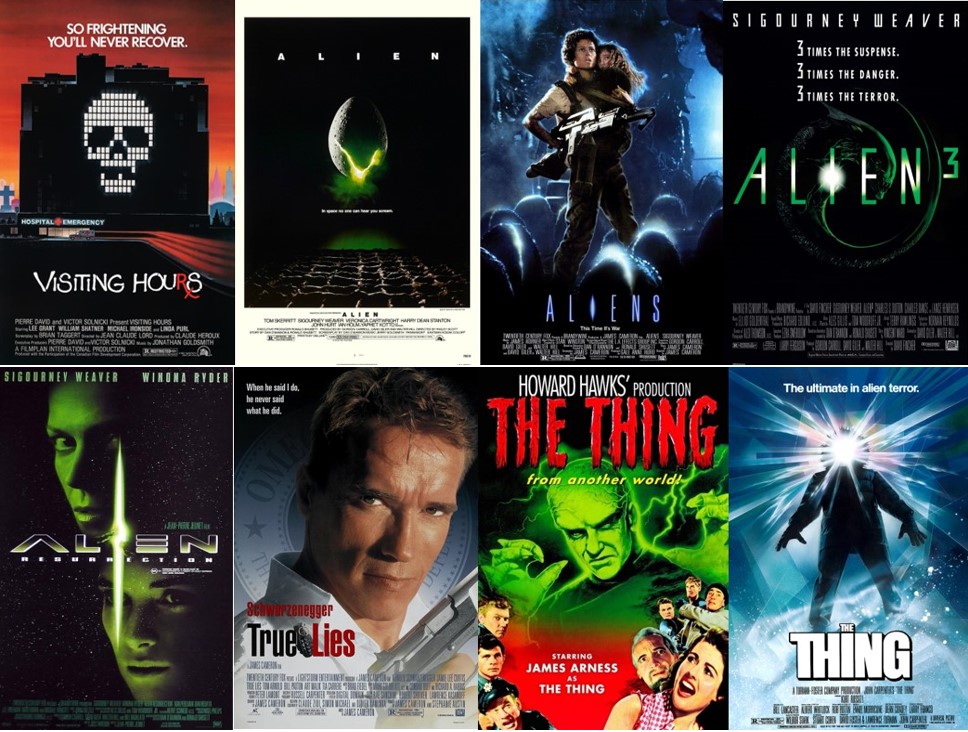
Visiting Hours (1982)
Visiting Hours is a Canadian psychological thriller directed by Jean-Claude Lord, that also sits comfortably in the slasher genre of horror films. It’s a film that I’ve only seen once before, and I remember not liking it. Well, I can confirm, my younger self was wrong.
Deborah Ballin (Lee Grant) is a feminist activist and television presenter. On air, she puts a misogynistic lawyer in his place as Deborah defends a woman who was on trial for defending herself against her abusive husband. Her friend and producer Gary (William Shatner, playing it straight here) is upset because Deborah went on the attack and didn’t remain impartial. Ah, those were the days.
The broadcast has drawn the eye of a misogynistic psychopathic killer, Colt Hawker (Michael Ironside), and he attacks her in her home, also killing the housekeeper. Neighbours come to her rescue, and Colt flees. Deborah is rushed to County General Hospital with cuts, a broken bone and surgery in her future.
Colt, after repeatedly entering the hospital, kills off any woman who’s supportive of Deborah, as well as a few men who get in the way. Until the inevitable confrontation between Deborah and Colt.
The psychological terror of the main character in this film, you can feel. For most of the film’s running time, Deborah is trapped in a hospital while Colt messes with her, killing off friends and her support. And Academy Award winner Lee Grant (yes, you read that right) does an amazing job here. You feel for what she is going through and you want her to succeed and be safe in the end.
Likewise, Michael Ironside is on point as the killer in this film. He just oozes sleaze and malevolence in every frame, chilling you to the bone. Not bad for a performance with hardly any dialogue.
A nice addition to this story, is the character of nurse Sheila Munroe (Linda Purl), who befriends Deborah. After a bad divorce, she is now in a same sex relationship, raising her children. And it is presented in a positive light. Something that didn’t get seen in the 70s and 80s all that often. While she becomes a target of Colt, she goes into Mama Bear mode and survives.
Well, worth a watch.
Alien (1979).
The Alien franchise is iconic in the sci-fi realm and in film history. So, with four films in the original series, let’s get started.
Onboard the commercial spacefaring tug Nostromo, the seven crew members are woken from statis by the ship’s computer, known as MOTHER. Captain Dallas (Tom Skerritt), Executive Officer Kane (John Hurt), Warrant Officer Ripley (Sigourney Weaver), Navigator Lambert (Veronica Cartwright), Science Officer Ash (Ian Holm), and engineers Parker (Yaphet Kotto) and Brett (Harry Dean Stanton) have all been woken early so they can investigate a mysterious signal of unknown origin. Upon reaching the source of the signal, a planetoid LV-426, they land with Dallas, Kane and Lambert venturing out in spacesuits to find the signal’s source.
They find a crashed alien spacecraft that looks like it has been there for some time. Inside they find a giant alien pilot (nicknamed the Space Jocky by the production) dead in his chair with a hole punched through his chest. They also come across a hole burnt into the floor leading down into another cavernous room. A room filled with leathery pod-like eggs. When Kane is lowered down to check it out, he gets too close to one and it opens, launching a creature like a fleshy mix of a spider and a grab at Kane. It smashes through his helmet and attaches itself to his face.
When Dallas and Lambert take Kane back to the ship, Ripley refuses to let them onboard citing company rules. But Ash disobeys and opens the door. This causes major tension between the crew. Finding they can’t remove the creature from Kane’s face without killing him, because the little critter has acid for blood, they monitor Kane and the creature and learn all they can. Later the creature falls off and dies, leaving Kane alive and well and with no memory of the events prior to the chamber on the ship. Later at dinner, an alien burst out of Kane’s chest, killing him, before racing off into the bowels of the ship. Waiting to exterminate the thing, they soon find it has grown to the size of a man, and starts picking them off one by one until only Ripley and the ship’s cats Jones remain.
Sci-fi horror films were nothing new when Alien arrived on screens in 1979, but they were never taken seriously. Apart from the original Godzilla, most of them were cheesy monster movies with atomic power and the cold war at the centre of the story. But as horror started to be taken seriously in the 70s, it was only natural to combine the two genres. Even if Alien was only greenlit because of the success of Star Wars.
Dan O’Bannon and Ronald Shusett’s script is full of ideas from all over sci-fi and horror, with many influences from novels, comics, film, and TV. But having H.R. Gieger come on board from very early on, (O’Bannon had Gieger’s designs in mind when writing), creating a movie monster that has been theorised about, critiqued, analysed, and then improved upon. Its biology is just as terrifying as its visage.
Ridley Scott, along with cinematographer Derek Vanlint, and the production designers, created a horror film full of atmosphere and tension, and like a classic road-based thriller, with nothing but empty space around them, the characters and the action are confined in an increasingly more claustrophobic structure. Having the sets be real, enclosed and as functional as possible sells that, as does the performances from the cast. Which is one of the best in the genre.
This film is often called a gothic horror or a ghost story in space. And I can’t say I disagree. That idea is telegraphed when you first see the Nostromo in space looking like a giant gothic cathedral. And the crew waking from stasis, evokes vampires rising from their coffins. It’s like gothic meets space age, and seeing that Ridley Scott always plans out his visuals, I don’t think either of these was an accident. And the visuals in the film are amazing. Ok, the explosion of the Nostromo at the end is a little weak.
It’s a film that starts slow and then ramps up to a fever pitch. Jerry Goldsmith’s score just adds to the effect with a mix of traditional orchestrations and romantic themes with an electric soundscape.
This movie was also the birthplace of the best female action hero in cinema.
I could talk about this film all day.
Sidenotes – Alien (1979)
In the Alien franchise, company Weyland-Yutani and its greed is just as big of a villain as the Xenomorphs. Maybe more so. Their mandate to seek out alien races and alien technologies to steal and/or destroy, for the company’s bottom line is what started this mess in the first place.
It starts in the original, with the computer MOTHER waking the crew from stasis to investigate a signal. MOTHER, whilst not A.I., is close. And company tech. When the company is informed of the possible hostile alien that they could use in their bioweapons division, it becomes all other objectives rescinded and crew expendable.
The company’s imperatives are embodied in the science officer Ash, who we find out is an android placed on the Nostromo by the company to protect their interests. And their interests here is procuring a xenomorph.
In the sequel, the company has a terraforming colony on LV-426, where the crew from the original found the alien spacecraft full of eggs. A salvage team to the coordinates, and find it they do. One of the team comes back with a face hugger attached. Starting the genocide of the human colonists. The aftermath Ripley and the Colonial Marines walk into. Burke, who accompanies them, doesn’t mind sacrificing everyone to get rich by bringing back a xeno. On both counts, it’s humans and facilities expendable. This could be the filmmaker commenting on the yuppy and consumer/business culture of the 80s. These business assholes were reading The Art of War like it was a manual for success. The corporation, like the alien hive, is every part working for the whole. But their goal is cult-ish and artificial.
In the third film, the company is not as evident, but it is a driving force moving Ripley along as she knows what is likely to happen when the “rescue” team arrives on Fury 161, that whole expendable thing again.
The fourth film, Weyland-Yutani is replaced with Combined Earth Military, but it’s basically the same cold heartless organisation. Money and military advantage trumps human life. They have to have the bigger dicks.
Ripley says it best: “You know, Burke, I don’t know which species is worse. You don’t see them fucking each other over for a goddamn percentage.”
Aliens (1986).
The film opens with a salvage team finding the Nostromo’s shuttle Narcissus floating in space. Inside they find the still alive and sleeping forms of Ripley (Sigourney Weaver) and Jones (the cat). When she wakes, she is in a space station hospital with stunning views of Earth, and a company rep Carter Burke (Paul Reiser) breaks the news that she has been sleeping for 57 years and her daughter Amanda is dead. After a hearing, she is stripped of her rank and flight status and blamed for the destruction of the Nostromo. The company man deciding her fate informs her that there are now hundreds of people living on LV-426 as it’s now a terraforming colony.
After the company loses contact with LV-426, Burke and Lt. Corman (William Hope) of the Colonial Marines, come to Ripley and ask for help. Accompany the Marines to the planetoid and advise them, and all rank and privileges will be restored. Still traumatised, she agrees on one condition. If the alien threat is there, they are to be wiped out.
On the spaceship Sulaco, Ripley, Burke and the marines wake up for stasis. We meet stoic bad-ass Corporal Hicks (Michael Biehn), over confident Private Hudson (Bill Paxton), science officer and android Bishop (the great Lance Henriksen), Sergeant Apone (Al Matthews), and the warriors of the group Privates Vasquez and Drake (Jenette Goldstein and Mark Rolston). There are others, but they are mainly alien fodder.
Landing, they get to work. They find the place deserted, evidence of a fight, makeshift barricades and strange burns on the floor. The only survivors are two face huggers in containment tubes in medlab and a frightened little girl named Newt (Carrie Henn), who has been using the air vents to stay alive. Ripley and Newt bond. And Burke, forever the company man, hatches a plan to take an alien back to Earth.
When the aliens reveal themselves, the marines fight back, losing many of their numbers. The rest make a plan, to escape the alien threat but also, they have to race against the clock to get off planet before the nuclear reactor goes critical. But the alien queen and her children won’t make their escape an easy one.
You would think that a sequel to Alien was a forgone conclusion, but it took 7 years before a follow up would be released. Mainly due to legal issues between 20th Century Fox and Brandywine Productions and no one at the studio thought a sequel had legs. But in 1986, James Cameron’s follow-up hit screens, pluralised no less.
If you have seen it, you will know that the sequel is a very different beast. The original had the pacing of a psychological thriller with a much slower pace. If the first was a haunted house in space, the sequel is definitely an allegory for the Vietnam war, but in space with creepy aliens. Superior technological force taken down by its opposite. Cameron’s sequel, while maintaining the sci-fi horror elements, is an action film. It is filled with gung-ho soldiers, guns, explosions, and a fast-paced story. But it also maintains the quieter dramatic moments and character development for all. It’s something that Cameron does better than most, you become invested in the characters, even the minor ones, and you feel it when they die.
While Bill Paxton’s Hudson steals every scene he is in, (and gives us on of the most quoted lines) and Lance Henriksen gives one of his best performances as Bishop, it’s the slowly evolving family dynamic between Ripley, Newt and Hicks that is the centre of the story and the element that sees them surviving the events. Because elements of family are present in this film more so than the original. Ripley finding out her daughter has died, and getting a second chance with this odd family unit are quite lovely. She feels she failed to be there for her daughter because of the events of the first film, and on some level, she blames the aliens. The alien Queen protecting her family is the dark mirror of this.
James Horner’s score enhances every scene perfectly, not bad considering he only had 3 weeks, and Stan Winton and his team effectively add to the aliens’ designs. This is a flawless sequel that delivers. Weaver was even nominated for an Oscar for her role in this. And it also gave us the most bad-ass line ever, “Get away from here, you bitch!”
Sidenotes – Aliens (1986)
There has been a lot said of the maternal nature of Ellen Ripley in the Alien franchise. The protective mother keeping her family safe. But I put it to you, in the course of the original four films that she had to become that warrior mother over time, and it wasn’t set in stone from the beginning.
In the first film, Ripley is part of a crew, and apart from her apparent friendship with Dallas, she doesn’t seem to be close with any of them. They are just ‘friends from work’. She seems more interested in doing her job by the book, than developing any lasting relationships on ship.
Her motivation is to get home for her daughter Amanda’s 11th birthday. Apart from this throw away piece of information, there is no other indication that she is maternal or even a hero, of any variety. She is just trying to survive the ordeal. She ends up starting to embody the maternal action hero that she is seen as, when, in the middle of a self-destructing ship, she goes back to rescue Jones the cat.
In the sequel, the pain and trauma Ripley goes through before returning to LV-426, is not only because of her encounter with the alien, but the feelings of guilt and failure at not being there for her daughter. Learning that her daughter had grown old and died while she was sleeping, adds to this.
The relationship she forms with the orphan Newt is her redemption of sorts. And the odd little family she ends up with by the films end of Newt, Hicks and Bishop, and them all sleeping peacefully, shows she has healed.
With rescuing Newt from the Alien hive, she evolves into the warrior action hero. She is set on burning the world down to find, for lack of a better term, her adopted daughter. Her only real obstacle is the Xenomorph Queen, who like Ripley, is protecting her family. It is one of the best action sequences ever put to film in my opinion.
When she again loses everything by the start of the third film, we feel her pain. We know it’s the end for her. One last act to protect other families is all she has left.
Alien 3 (1992)
After another 7 years, 20th Century Fox released another sequel in the Alien franchise. It hit screens in 1992, directed by David Fincher. It was not received well, and is still considered one of the weakest entries.
Set shortly after the events of Aliens, our survivors are sleeping in stasis on their trip back to Earth. Somehow, there are alien eggs on board. One of the face huggers causes a fire onboard. The ship’s computer seals off the stasis room, and since it also operates as a life pod, ejects it into space and programs it to head to the nearest planet.
That planet is Fury 161, a prison planet where the inhabitants have all been rehabilitated via a Christian fundamentalist faith. But the pod crashes and the prisoners rescue the only survivor, Ellen Ripley (Sigourney Weaver). The prison doctor, a former inmate, Dr Jonathan Clemens (Charles Dance), heals her wounds and when she wakes up informs her of her current situation.
After examinations on Hicks and an autopsy on Newt, to determine if there was an alien presence, she soon finds out that she has been impregnated with a new alien queen. Else were in the prison, an alien bursts out of a dog, and when grown to full size, starts picking off the prisoners. This further strains the relationship between her and the inmates, believing she and the alien are a punishment from God. After Clemens is killed, her only ally is Dillon (Charles S. Dutton), who convinces the prisoners to help Ripley kill the alien before the company reps/rescue team arrive on the planet. And the race begins, as does the screaming and the dying.
There are great actors in this film from America and England, such as: Paul McGann, Brian Glover, Ralph Brown, Danny Webb, Holt McCallany, Christopher Fairbank, Pete Postlethwaite, and Lance Henriksen reprising his role as Bishop and Bishop’s human creator.
Even with Fincher in the director’s chair and more money thrown at the production, this was a mis-step. Not only does everything look cheap, but the footage is edited badly, the SPFX doesn’t hold up, and the story logic is non-existent. Which is a shame, Fincher is a good director and there are good ideas here. Verdict: Skip it.
Sidenotes – Alien 3 (1992)
The making of this film would make an amazing film. Or at least a great book. The treatment of the film’s director, David Fincher, was so traumatic that he didn’t direct another feature film for three years. And he has disowned the film, not even returning to participate in the DVD and Blu-Ray Special Editions or audio commentaries. To find out more, check out these materials and the endless YouTube reviews.
Fincher isn’t the only one who didn’t have a good experience. Sci-fi novelist and father of modern cyberpunk, William Gibson, wrote an amazing script. Having a communist off-shoot creating their own empire and being at war with the Weyland-Yutani run Earth government was a nice touch. And having them encounter the Xenomorph and their eggs after boarding the Sulaco got the story rolling. Ripley is unconscious for most of the story, giving Hicks, Newt and Bishop control of the story. Many of the ideas about the origin of the Xenos, their continuing evolution, and how the company wanted to use them turned up in Alien Resurrection and the two Ridley Scott prequels. If you are curious about this story, the screenplay was published, and it was also adapted into a graphic novel and an Audible Original audio play with Michael Biehn and Lance Henriksen reprising their roles as Hicks and Bishop. I would have preferred this as the third movie.
Filmmaker Vincent Ward was the next one to tackle the script, and his idea of a strange wooden planet hanging in space with advanced technology at its core that none of the technology renouncing pacifist monks know how to operate, was an interesting idea. But a lot of this script was re-written into what Alien 3 became. And again, after watching documentaries on this aspect and doing some reading, I would like to see this too.
These are just three battles in the making of Alien 3, and none of them ended well for the creative artists who undertook them. The studio, trying to protect their investment, people who were not filmmakers, destroyed something wonderful. In the process, damaged their own I.P. and cause harm to the people they rely on to bring these tentpole attractions to life. And it hasn’t gotten better.
Alien Resurrection (1997)
At the end of 1997, Alien Resurrection was released at cinemas, directed by acclaimed French director Jean-Pierre Jeunet, and with Sigourney Weaver returning to her most iconic role.
Set 200 years after the events of Alien 3, military scientists on board the space vessel USM Auriga, led by Doctor’s Wren and Gediman (J.E. Freeman & Brad Dourif), have been using Ellen Ripley’s blood samples from Fury 161 to clone Ripley and the Xenomorph queen. The clone is the embodiment of Ripley, all her memories, feelings and her appearance. But also, something else. Even though the alien queen had been surgically removed, there has been some genetic crossover. Ripley now has increased strength, hearing, acid for blood, and the Xenomorph’s genetic memory. But Ripley is not the prize, just a side effect. The alien queen was the goal. And she has started producing eggs.
The military contracts the mercenary crew of The Betty for human test subjects for embryo implantation. The Betty’s grew, Captain Elgyn (Michael Wincott), Johner (Ron Pearlman), Christie (Gary Dourdan), Vriess (Dominique Pinon), Hillard (Kim Flowers), and Call (Winona Ryder) enjoy some R&R onboard the Auriga after delivering their human cargo. Call is carrying a secret.
In the lab, they lose control of the new Xenos. Ripley teams up with The Betty’s crew, a military grunt Distephano (Raymond Cruz), and Wren, to escape the ship and destroy it before it reaches Earth.
The fourth instalment is a little decisive, you either love it or you hate it. Personally, I love it. Unlike three, four went in a different direction but that direction was solidly built upon previous films. Along with cinematographer Darius Khondji, Jeunet delivers a visual feast of a movie that blends the elements of the first two entries with a crazy and dirty aesthetic more in line with his previous fantasy films. And it’s the reason I love this movie.
The cast is great, dialogue is quotable, John Frizzell’s music gives me chills, and the CGI elements are more competent then three. But it’s the new, improved but still traumatised Ripley that takes centre stage, and Weaver is the queen. The aliens are practical, as is the Xeno/Human hybrid at the film’s climax, which is stuff of nightmares.
Sidenotes – Alien Resurrection (1997)
There are just a few things I’d like to mention here.
While Jean-Pierre Jeunet was the director, all the major decisions were already made by the studio, and couldn’t be changed. So, he added his own look and feel to the film through the visuals, which cinematographer Darius Khondji and French effects wizard Pitof helped make a reality. And with the special effects and CGI crews, made the film look very different to the previous entries. Especially the colour palette. The sterile and cold blues and greys, mixed with Earth tones and greens. Both achieved mostly through lighting and costumes. And I like the way the light picks up on all the organic reflective surfaces, like water, blood, and the alien goo, of which there is a lot in this film. Just look at the sexualised imagery on display when you get to the alien hive.
Jeunet also uses kinetic camera movement and odd camera angles throughout the film which inform the action and horror element better than the first and third instalments.
There are a number of scenes where the Xenos are completely CGI. While some are jarring, some work well, and are their best in the underwater sequences, giving the Xenos a shark or eel like quality thanks to their tails.
But one thing that isn’t CGI, but all practical, is the Xeno/Human hybrid called The Newborn. It is a fully designed and articulated puppet. The amount of movement in the facial expressions, coupled with the sounds the creature makes, are frighteningly effective. It’s like a toddler from hell.
Joss Whedon’s script, while tailoring the story for what the studio wanted, has some great ideas and themes, but the dialogue is flat, with the exception of that spoken by the characters Johner, Vriess and Elgyn. But Weaver does get some good lines too. I watch this film now and I can’t help thinking that the crew of The Betty was an early run though for what would later become Firefly.
While I did mention in the main review that the film had quotable dialogue, it has only a few memorable lines, and they are not as epic as “Get away from her, you bitch!”. The script, personally, is where the film alternately fails.
True Lies (1994)
True Lies is an Action Comedy that I first saw when it was first released in cinemas. Then, as now, the enjoyment I have watching the film should be illegal.
Arnold Schwarzenegger plays Harry Tasker, a U.S. government agent/ super spy who struggles to balance his clandestine job with his life as a husband and father in suburbia. His introduction is on a mission where he is infiltrating a heavily guarded mansion in the middle of a party, to steal data. Harry’s best friend and partner in the agency, Gib (Tom Arnold) is running tech support in a nearby van with Faisil (Grant Heslov). To distract security on the way out, Harry tangos with sexy archaeologist Juno (Tia Carrere). Then there are explosions.
The data they retrieved points to a terrorist organisation, Grimson Jihad, led by Aziz (Art Malik), using Juno’s diplomatic connections to smuggle nuclear warheads into the United States to make a destructive statement.
What throws a spanner in the works, Harry finds out that his wife Helen (Jamie Lee Curtis) is having an affair. Which isn’t the case. She is being scammed by a car salesman who is trying to sleep with her. Harry uses his agencies’ resources to follow and spy on his wife and the sleazy Simon (Bill Paxton).
But the terrorists are not so distracted. They kidnap Harry and Helen for interrogation. Our heroes escape in a great sequence, but have to jump into action when Aziz’s big statement also involves kidnapping Harry’s daughter Dana (Eliza Dushku).
His film is what a fun cinematic experience should be. Directed By James Cameron, proving he can do comedy, it’s a perfect mix of action and comedy with everyone in the cast getting moments in the sun with the comic, dramatic and action elements. Jamie Lee Curtis even won a Golden Globe for her role. Curtis herself performs the film’s best stunt, for real. That is actually her hanging from the helicopter when her character is being rescued from the Florida Keys.
Arnold is believable as the family man/spy, and delivers the comedy better than any of his comedy film outings. But it’s Tom Arnold who steals the show with his improved and amazing line delivery.
Sidenotes – True Lies (1994)
Doing some reading on this 90s action classic, I found out a few things I have to mention.
Did you know that this is actually a remake? Well, it is. Cameron’s script was based on the screenplay for a French 1991 action comedy called La Totale! Written by Simon Micael, Didier Kaminka and Claude Zidi, who also directed. The Schwarzenegger remake follows many of the same story beats, but ramps up the action in true Hollywood style. I’ve only seen the trailer for the French film, but it is now on my list of movies to track down.
The items I found out were not always nice ones. In 2018, Eliza Dushku, who plays Dana Tasker, revealed that as a twelve-year-old working on the film, she was sexually molested by the then thirty-six-year-old stunt coordinator Joel Krammer. After an adult friend of Dushku’s confronted Krammer about this, Dushku was seriously injured in a stunt. When the director James Cameron and stars Schwarzenegger, Jamie Lee Curtis and Tom Arnold found out about it in 2018, they all stood behind her and praised her for her bravery. I think if Cameron found out about it back then, Krammer would have fallen victim to one of his own stunts. You don’t mess with Cameron or his stars. I considered Dushku an icon of sci-fi fantasy, now I think she deserves the title ‘Legend’.
Jamie Lee Curtis’ role, and the actual stunt she performed hanging from the bottom of a helicopter, are amazing, many critics at the time had issue with the sexy strip tease dance she does in the hotel room. That sequence has become iconic, and is now seen as a feminine empowerment moment. It was Curits who worked out exactly how that scene would be played out. Including all the mistakes her character makes.
And finally, did you know Schwarzenegger was nervous about performing an important element in his film. And not, it wasn’t the comedy. It was dancing. He trained for six months to be as good or better than Al Pacino was in Scent of a Woman at the tango.
This film is amazing. All the principal cast are still friends to this day. While no sequel materialised, there is a new TV series.
The Thing From Another World (1951)
John Carpenter’s The Thing wasn’t the first film to adapt John W Campbell’s 1938 novella “Who Goes There?” into a feature film. Released by RKO Pictures, produced by the legendary Howard Hawks, and directed by Christian Nyby, this nail-biting sci-fi horror film was released in 1951, in the middle of cold war paranoia.
The film centres around a group of US Air Force personnel, scientists and civilian crew at an Arctic research station investigating a crashed flying saucer buried in the ice. When the thermite charges they use to retrieve and examine the downed spacecraft inadvertently cause it to self-destruct, they start to head back. They discover a humanoid shape frozen in the ice. Playing it safe this time, the crew cut the alien out of the ice and transported it back to base.
While at the facility, the ice melts thanks to an electric blanket keeping one of the guards warm, and the alien begins to kill. Starting with the sled dogs. The scientist soon discovers that the alien is not an animal, but a plant. A humanoid, intelligent vegetable who feasts on animal protein, specifically blood. With the members of the research station now on the menu, they all band together to defeat the ‘walking carrot’ and win the day.
Okay, it does sound a little silly compared to the 1982 remake. But I assure you, it is actually a really good film. The black and white presentation allows for more interesting creature effects, for the time anyway, and the use of light and shadow with the black and white photography, is as stunning as it is atmospheric.
The cast of characters are the stock standard collection of sexes, ideological views, educational achievement, and socio-economic backgrounds. And they are all played by character actors and old school sci-fi stock players.
Robert Nichols and Douglas Spencer from This Island Earth, Kenneth Toby from everything, and the monster is played by future western TV icon James Arness.
There are many of Howard Hawks signature touches here too. The overlapping dialogue, conflicting authority figures and a strong female character (often called the Hawksian Woman).
It is an important film in science fiction, despite the killer vegetable. And still an enjoyable watch.
The Thing (1982)
In Antarctica, a team at an American Research Station witnesses a helicopter chasing a shed dog. The Norwegian’s onboard from a nearby research station, are shooting at the dog and dropping explosives to kill it. When the helicopter lands at the American camp, it doesn’t end well for the Norwegians. The dog is rescued by the dog handler, Clarke. Pilot MacReady and Dr Copper head to the Norwegian camp to investigate.
Once there, they find charred and frozen corpses, a giant block of ice that once had something large inside it and a burnt corpse of a malformed humanoid. Which they bring back to the American station for biologist Blaire to examine. This is the body of an alien creature that assimilates any living thing it touches and copies them completely. It only needs a few active cells to do this. Between the corpse and the rescued sled dog, the assimilation begins. The story becomes one of paranoia and survival as the creature hides in plain sight waiting to find a larger population and the human’s try to find all of this alien threat and destroy it before it gets to a large population.
This film is one of the best sci-fi horror movies ever made. A box office failure when it was first released, it has become a certified cult classic being studied, analysed, and discussed since it landed.
Like The Thing From Another World, this is also based on John W Campbell’s Who Goes There?, but it’s not a remake of the original film. To use a contemporary phrase, it’s a re-imagining, with callbacks and homages to the 1951 film. Directed by John Carpenter (my favourite filmmaker) he uses his amazing talent to bring this story to twisted life. With a script by Bill Lancaster, cinematography by Dean Cundey and music by the legendary Ennio Morricone, he crafts a tale that is visual stunning, but ultimately terrifying with the performances of the ensemble cast of character actor as front and centre as that of the creature effects created by the great Rob Bottin, which are some of the best put to celluloid. I seem to watch this twice a year, including the documentaries. I recommend it to every human and non-human on the planet.
Sidenotes – The Thing (1982)
This film has one of the best ensemble casts of any sci-fi horror film. Especially for the time. It’s a mix of film, television and theatre characters actors. And everyone gets a moment to shine. We have Kurt Russell, Wilford Brimley, Keith Daivd, Richard Masur, T.K. Carter, David Clennon, Richard Dysart, Charles Hallahan, Peter Maloney, Joel Polis, Thomas Waites, and Donald Moffat (who has my favourite line in the whole movie). And that line is, “I know you gentlemen have been through a lot, but when you find the time, I’d rather not spend the rest of this winter TIED TO THIS FUCKING COUGH!”
The Thing when it was first released, was a box office flop. Opening against E.T.’s box office strong hold, audiences were put off by the bleak story and the gory effects. And the critical reception wasn’t much better. Critics attacked its gory effects, tone, and characters. Vincent Canby, called it “too phony looking to be disgusting. It qualifies only as instant junk”. Dave Kehr wrote that it was “hard to tell who’s being attacked, and hard to care.” Likewise, Roger Ebert was disappointed by the “superficial characterizations and the implausible behaviour” and dismissed the film as nothing more than an Alien (1979) knockoff. All bullshit, and time has proven this. The film has gone on to be not only a cult classic, but one of the finest examples of the sci-fi and horror genres. It’s also John Carpenter’s favourite of all his films.
The studio that made The Thing, cancelled their multi-picture deal with Carpenter. Projects were cancelled. The only reason he took on the directing duties on Christine (1983), is because he needed a job, and so far, it’s one of the only studio experiences that didn’t end in disaster for Carpenter because of either box office or studio executive interference.
Carpenter is a storyteller. It’s a simple enough moniker for this creative cinematic titan. But the way he tells his tales is unique, and has influenced other filmmakers, writers, and artists. The Thing, like Ridley Scott’s Blade Runner, has influenced in, of been homage by, other creatives and their work.
Not bad for a man who was once called the Pornographer of Violence.
 Exploiting Wonderland
Leave a comment