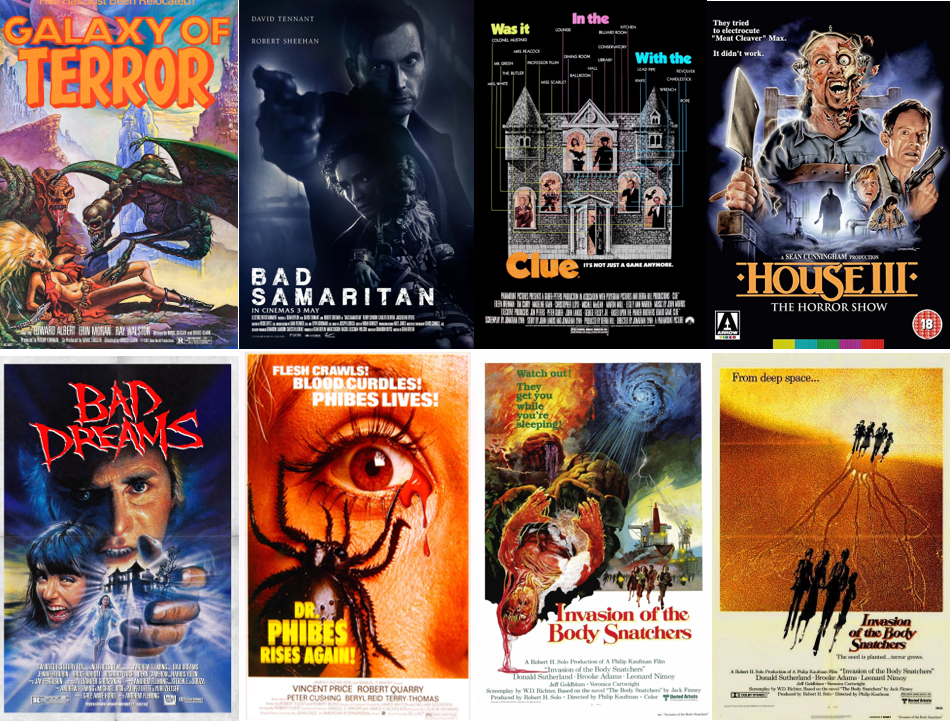
Galaxy of Terror (1981)
When your friend discovers a movie they haven’t seen, sometimes you just wanna be there and watch it with them just to see their reactions to the film. And today’s film is just one of those.
Galaxy of Terror is a 1981 sci-fi horror film from New World Pictures and Roger Corman. Usually called one to the Alien knock-offs that flooded the cinematic landscape, but that is selling the film short.
The story opens with the sole survivor of a mission on the planet Morganthus, being stalked and killed by an unseen killer. On the planet Xerxes, Planet Master, a mystic and leader, sends one of his military commanders to Morganthus, with a team, on the ship Quest, to investigate the lost mission. After crashing on the planet, the crew investigate the surface and a strange looking pyramid they find there. Inside, each member of the crew falls victim to their own worst fears made real.
The team is the classic rag tag team that covers the spectrum of the socio-political and cultural of the times. The characters are, over the hill commander (Bernard Behrens), the ‘hero’ Cabren (Edward Albert), his love interest and ship psychic Alluma (Erin Moran), ships mysterious cook Kore (Ray Walston), by the book asshole second in command Baelon (Zalman King), technician Ranger (Robert Englund), technician and pin up girl for the film Dameia (Taaffe O’Connell), warrior Quuhod (Sid Haig), the first to die Cos (Jack Blessing), and unhinged pilot Captain Trantor (Grace Zabriskie). All genre favourites and character actors.
The production shines, even if the direction and the story at times does not. The alien world and sets are very Gieger like, which is where, along with the diverse crew, the Alien comparison comes in, but this is a different beast altogether. On a small budget, the creatures and the special effects are just wonderful, and still hold up, even in HD. While one creature looks like a melted genetic experiment of a donkey and a lizard, all the deaths, especially the giant maggot death (you read that correctly) are executed masterfully. And why shouldn’t they be, James Cameron was responsible for those.
Not the best, looks amazing.
Bad Samaritan (2017)
Ever since David Tennent took over the Timelord duties in Doctor Who, there hasn’t been a role or genre he hasn’t tackled. I’ve always gone out of my way to watch everything he has appeared in or lent his voice too. The first season of Jessica Jones, and Good Omens are some of my favourites.
So, when I found out he did a small American independent film directed by Dean Devlin, my ears pricked up. And considering I heard about this film in 2020 and it was made in 2017, I wondered why it took so long. After a brief search, I landed a copy.
This crime thriller starts out with artist Sean Falco (Umbrella Academy’s Robert Sheehan) and his girlfriend Riley (Jacqueline Byers) sharing some quality time. Sean works as a valet with his best friend Derek (Carlito Olivero) at an expensive Italian restaurant. But they have a side hustle. The boys, before parking their cars of the restaurant’s patrons, drive to their houses with the use of GPS tech in most high-end cars and robs.
The second score of the night comes when Cale Erendreich (David Tennent, struggling with the American accent) pulls up in his Maserati (someone should have told him the 80s are over), and acts like a massive dick. But when Sean takes the car and arrives at Cale’s house, he finds something rather disturbing. A young woman, Katie (Kerry Condon) bound, gagged and chained to a chair in Cale’s blacked out office surrounded by security cameras. Sean freaks out, and after failing to free Katie, heads for the police.
But Cale is the smart and imaginative kind of psychopath. And as Sean goes from authority to authority to get someone to listen to him, Cale starts to systematically destroy Sean’s life. His family is financially ruined, and Derek and Riley attack.
While the climax is amazing and a little refreshing, it’s the performances that keep you watching. The story, while has an interesting idea, of a nutter using modern technology to carry out his plans (which I’ll keep secret), is where the film is let down. It never reaches the heights aimed for. There is a great film in here somewhere. As it is, this is just okay.
Clue (1985)
It always surprises me that films that fail at the box office on their initial release, become some of my favourites and cult classics. The endlessly quotable black comedy mystery film Clue, is one just film. Based on the classic board game of the same name (well, it’s called Cludeo out here), this comedy that constantly appears on the best comedies of all time lists, just missed the mark, only making $14.6 million on a budget of $15 million. Missed it by that much.
The film opens with the butler Wadsworth (the flawless Tim Curry) arriving at a mansion to prepare for a mysterious dinner party. The other servants, the maid Yvette (the busty Colleen Camp) and the cook Mrs Ho (Kellye Nakahara), are also preparing. As the guests arrive as instructed by letters, they all received, they all have been given pseudonyms for the evening. All the characters are here: Mrs Peacock (Eileen Brennan), Mrs White (Madeline Kahn), Professor Plum (Christopher Lloyd), Mr Green (Michael McKean), Colonel Mustard (Martin Mull), and Miss Scarlet (Lesley Ann Warren). The dinner party gets under way as they await Mr Body (Lee Ving) and the revelations that every guest is being blackmailed by My Body. When Mr Body seems to be killed, the comic insanity begins as the guests and staff try to figure out what happened and what is going on.
Directed by Jonathan Lynn (Nuns of the Run, My Cousin Vinny, The Whole Nine Yards) and co-written by Lynn and John Landis, I always wonder what exactly was scripted and what was improvised by this cast of comic talent. Because this movie is laugh out loud funny, quotable as hell, and features three endings. When originally released, different cinemas showed different endings. An odd piece of marketing, but home video releases had them all.
The word play is one of the best in 80s comedies. Tim Curry’s manic energy in the last third as he races around replaying the entire film in an effort to figure out the mystery, is the highlight of the film.
Random Quote:
– Wadsworth: I suggest we take the cook’s body into the study.
– Colonel Mustard: Why?
– Wadsworth: I’m the butler, I like to keep the kitchen tidy.”
House 3: The Horror Show (1989)
Entries in the House franchise have never been connected. Except for the central location of a house and ghosts of some description. One was horror comedy, two comic fantasy, but three one is horror all the way.
Directed by Jim Isaac (Jason X, Skinwalkers), this film sees Detective Lucas McCarthy (Lance Henriksen) and his family tormented by the recently executed serial killer Max Jenke (Brion James). The film opens with Lucas and his partner finally apprehending Meat Cleaver Max, but that is revealed to be a nightmare Lucas is having. Giving the impression the killer in this film is a riff on Freddy Kruger. But after watching Max executed in the electric chair, Lucas thinks it’s over. But Max has become a ghost, one based around electricity, that can physically interact with the physical world but can’t be hurt. Well, that is what parapsychologist Peter Campbell (Thom Bray) tells Lucas. He needs to be electrocuted for the ghost to become real. Apparently.
This film is damn amazing, and strangely pretty much unknown except by horror fans. The atmosphere is spooky, the tension remains thick, the creature and makeup effects are so inventive, memorable and well executed (the turkey scene anyone?), and the story is peppered with a sense of malicious fun from the villain.
The performances here are amazing, it makes you a little sad they were not recognised. Henriksen is always magnetic to watch on screen, but he is overshadowed by Brion James’ performance, who just seems to be having a fun time bringing Jenke to life. And his laugh is creepy as hell. Rita Taggart as Donna McCarthy is on point and has a lot to do in what could have been a nothing role. Dedee Pfeiffer and Aron Eisenberg are perfect as the McCarthy teenagers and have their own little character quirks. Character actors Matt Clark and Lewis Arquette pop up as Dr Tower and Lt. Miller respectively, and a cameo by Lawrence Tierney as the prison’s warden steals the scene with just his face.
This film may have similarities to the Nightmare on Elm Street franchise (It is called a knock-off), but I think it’s different enough to stand on its own as a horror classic.
Bad Dreams (1988)
Now Bad Dreams is another one of those films that is lumped in with the Nightmare on Elm Street Knock-offs or clones. But I think that is very unfair to this flick. It is a different beast, albeit with some similarities.
The film centres around the survivor of a cult called Unity. In the 1970s, their leader Harris (Richard Lynch), while preaching love and connection, douses himself and everyone else in fuel and burns them alive. Except young Cynthia (played by Melissa Francis in the flashbacks), who is rescued but remains in a coma for thirteen years.
When Cynthia wakes in 1988, (now played by Jennifer Rubin), she finds herself in hospital and later in a psychiatric hospital, because she has no memory but has nightmares of Harris. She is placed in group therapy with a bunch of patients that fill the quarter of cinematic oddballs, led by Dr Alex Karmen (Bruce Abbott). The head of the hospital, Dr Berrisford (Harris Yulin) also has a special interest in her case. But as Cynthia starts to remember more about her past, she is seeing visions of Harris, both as he was and as a horribly burnt nightmare man. And her visions of Harris directly proceed with her fellow patients and staff dying in gruesome ways. But is it really Harris back from the dead, is it Cynitha or one of the medical staff doing the killing?
While being called a knock-off of Elm Street 3, especially since they case Rubin from that entry and it takes place in a hospital, is a different kind of horror film, Despite the similarities. This is a psychological film masquerading as a slasher film. And after a WTF moment is expertly explained, the film takes a left turn. And in the wildly creative time of the 1980s, this stands out for me.
Director Andrew Fleming and cinematographer Alexander Cruszynski use the hospital set well, but the transitions from set to the brightly lit California of the 70s are wondrous and dream-like. If not unsettling.
Apart from the main cast being on point, extra mention to Dean Cameron as Ralph and a cameo by the voice of Roger Rabbit himself Charles Fleischer as a fast-talking pharmacist.
Highly recommend.
Dr. Phibes Rises Again (1972)
Okay, you knew talking about the sequel to The Abominable Dr. Phibes was going to happen. So, here it is.
One year after the original graced cinema screens, director Robert Fuest and star Vincent Price returned for Dr. Phibes Rises Again. And we all should be grateful. Returning is the strange mix of tongue in cheek humour and horror filtered through psychedelic and camp imagery. While it does have the same level of humour as the first, everyone is having so much fun here, regardless of the film’s flaws.
The first film saw Phibes taking revenge on the doctors and medical staff he felt were responsible for the death of his wife and his own disfigurement. In the sequel, Phibes, newly resurrected for three years, sets out to travel to Egypt to find the River of Life, fabled to give long life and restore the dead. But upon waking, with the aid of his mute and beautiful assistant Vulnavia (Valli Kemp), he finds his house which had hidden his underground crypt, has been destroyed. And the safe which held the ancient scroll has been ransacked.
Phibes tracks the scroll to a collector, Darius Biederbeck (Robert Quarry) who has his own reasons for finding the River of Life. After a few imaginative murders, Phibes has what he needs and heads to Egypt. But so is Biederbeck, who already has a dig in progress. And so, the battle of wills begins, with workers and friends caught in the middle.
Also returning to the sequel is Detective Inspector Trout (Peter Jeffery and his amazing nose) and his superior Superintendent Waverly (John Cater), who are once again after Phibes. Some good new additions also include the beautiful Fiona Lewis as Diana Trowbridge. As well as Peter Cushing and Terry-Thomas in small but memorable roles. Plus, a small non-speaking part for Inspector Morse himself, John Thaw.
While Phibe’s main adversary is kind of bland, he does look like a camp vampire lounge singer, so that’s something, I guess. But Price delivers a good performance and the director delivers the eye-popping visuals.
Not as good as the original, but still twisted fun. 9/10 melted faces.
Invasion of the Body Snatchers (1978)
There are a few great films that are often called remakes, and cited as good examples of such. Films like The Thing, The Fly, The Blob (all in the 80s), and today’s film, the 1978 sci-fi film Invasion of the Body Snatchers. This is a different interpretation of the original Jack Finney novel. But it also has influences from the 1956 film of the same name directed by Don Siegel.
If you don’t know anything about the story’s premise, basically, alien pods or spoors (depending on the version) arrive on Earth and grow. They grow into duplicate humans, perfect in body and mind, when someone falls asleep in their proximity. But they have no emotions. They plan to replace us as the dominant species.
The film kicks off with the spoors arriving on Earth, and attaching themselves to the planet life in San Francisco with some marvellous practical effects. And they start duplicating. Scientist Elizabeth Driscoll (Brooke Adams) brings one of the small pods home with her because of the pretty flower blooming from it. Her boyfriend Jeffery (Art Hindle) wakes up the next day as a pod person. Her best friend and city health inspector Matthew (Donald Sutherland) tries to help her, even as he notices strange things going on. He takes her to see his friend and pop psychiatrist David Kibner (Leonard Nimoy) at a book signing. Kibner makes the idea of duplicates seem ridiculous and offers other, more sound reasons for what Elizabeth is feeling. We also meet Matthew’s friend and struggling poet Jack (Jeff Goldblum) who hates Kibner’s work with a passion.
Across town, Jack’s wife Nancy (Veronica Cartwright), works in the spa she owns, and after a few weird goings on, finds a strange grotesque body in one of the stalls shortly after Jack arrives. They call Matthew. They examine the body. It is similar in height and weight to Jack, even a similar face, but not details. Like it is unfinished. After they call Kibner in to help, the action really gets going as Matthew, Elizabeth, Jack and Nancy go on the run as people are changing all around them. Can they get out of the city before it’s too late?
The way the film is structured, it isn’t always obvious when a character has been duplicated. This adds to the tension of the protagonist’s plight as the film goes on. And it’s fun to rewatch the film and figure out when the change happens. Director Philip Kaufman (The Right Stuff, Henry & June, Rising Sun) handles the material seriously and with respect. And a lot of the time the film comes off more like a political thriller from the 70s than a sci-fi film. W.D Richter’s script works well with the existing elements in a new location, from small town of the original to big city and writes the dialogue for the individual characters nicely to separate them from each other. Which makes the uniform way the pod people talk after they turn all the more unsettling. The camera work by Michael Chapman, while utilising film noir lighting on occasion, and the use of seemingly out of place camera angles (oh, and POV steadicam work), give the film an engaging visual quality that isn’t distracting and informs the emotional state of the characters. And the experimental score by Denny Zeitlin (his only film score) is amazing and a cult classic on its own.
The low budget didn’t stop them from creating some visually great and disturbing practical effects for the pod people transformations. It is dangerously close to Cronenberg style body horror, and creeped me the fuck out when I watched it as a 12-year-old. A pure triumph of genre filmmaking. And while it is maybe heresy to say this, I prefer it to the original film. Sorry film snobs.
Under the surface, the film is an examination of paranoia, loss of identity, and the effects of lack of sleep on the human body. And all versions of the story have a connection to a big cultural and political fear of their time. The story and themes are similar to Robert A Heinlein’s The Puppet Masters and the film adaptation, and Robert Rodriguez’s teen sci-fi horror film, The Faculty. They all ask, who can you trust? And in this story, that fear is real.
 Exploiting Wonderland
Leave a comment